SNIPPET DEFINITION — A hotel pricing strategy is the system a hotel uses to set, adjust, and defend room rates across dates, segments, and channels. It combines a base rate structure (methods like BAR, LOS, and segmentation) with a dynamic layer that moves rates in response to demand signals, and a decision workflow that turns those rates into published prices without losing control of the guest experience.
A revenue manager runs 12 properties from a single spreadsheet. Monday morning they set the rates for the week. By Thursday, one hotel is compressing 20% over forecast and another is 15% behind pace — but nobody is going to re-price until next Monday. That gap between what your rates should be and what they actually are is where a pricing strategy either earns its keep or costs you a full RevPAR point.
Most hotels do not have a pricing strategy. They have a rate structure and a habit. This guide fixes both. We’ll cover what a pricing strategy actually is, the five core methods, how dynamic pricing fits on top, the six-step workflow to run one at scale, and the four metrics that prove it’s working — end to end, in one place.
We change rates once a week because the spreadsheet is too slow to run daily. I know we’re leaving money on the table — I just don’t know how much.
This is the pillar guide. For component deep dives — ADR, RevPAR, occupancy, rate shopping, channel management — we link out inline. For the product decision of running dynamic pricing at scale, see the dynamic pricing engine.
Key takeaways
- Pricing strategy = base rate structure + dynamic layer + a decision workflow. Missing any one of the three costs you revenue.
- There are five core pricing methods; most hotels default to BAR + segmentation and never add a dynamic layer.
- Dynamic pricing is not “turn the model on and walk away.” It is a recommendation layer a human reviews and applies.
- A working strategy shows up in four metrics — RevPAR, RGI, ADR, and forecast accuracy — not just occupancy.
- The bottleneck is almost never the model. It is the workflow: how fast the RM can see, decide, and act.
What is a hotel pricing strategy?
A hotel pricing strategy is the system that turns demand into revenue. It has three parts. First, a base rate structure — the fixed rules that decide how rooms are priced across segments, channels, and stay patterns. Second, a dynamic layer that moves rates in response to demand, competitor moves, and pace. Third, a decision workflow that lets a human review the change, catch outliers, and apply the new rate cleanly across channels.
Most hotels have part one and skip parts two and three. They set a Best Available Rate at the start of the season, add a few OTA discounts, and let the rate hold until someone notices pickup is off. That is a rate structure, not a strategy. Strategy is what you do when Tuesday looks weak, when a group cancels 30 rooms three weeks out, or when the property across the street drops their rate by $30.
The rest of this guide walks the three parts in order — methods first, then dynamic, then workflow — and closes with the metrics that tell you it is working.
The 5 core hotel pricing methods
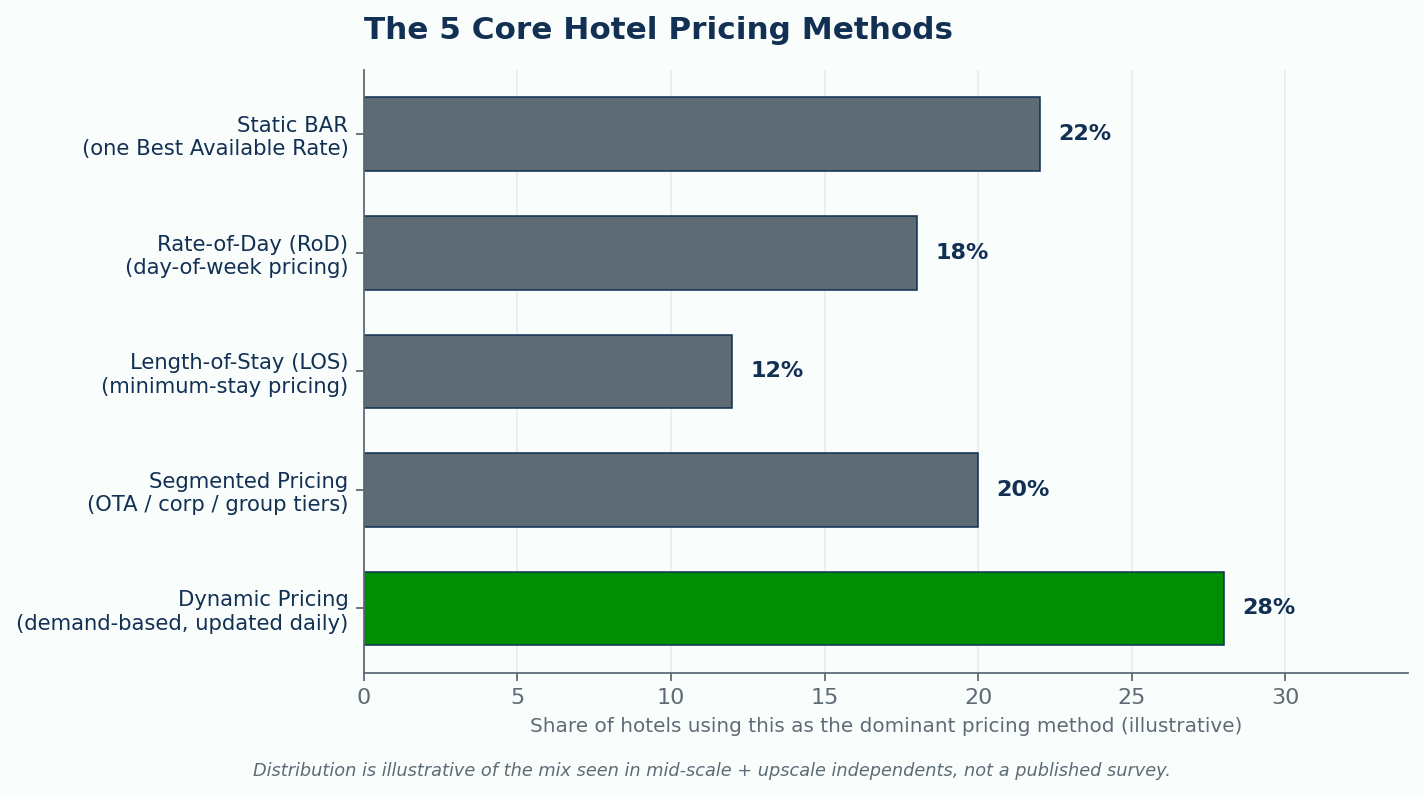
Every pricing strategy is built out of these five methods. Most hotels use two or three; the best hotels blend all five and let the dynamic layer decide which one dominates on a given day.
1 · Static BAR (Best Available Rate)
One rate the whole property sells at, changed occasionally by a human. Simple, defensible, terrible for revenue on high-variance dates. Works for small properties with steady demand.
2 · Rate-of-Day (RoD)
Different rate for each day of the week based on historical patterns. Monday is cheaper than Friday. Better than static BAR because it captures weekday/weekend variance, but blind to compression events and short-lead demand.
3 · Length-of-Stay (LOS) pricing
Rates vary by stay length: a 1-night stay costs more per night than a 3-night stay, or vice versa. Useful for shoulder-date protection (require min-stay through peak) and for defending compression nights against 1-night bookings that block longer patterns.
4 · Segmented pricing
Different rates for different guest segments — OTA, direct, corporate, group, government, wholesale. Fences (advance purchase, non-refundable, member-only) keep segments from cannibalizing each other. Nearly every hotel does this; few do it well.
5 · Dynamic pricing
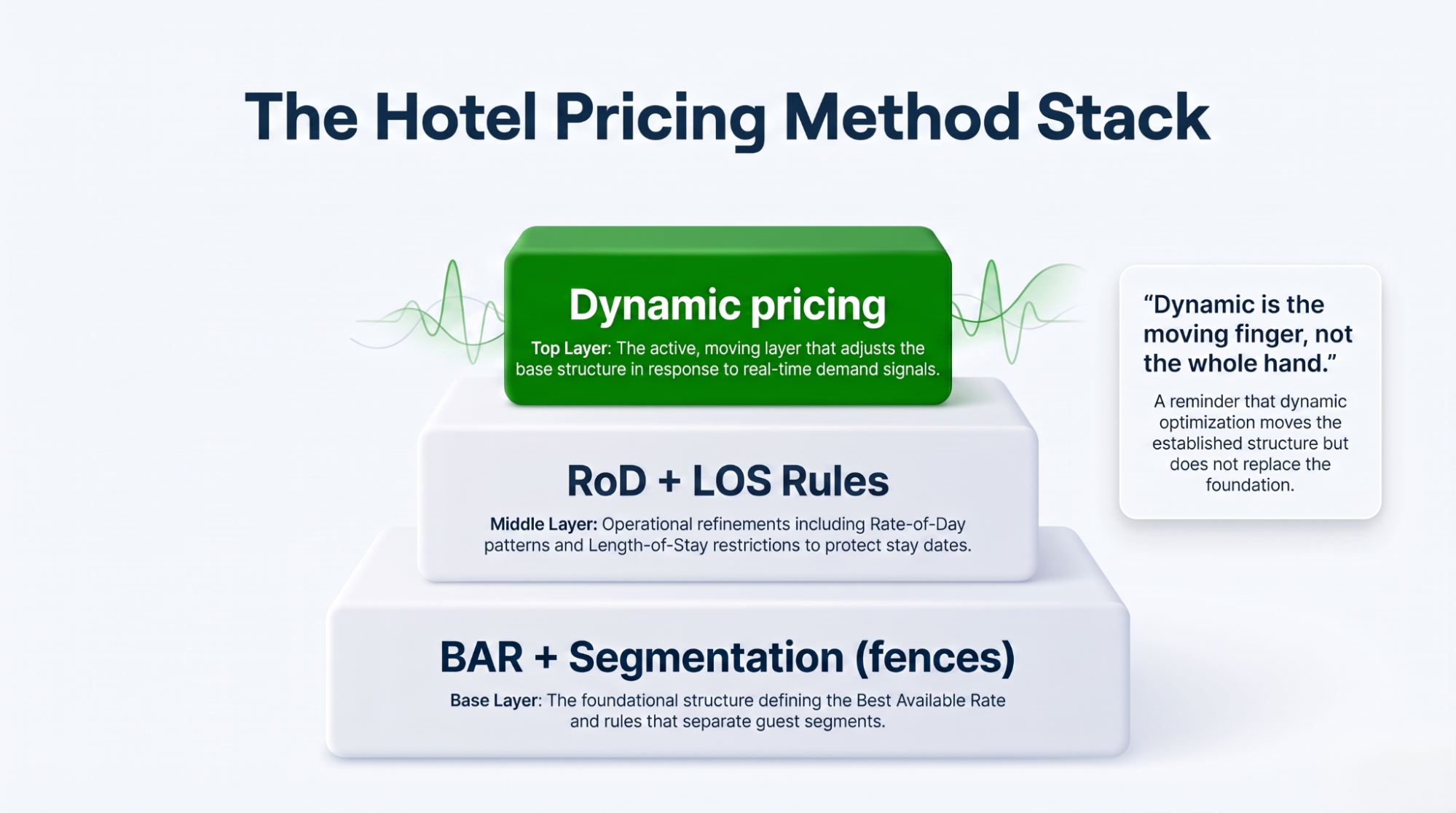
Rates move daily (or intra-day) based on demand signals — pace, comp set, market compression, forecast accuracy. This is the layer that sits on top of the other four. Dynamic is not a replacement for BAR or segmentation; it is the mechanism that moves them.
What is dynamic pricing in hotels?
Dynamic pricing gets pitched as “the model prices for you.” That is not how it works in a well-run hotel. The model watches signals humans cannot watch fast enough — every pace change, every comp set move, every OTA search spike — and surfaces a recommended rate with the reasoning attached. The revenue manager reads the recommendation, checks it against context the model does not know (a citywide event, a group that just cancelled, a service issue affecting reviews), and either applies it or overrides.
The value is not the automation. The value is the recommendation velocity — being able to reprice a dozen properties in the time it used to take to reprice one. That is why the same RM who managed 7–8 properties on a spreadsheet can now cover 22 with the same rigor.
The RevEvolve dynamic pricing engine is built this way. It surfaces recommendations with the signals that drove them, lets the RM simulate the outcome before publishing, and logs every applied rate with a reason code for the audit trail.
Rate strategy vs pricing strategy (the difference)
These terms get used interchangeably. They are not the same thing.
Rate strategy is the structure — which segments exist, what fences protect them, how BAR relates to negotiated corporate rates, how OTA rates map to direct. It is set quarterly (or seasonally) and it changes rarely.
Pricing strategy is the motion — how you move the rate within that structure as demand changes. It runs daily.
How to build a hotel pricing strategy (6 steps)
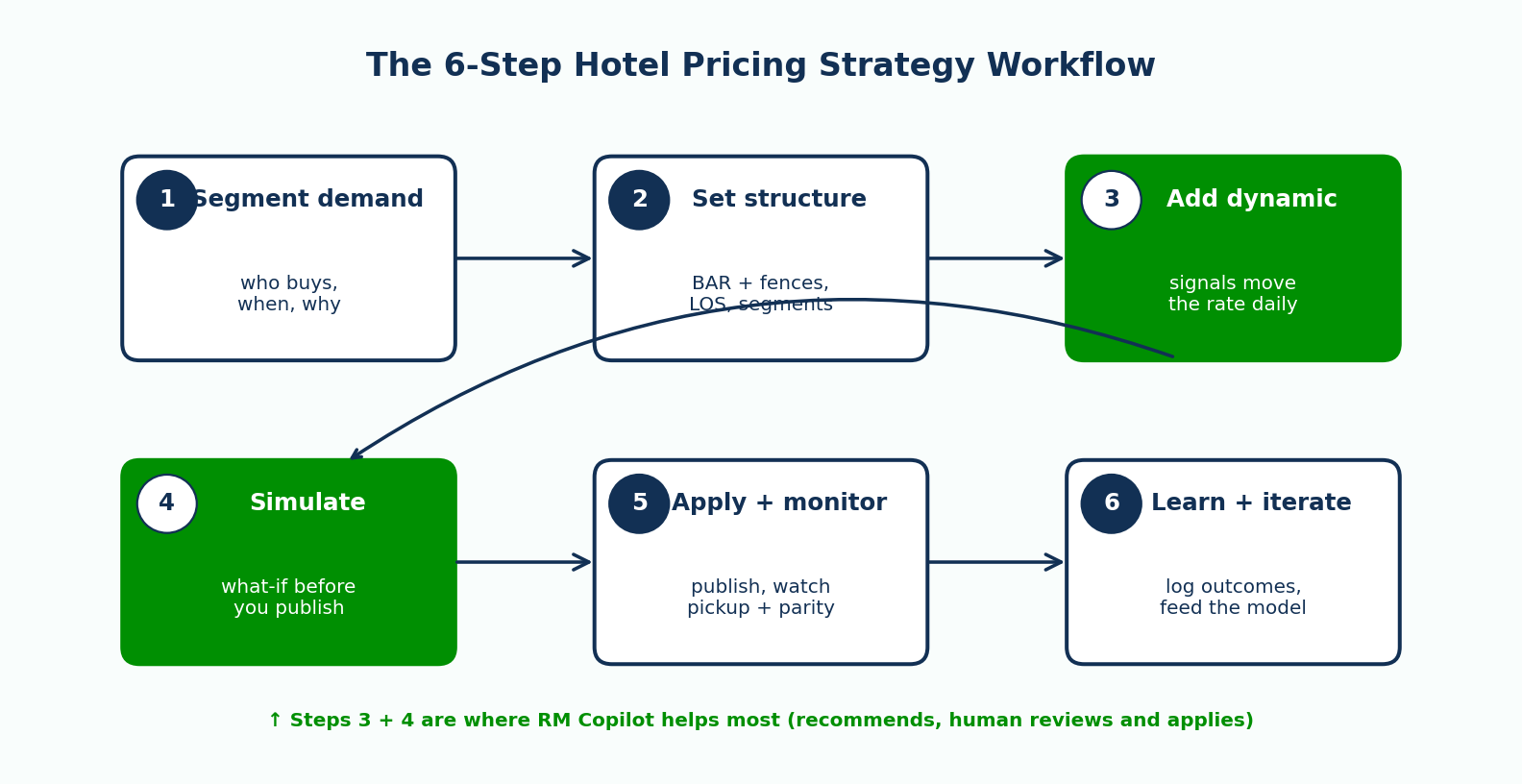
Six steps, in order. Each one is a checkpoint — if any of them is missing, the strategy is not complete.
- Segment demand. Understand who buys your rooms and why: OTA leisure, direct leisure, corporate transient, group, government, wholesale. If you cannot name your top 5 segments and what percent of revenue each represents, the rest of the strategy has no foundation.
- Set the rate structure. Publish your BAR and the segment ladder underneath it. Add fences (advance purchase, refundable vs non-refundable, member rates) so segments do not cannibalize each other. Add LOS rules for compression dates.
- Add the dynamic layer. At the low-fidelity end this is “the RM updates a spreadsheet Monday morning.” At the high-fidelity end this is a dynamic pricing engine that recommends daily changes with the signals attached.
- Simulate the outcome. Before you publish a new rate on a high-value date, model it. What does RevPAR look like if pickup follows the last 3 similar dates? What does displacement look like if a group comes in at 60% of the block? A what-if simulator makes this a 30-second question instead of a 30-minute one.
- Apply and monitor. Push the rate to your channels. Watch pickup and parity. Set threshold alerts if the rate drifts out of position across OTAs or if pace falls behind forecast.
- Learn and iterate. Log every applied rate with the reason it was chosen. Each month, review where the model was right, where the RM overrode and won, and where you left money on the table.
Manual vs spreadsheet vs Copilot
Same six-step workflow, three ways to run it. The question is not which is smartest — it is which lets a real RM cover more properties without losing accuracy.
| Capability | Manual / gut feel | Spreadsheet model | RM Copilot |
|---|---|---|---|
| Sees live pace + pickup | No | Refreshed weekly | Yes |
| Prices against demand signals | Rarely | Manual | Built in |
| Simulates rate before publish | No | Manual formula | One click |
| Rate change velocity | Weekly | Weekly / daily | Daily, per property |
| Scales across a portfolio | No | One sheet per property | One view, many properties |
| Audit trail with reason codes | No | No | Every rate, timestamped |
| Who decides | You | You | You — Copilot recommends, you apply |
Pricing by property type
The five methods do not apply the same way to every hotel. Rough map:
- Limited-service, steady demand: BAR + RoD + light segmentation. A dynamic layer adds 3–5% RevPAR but is not urgent.
- Mid-scale, mixed demand: BAR + RoD + full segmentation + LOS on compression dates. The dynamic layer is where the money is.
- Full-service, group-heavy: All five methods, plus displacement math on every group inquiry. Dynamic pricing without displacement modelling costs group hotels 5–10% RevPAR.
- Resort, event-driven: Heavy LOS + segmentation + dynamic. Peak nights need aggressive min-stay rules; shoulder dates need dynamic response to compression signals.
- Extended-stay: LOS pricing is the strategy. Everything else is a rounding error.
The 4 metrics that prove a pricing strategy is working
Occupancy alone does not prove your strategy is working — a full hotel at the wrong rate is a lost year. Watch these four.
1 · RevPAR (Revenue Per Available Room)
The headline metric. RevPAR = ADR × occupancy. If your pricing strategy is working, RevPAR moves up faster than occupancy alone would predict.
2 · RGI (RevPAR Index)
Your RevPAR divided by your comp set’s RevPAR, indexed to 100. Above 100, you are outperforming your competitive set. RGI removes the market as a variable and shows whether the strategy — not the market — is working.
3 · ADR (Average Daily Rate)
The mix effect. A strategy that grows RevPAR by dropping ADR and lifting occupancy is fragile — the moment the market softens, the rate compression exposes you. Watch ADR as a durability check.
4 · Forecast accuracy
The most underrated metric. If your 30-day forecast is off by 15%, no pricing strategy will save you — you are pricing to the wrong number. Forecast accuracy below 90% at T-30 is where most pricing problems actually live.
A pricing strategy in practice: EMA Hospitality
EMA Hospitality runs a multi-property portfolio in a market where transient demand is spiky and group business is unpredictable. Before RM Copilot, the RM team was pricing 7–8 properties each from a Monday spreadsheet, with weekly rate reviews and no simulation layer.
After deploying RM Copilot as the recommendation layer on top of the existing rate structure, each RM began covering the entire portfolio. The engine surfaces daily recommendations with the signals attached; the RM reviews, adjusts for context the model does not know, and applies the rate across channels. The workflow — segment → structure → dynamic → simulate → apply → learn — became the daily job.
Outcomes across the deployment: +5–8% RevPAR, 18 hours per RM per week recovered, and a 6-month payback. Each RM now covers 22+ properties with more rigor than they applied to 8 before.
Common hotel pricing strategy mistakes
- Confusing rate structure with pricing strategy. Setting a rate ladder and calling it a strategy. A strategy is what you do when demand moves.
- Auto-executing rates from a black box. Guest trust and channel parity break when a model drops the rate $40 at midnight with no reason attached. Recommend, don’t execute.
- Pricing to occupancy. Chasing 100% at any rate kills ADR durability and displaces higher-value guests.
- Ignoring displacement on group nights. Every group booking is a transient booking you turned away. If the group rate is less than the displaced transient revenue, you lost money at 100% occupancy.
- Weekly repricing. Demand moves in hours; a weekly cadence is a week of missed revenue on every date.
Objections we hear (and what we say)
Where to go next
A hotel pricing strategy is not a spreadsheet or a rate ladder. It is the system that turns demand into revenue — rate structure, dynamic layer, decision workflow, and the metrics that prove it is working. Most hotels have one of the four. Winning hotels have all four, and the RM Copilot layer is what makes running all four across 20+ properties possible.
Start where the leverage is: take the six-step workflow above, place your hotel on it honestly, and fix the first missing step. That is usually the dynamic layer — and it is usually the workflow, not the model, that is holding you back.
Keep going: RevPAR Index (RGI) · Hotel rate shopping · Dynamic pricing engine · More pricing & forecasting reads.