QUICK ANSWER — Lighthouse (formerly OTA Insight) is a hotel commercial intelligence and revenue management platform used by revenue teams — strongest in market-facing data: competitor rate shopping, market demand, parity, benchmarking, and channel management, alongside operator-facing AI such as Ernest and a developing Revenue Agent. RevEvolve is a revenue platform strongest in own-data decision support — built on a unified PMS layer, it recommends a specific rate with the reasoning attached and lets your team simulate the impact before applying it. The right choice depends on which question is currently unanswered at your property.
If you are reading this you are probably already using Lighthouse, or seriously evaluating it, and something has prompted you to look at what else exists. Worth saying up front: we make a competing product, so read this the way you would read any vendor writing about a rival. We have tried to make it useful anyway, which mostly means being straightforward about what Lighthouse does well.
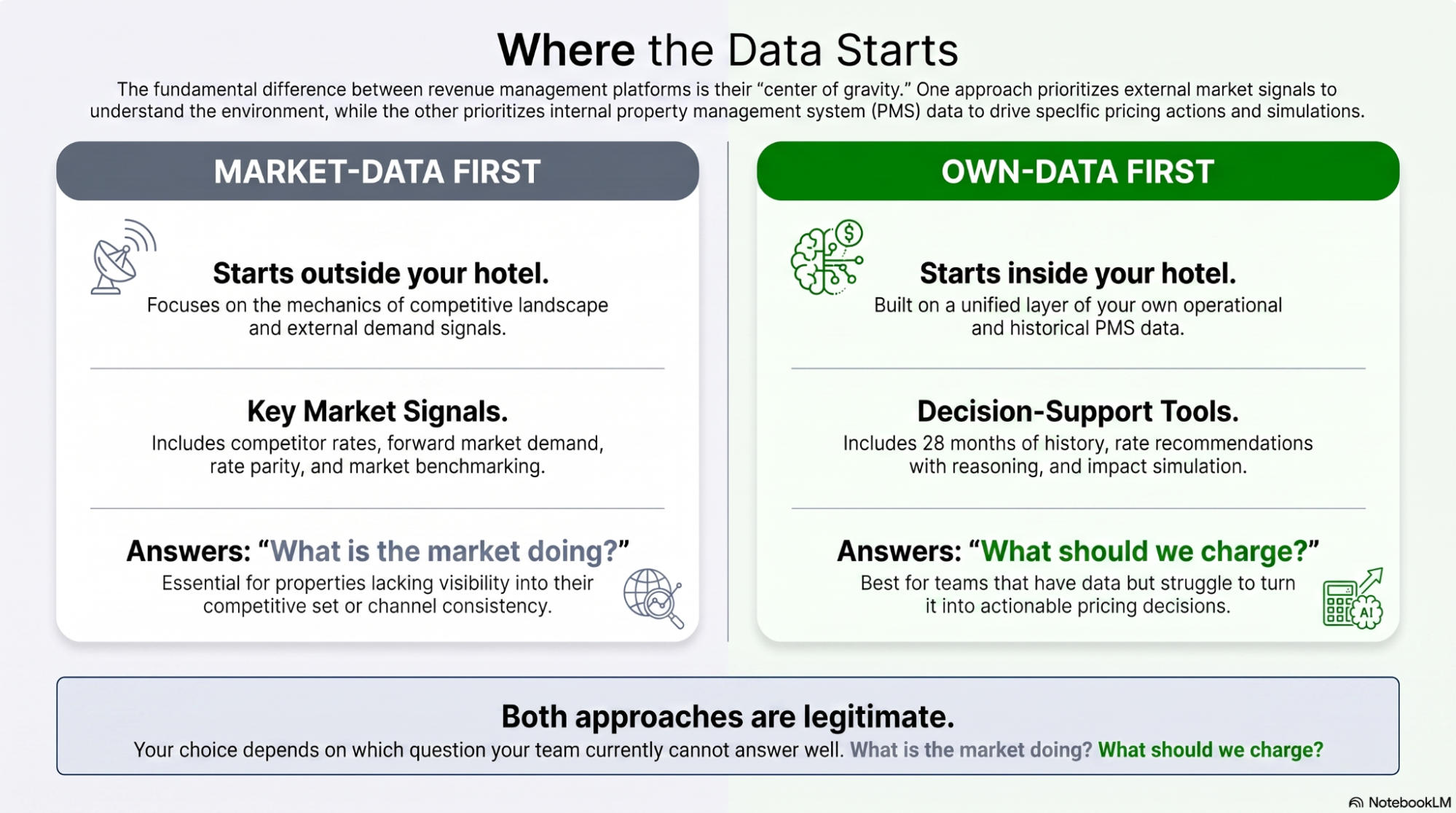
The short version is that these two platforms have different centres of gravity. Lighthouse starts with market and competitive data — what is happening across your market and comp set. RevEvolve starts with your own PMS data and produces a specific rate recommendation you can test before applying. Plenty of properties would be well served by either; a fair number end up using both.
Key takeaways
- Different starting points: Lighthouse begins outside your hotel with market and competitive data; RevEvolve begins inside it with your PMS.
- Lighthouse is the larger, longer-established platform — 65,000+ properties, 185 countries, five consecutive HotelTechAwards.
- RevEvolve’s ground is the decision itself: a recommended rate with reasoning, simulated before you commit, logged with a reason code.
- If your gap is competitor rates, parity, or benchmarking breadth, Lighthouse is likely the better answer. We say so below.
- Neither product replaces a revenue manager. Both are decision support; a person applies the decision.
What Lighthouse Actually Is
Lighthouse was founded in 2012 in Ghent as OTA Insight and rebranded in November 2023, consolidating several acquisitions — Transparent for short-term rental data, Kriya RevGen for revenue intelligence, Stardekk for channel management — into one commercial platform. It is headquartered in London, employs several hundred people, and raised a substantial growth round in late 2024.
The scale is genuine and worth stating plainly on a page like this: Lighthouse reports use across roughly 65,000–70,000 properties in 185 countries, processes a very large daily volume of travel and market data, and has won HotelTechAwards categories in rate shopping, market intelligence and business intelligence for five consecutive years. It is primarily a commercial intelligence and revenue management platform, and revenue teams are its core users. Anyone telling you it is a weak product is not being straight with you.
Their core products
| Product | What it does |
|---|---|
| Rate Insight | Competitor rate shopping across channels |
| Market Insight | Forward-looking market demand signals |
| Benchmark Insight | Performance benchmarking, including AI-assisted comp set selection |
| Parity Insight | Rate parity measurement across distribution |
| Business Intelligence | Portfolio BI, including generative-AI daily summaries |
| Channel Manager | Distribution across 200+ OTAs, integrating with 50+ PMS |
| Ernest | Operator-facing AI assistant — questions about your business, answered from your data |
| Revenue Agent (in development) | Operator-facing AI in the revenue decision-support space |
| KITT / Connect AI / Direct | Guest-facing: AI front desk, AI-search discoverability, website conversion |
The Real Difference: Where the Data Starts
Both platforms describe themselves as helping hotels price better. They approach it from opposite ends.
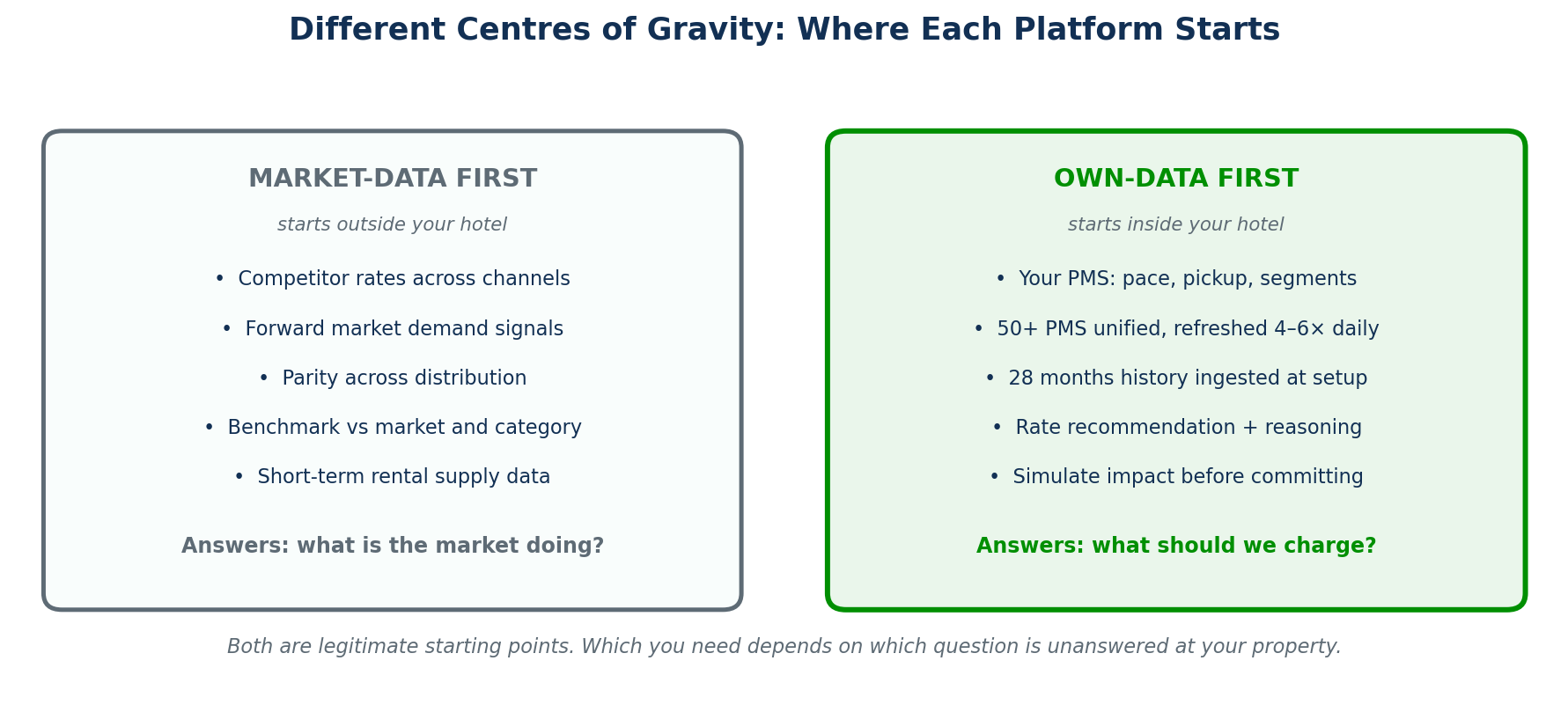
Market-data first
Lighthouse’s foundation is external data at scale: what competitors charge, where the market is heading, whether your rates are consistent across channels, how you index against a comp set. That data is the product, and their breadth of it is their strongest asset. If you want the mechanics of using competitive data well, we wrote about rate shopping workflow separately, and about building a comp set that is not built on ego.
Own-data first
RevEvolve’s foundation is your operational data. The platform sits on a unified layer spanning 50+ PMS systems, refreshed four to six times a day, with roughly 28 months of history ingested during implementation so seasonality is available immediately rather than accumulated over a year. From that it models demand per date and segment and produces a recommended rate.
Neither approach is complete on its own, which is the honest reason a number of properties run both. Competitor rates without your own pace tell you what the market is doing but not what you should do. Your own pace without market context can leave you confidently repricing against a market that already moved.
Capability Overlap — An Honest Read
Comparison tables on vendor sites tend to be built so the vendor wins every row. Here is a version that does not.
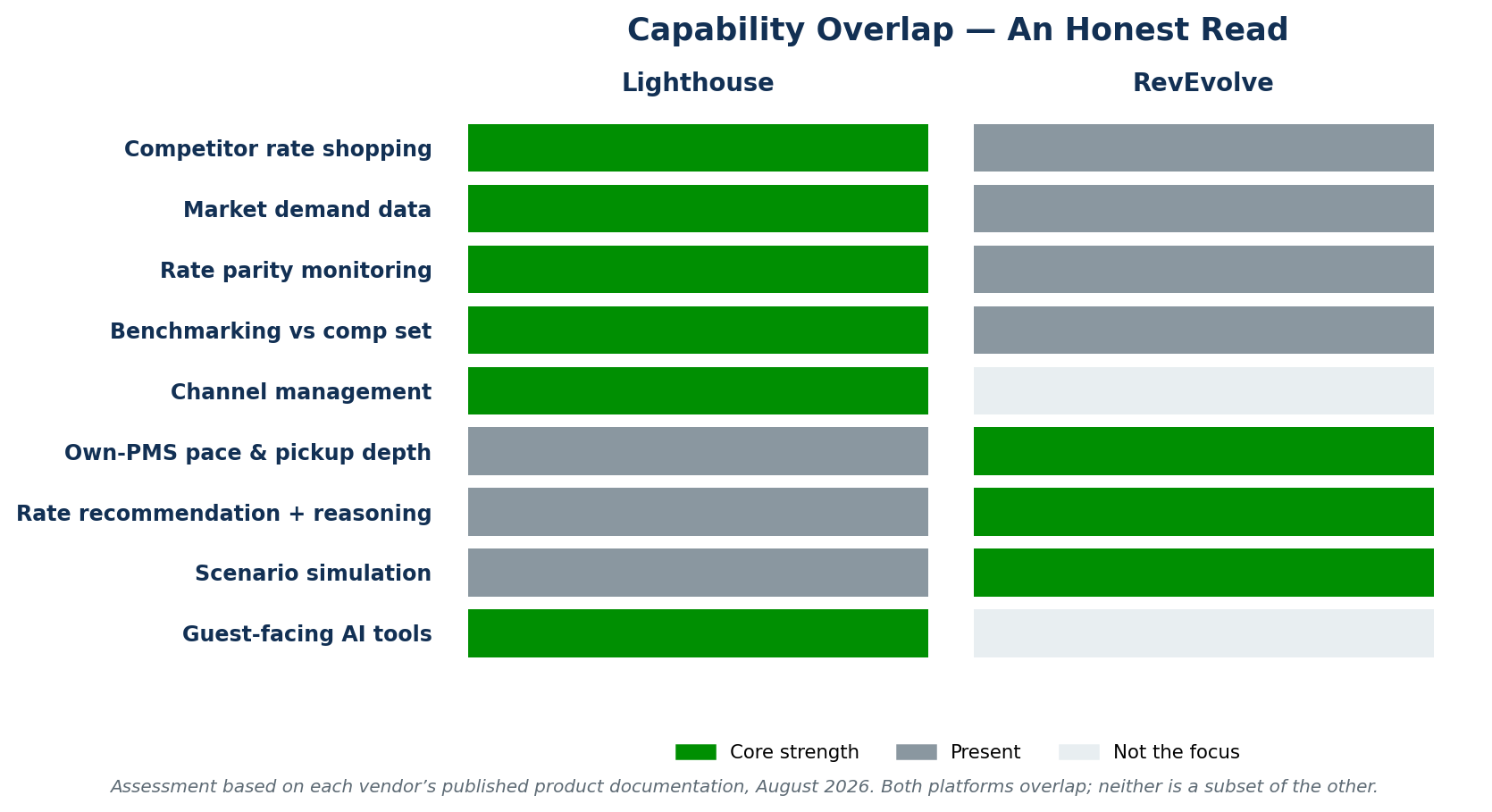
Lighthouse is the stronger product on competitor rate shopping, market demand data, parity monitoring, benchmarking breadth, and channel management — and it ships guest-facing AI tools we simply do not build. Those are not marginal categories; for many properties one of them is the whole reason to buy.
RevEvolve is the stronger product on depth in your own PMS data, on producing a specific rate recommendation with the reasoning attached, and on simulating the projected impact of a change before you commit to it. Those are the categories where we would expect to win an evaluation, and we would not expect to win the others.
Start From the Question You Cannot Answer
The most useful way to choose between these is not a feature checklist. It is asking which question your team currently cannot answer well.
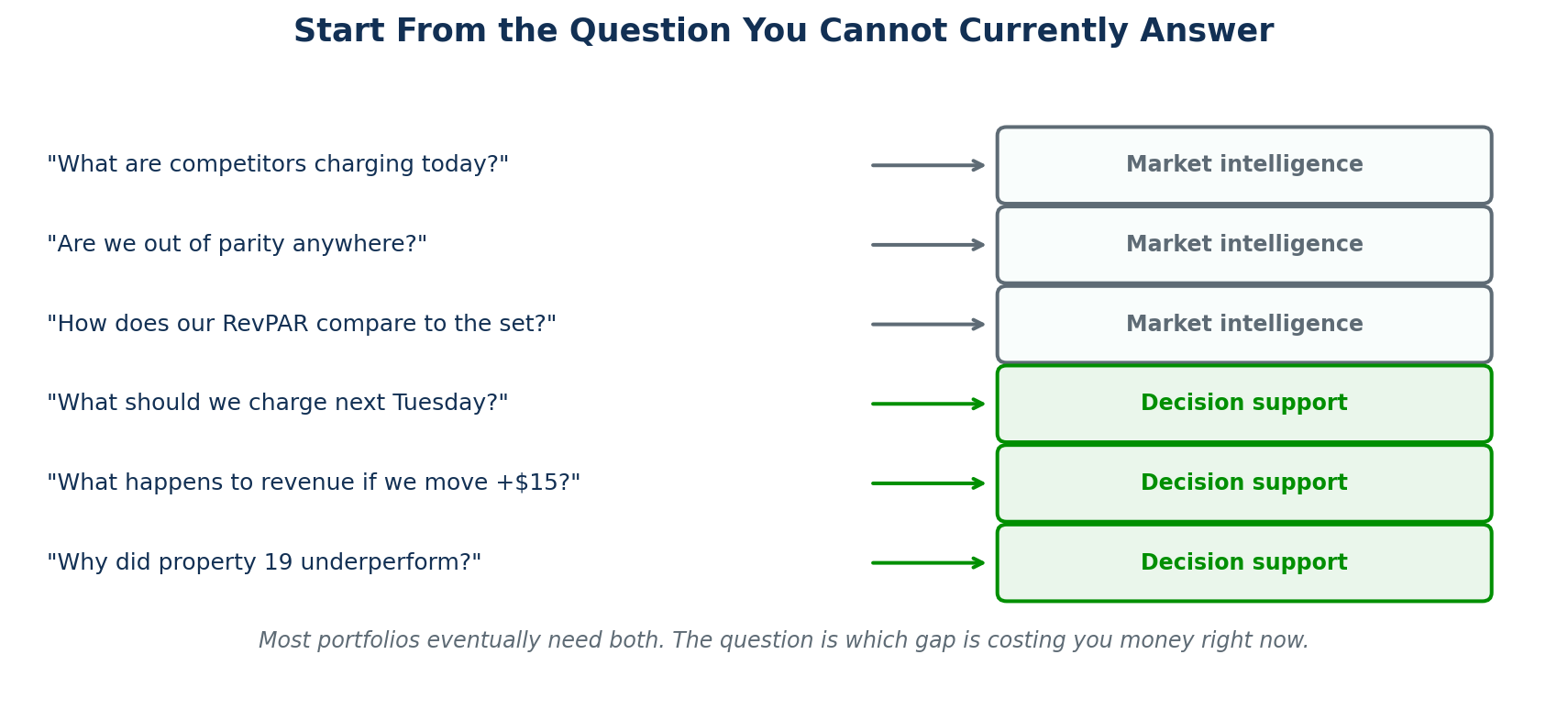
If nobody at your property can say what competitors are charging next weekend, or whether you are out of parity on a channel, or how your RevPAR indexes against the set, that is a market-data gap and Lighthouse is built for it.
If you have that data and the recurring problem is what to do with it — the rate for a specific Tuesday, whether a group block is worth accepting, what happens to revenue if you move fifteen dollars — that is a decision-support gap, and it is the ground RevEvolve is built on.
When Lighthouse Is the Better Choice
Stated plainly, because a comparison that finds no case for the competitor is not a comparison.
- Competitive and market data is your primary gap. It is their core product and their scale advantage is real.
- You need parity monitoring across many channels. A dedicated parity product beats a general capability.
- You want channel management in the same platform. We do not build one, and we would point you at a channel manager rather than pretend otherwise.
- You operate short-term rentals alongside hotels. Their short-term rental data coverage is something we do not attempt.
- You want guest-facing AI in the same contract. KITT and Connect AI have no equivalent on our side.
- Scale and track record are decisive criteria for you. They are considerably larger and longer established than we are.
When RevEvolve Is the Better Choice
- You have data and need decisions. The recurring complaint is dashboards without a next action.
- You want to test a change before making it. Simulating projected occupancy, ADR and revenue before committing is our specific ground.
- Your own PMS history is the signal that matters, particularly where segment mix and group business drive the decisions.
- You run a portfolio and variance is the problem. Applying the same recommendation logic across properties is what pulls the RGI spread in.
- You need an audit trail of pricing decisions, logged with reason codes, for ownership or asset-manager reporting.
- One revenue manager needs to cover many properties. The industry baseline is roughly 7–8 per manual RM; RevEvolve customers run 22+ per seat.
What RevEvolve Adds After the Data Arrives
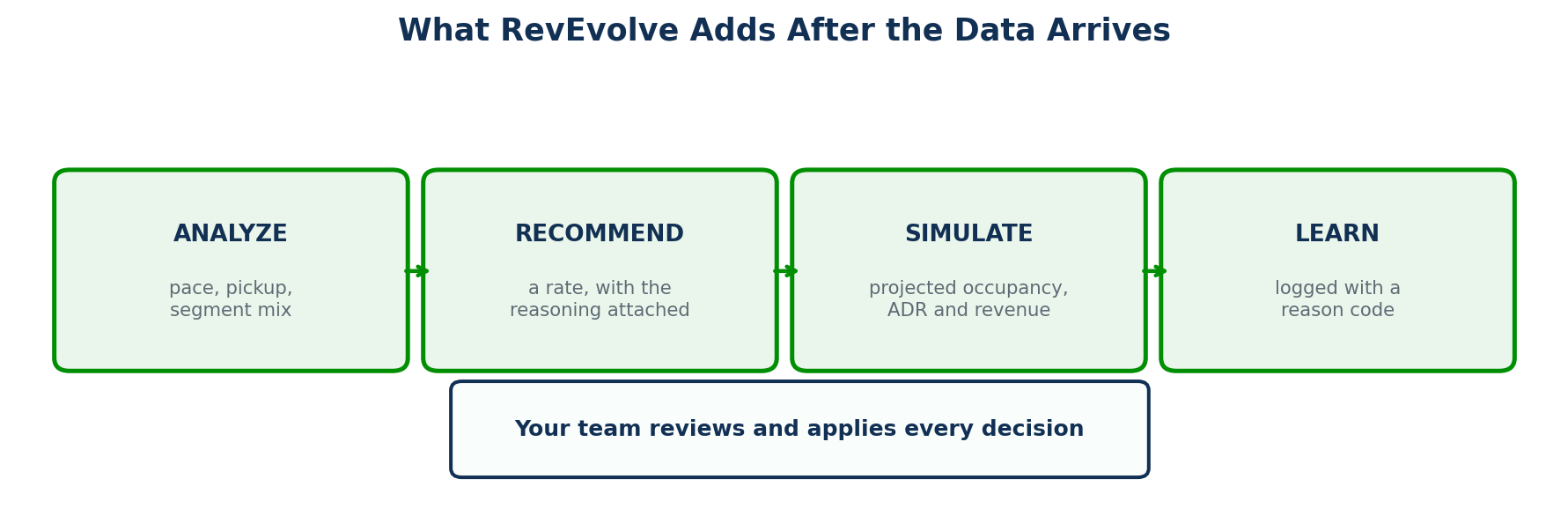
The loop is four steps. RM Copilot analyzes pace, pickup and segment mix from your PMS data; recommends a rate with the reasoning attached; lets you simulate the projected occupancy, ADR and revenue impact before you commit; and logs the applied decision with a reason code so the recommendations improve and the audit trail exists.
Two things that are deliberately not in that description. It does not publish rates to your channels — your channel manager does that, and RevEvolve does not replace one. And it does not act without you: every recommendation is reviewed and applied by a person. If you want a system that prices without human involvement, neither of these platforms is that, and we would be sceptical of one that claimed to be.
If You Do Want to Switch or Add
Practical notes, whichever direction you go. Implementation on our side runs PMS integration and historical ingest in the first few days, configuration and forecast validation through the first week or so, training in the second, and full go-live inside the first month. You keep your own data.
Adding rather than replacing is common and reasonable. Several properties keep a market intelligence subscription for competitive and parity data and use RevEvolve for the pricing decision, which is a legitimate configuration rather than a failure to choose. If budget forces a single platform, go back to the question chart above.
Keep going: Compare all platforms · Hotel comp set analysis · Hotel rate shopping workflow · What RM Copilot does.