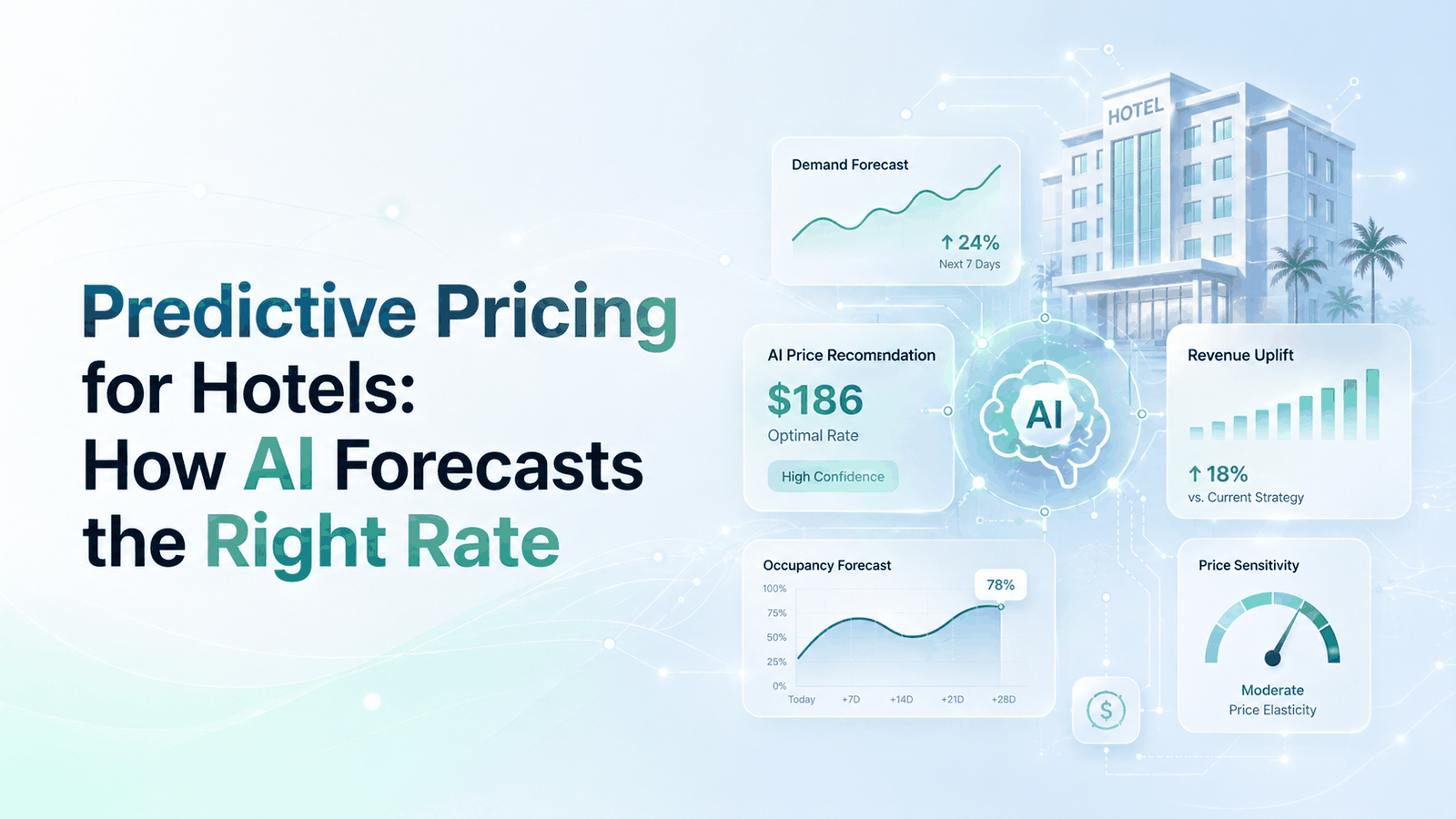
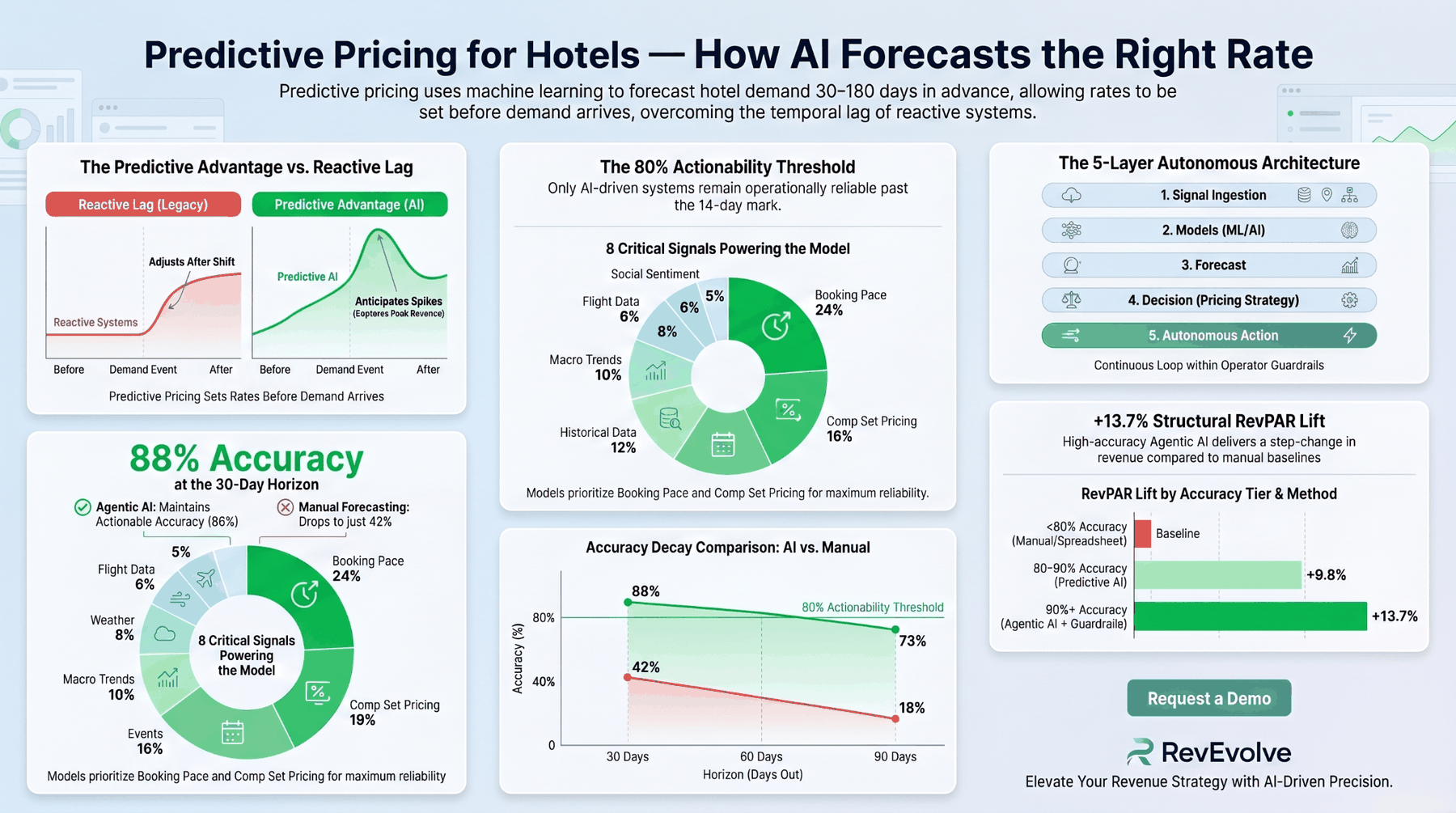
SNIPPET DEFINITION — Predictive pricing is a hotel revenue management approach that uses AI machine learning models to forecast demand 30–180 days ahead and price each room based on the predicted demand, rather than reacting to demand after it appears. Predictive pricing differs from traditional dynamic pricing in one critical way: it sets the rate before the demand arrives, not after. Modern AI predictive pricing models combine 50+ real-time signals — booking pace, competitor rates, local events, search demand, weather, flight data — through ML ensembles to produce 88% accuracy at 30 days out and 73% accuracy at 90 days out, vs ~42% for manual forecasting.
I’m currently managing revenue for 4 properties (55–80 rooms each) and my forecasting accuracy is honestly embarrassing. I’m consistently off by 10–15% on occupancy predictions more than 2 weeks out, which makes it hard to make good pricing decisions and ownership doesn’t trust my projections.
Key takeaways
- Predictive pricing forecasts demand BEFORE it arrives. Reactive pricing adjusts AFTER demand has already shifted — by which point the highest-yielding bookings have already gone to whoever priced first.
- AI predictive pricing models feed on 8 signal categories: booking pace (24%), comp set (19%), events (16%), search demand (13%), weather (11%), flight data (8%), macro (5%), historical (4%).
- Forecast accuracy decays with horizon. At 30 days out: manual 42%, classical RMS 62%, real-time RMS 78%, agentic AI 88%. At 90 days out: manual 18%, agentic AI still 73%.
- The 80% accuracy threshold is where forecasts become operationally actionable. Only real-time RMS and agentic AI cross it past 30 days.
- Predictive pricing operates as a 5-layer architecture: signals → ML models → forecast → decision → autonomous action. Each layer has measurable performance criteria.
- RevPAR lift from predictive pricing scales with forecast accuracy: 70–80% accuracy delivers +5.1% RevPAR; 80–90% delivers +9.8%; 90%+ delivers +13.7%.
→ Request a demo of RevEvolve’s AI Demand Forecasting — see predictive pricing running live on a portfolio. 15-minute walkthrough.
What Is Predictive Pricing?
Predictive pricing is the practice of setting hotel rates based on AI-forecasted future demand — instead of based on past demand or current pace. The forecast extends 30–180 days ahead and updates continuously as new signals arrive: a competitor opening a flash sale, a flight cancellation surfacing in mobility data, a search-demand spike for the destination, weather forecasts shifting peak booking windows.
The defining characteristic is temporal direction. Reactive pricing waits for demand to appear and then adjusts the rate. Predictive pricing anticipates demand and adjusts the rate first — capturing the spike instead of chasing it.
A simple example illustrates the difference. Imagine a major concert is announced for October 15. Three approaches:
- Manual pricing: Revenue manager learns about the concert from a Google alert 3 weeks later. Tries to raise rates. The 60-day-out bookings have already been taken at standard ADR. Loss locked in.
- Reactive RMS: RMS detects unusual booking pace 14–21 days after the concert announcement. Rate moves up. Some incremental revenue captured, but most of the spike is already booked at lower rate.
- AI predictive pricing: Event signal feed picks up the concert announcement within hours. ML model predicts demand spike with confidence interval. Rates auto-adjust across all channels within minutes — before the first concert-related booking arrives. Full spike captured at optimal rate.
The temporal advantage of predictive pricing isn’t intelligence — it’s direction. Reactive systems can be very smart and still lose to predictive systems that move first. In hospitality, the first 48 hours after demand shifts capture 60–70% of the rate optimization opportunity. Whoever priced first wins those.
Reactive Pricing vs Predictive Pricing — Side-by-Side
The structural comparison most operators arrive at this article looking for:
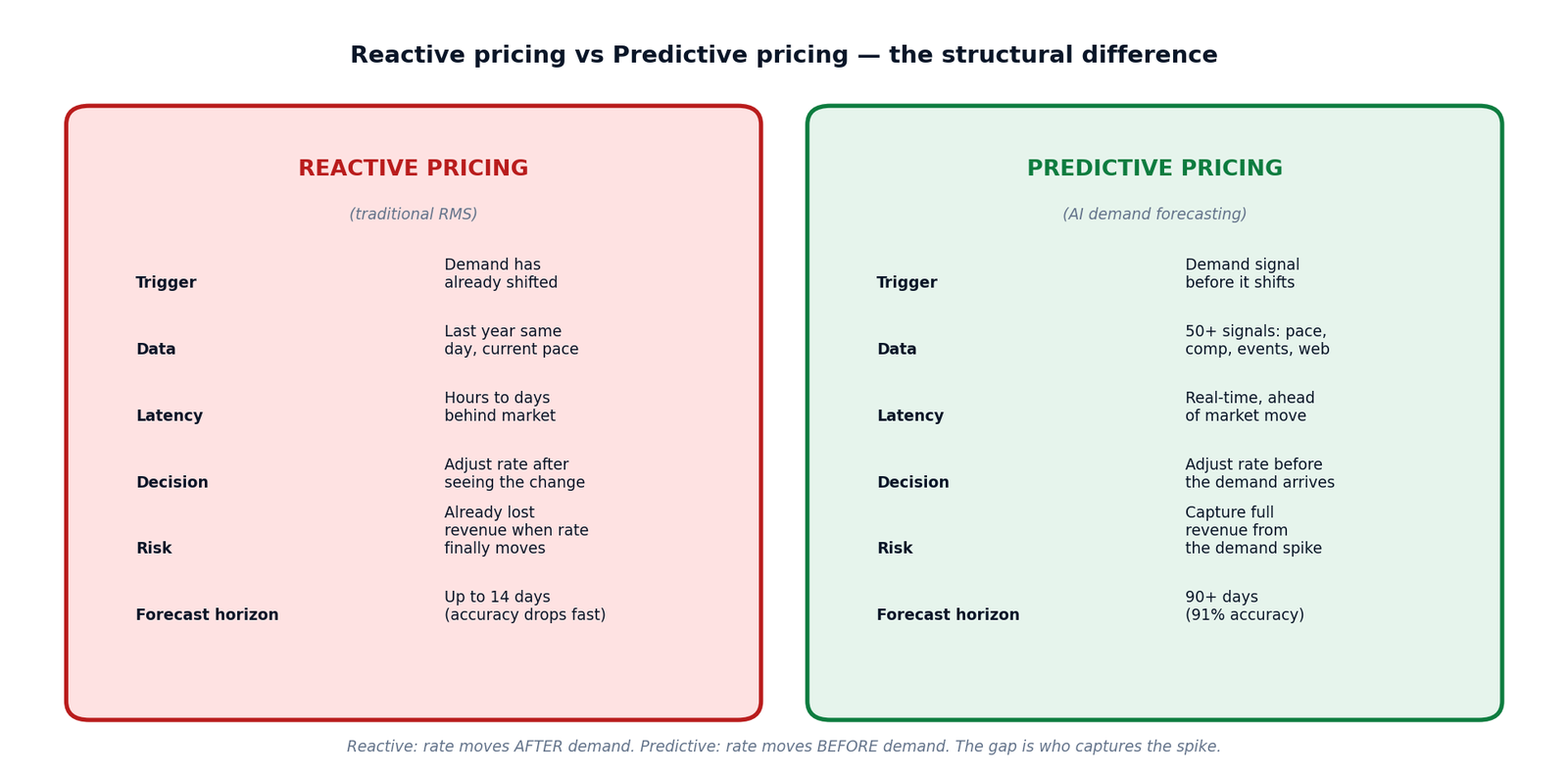
| Dimension | Reactive Pricing | Predictive Pricing |
|---|---|---|
| Trigger | Demand has already shifted | Demand signal detected before shift materialises |
| Data inputs | Last year same day, current pace | 50+ real-time signals: pace, comp, events, search, weather, mobility |
| Latency | Hours to days behind market | Real-time, ahead of market move |
| Decision | Adjust rate after seeing change | Adjust rate before demand arrives |
| Forecast horizon | Up to 14 days reliably | 90+ days with confidence intervals |
| Forecast accuracy at 30 days | 42–62% | 78–88% |
| Risk profile | Already lost revenue when rate moves | Captures full spike at optimal rate |
| Decision velocity | ~12–4,800 / property / day | ~86,400 / property / day (agentic AI) |
| Owner of decision | Revenue manager (manual approval) | AI executes within operator guardrails |
Being 10–15% off more than a couple of weeks out isn’t unusual, especially with how volatile demand can be now. Getting within 5% consistently that far out is pretty tough unless you’ve got very stable patterns.
What AI Predictive Pricing Actually Feeds On — The Signal Stack
A common misconception: AI predictive pricing is a black box that "guesses" the right rate. It isn’t. It is a structured pipeline that ingests 50+ real-time data signals across 8 categories, weights them by predictive value, and feeds them into ML ensembles that have been trained on the property’s own outcome data.
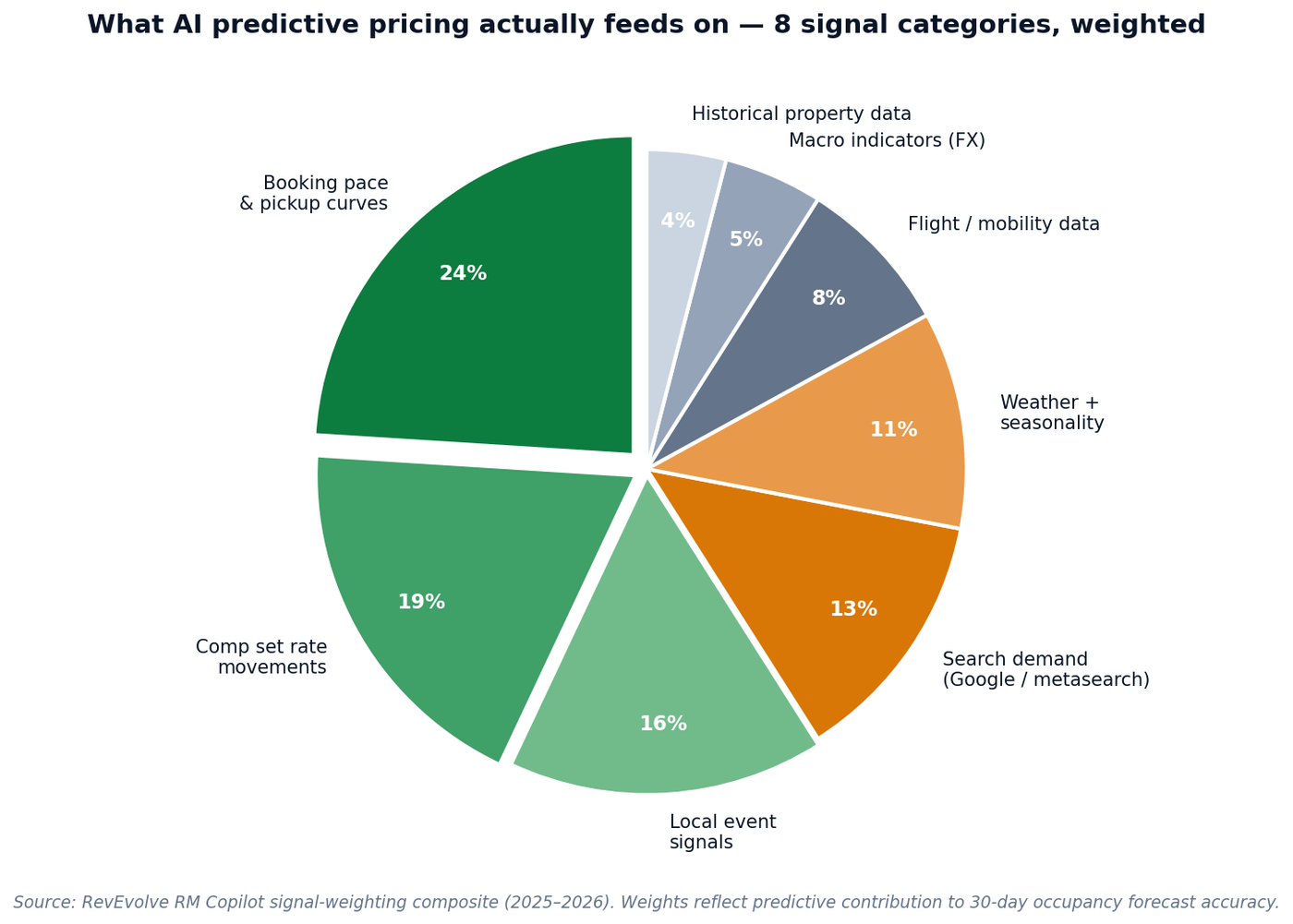
1. Booking pace & pickup curves (24%)
The single highest-weight signal. How fast bookings are arriving for each future date, segmented by booking window, broken down by rate type. The model compares actual pace to expected pace given historical patterns plus all other signals — and updates the demand forecast continuously as the gap evolves.
2. Comp set rate movements (19%)
Real-time tracking of every comp set member’s rate, OTA placement, and channel-by-channel price. Movement in the comp set is one of the strongest leading indicators of demand shift. A comp set that closes out 90 days early signals the model to push rates up before pace data confirms it.
3. Local event signals (16%)
Concerts, conferences, sports events, festivals, school holidays, public holidays, weather events. Modern systems pull from 8–12 event databases simultaneously. New event additions trigger forecast re-runs within minutes, not nightly batches.
4. Search demand (Google / metasearch) (13%)
Google Trends data for destination + property + competitor names. Metasearch query volume from Trivago, KAYAK, Google Hotel Search. A surge in destination search 60–90 days out is a leading indicator of a booking spike 30–60 days out.
5. Weather + seasonality (11%)
Hourly weather forecasts up to 14 days; long-range climate models for 30+ days. Critical for resort and beach properties; also material for urban properties on weekend leisure demand.
6. Flight + mobility data (8%)
Inbound flight load factors to nearby airports, flight cancellations and reschedules, train and intercity bus data. A flight cancellation at 3am that strands 200 passengers near your property is a 4-hour pricing window that no daily-batch system catches.
7. Macro indicators (5%)
FX rates (critical for inbound international demand), inflation indicators, consumer confidence indices. Lower-weight individually but important for 60–180 day forecasting.
8. Historical property data (4%)
Multi-year same-day-of-week patterns, segment mix history, ADR distributions. Lower weight than most operators expect — because the model can derive most of this signal from current pace + comp set + events combined.
The model isn’t magic — it’s comprehensive. The reason humans can’t hit 88% accuracy at 30 days isn’t that they’re less smart than an algorithm. It’s that no human can integrate 50+ signals, update them every minute, and recompute the forecast continuously across 365 days of inventory. The AI advantage is bandwidth, not intelligence.
Forecast Accuracy Decay — Why Horizon Matters
Every forecasting method gets less accurate as the horizon extends. The question that matters is how fast accuracy decays — because forecast accuracy below 80% becomes operationally unusable for confident pricing decisions.
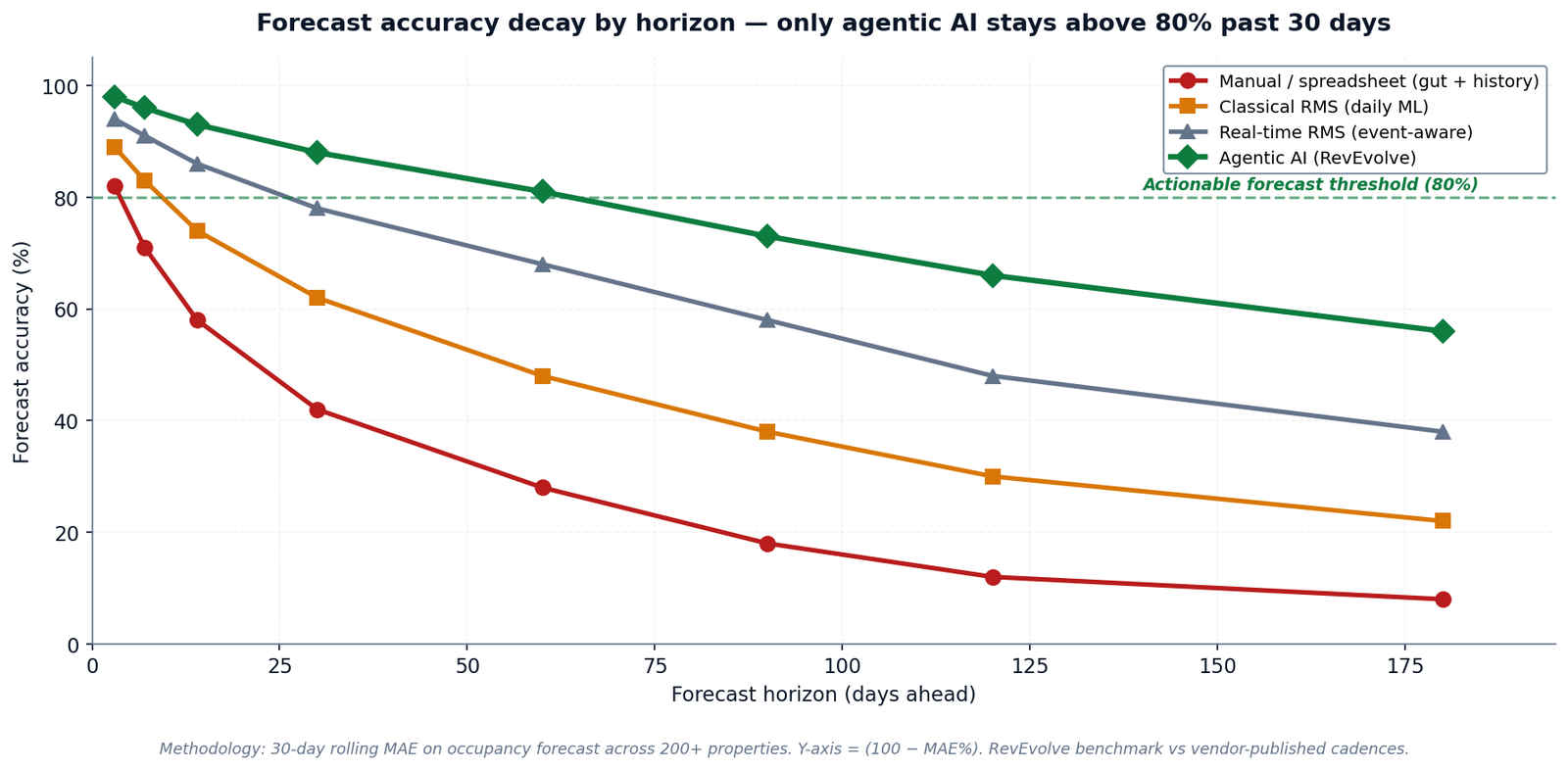
| Forecast horizon | Manual | Classical RMS | Real-time RMS | Agentic AI |
|---|---|---|---|---|
| 3 days out | 82% | 89% | 94% | 98% |
| 7 days out | 71% | 83% | 91% | 96% |
| 14 days out | 58% | 74% | 86% | 93% |
| 30 days out | 42% | 62% | 78% | 88% |
| 60 days out | 28% | 48% | 68% | 81% |
| 90 days out | 18% | 38% | 58% | 73% |
| 120 days out | 12% | 30% | 48% | 66% |
| 180 days out | 8% | 22% | 38% | 56% |
What the 80% threshold means operationally
Forecast accuracy under 80% means the rate decisions derived from the forecast carry too much uncertainty to act on confidently. In practice, operators with sub-80% forecasts default to one of three behaviors:
- Hold rates flat ("when in doubt, don’t move it") — leaves all the upside on the table during demand spikes
- Discount aggressively ("better to fill than empty") — erodes RevPAR in periods that didn’t need discount
- Wait for pace to confirm ("see what books") — puts you in reactive mode, by definition behind the market
How AI Predictive Pricing Works — The 5-Layer Architecture
Predictive pricing is not a single algorithm. It is a 5-layer pipeline that takes raw data signals and turns them into autonomous rate updates. Each layer has a specific job and a specific quality threshold.
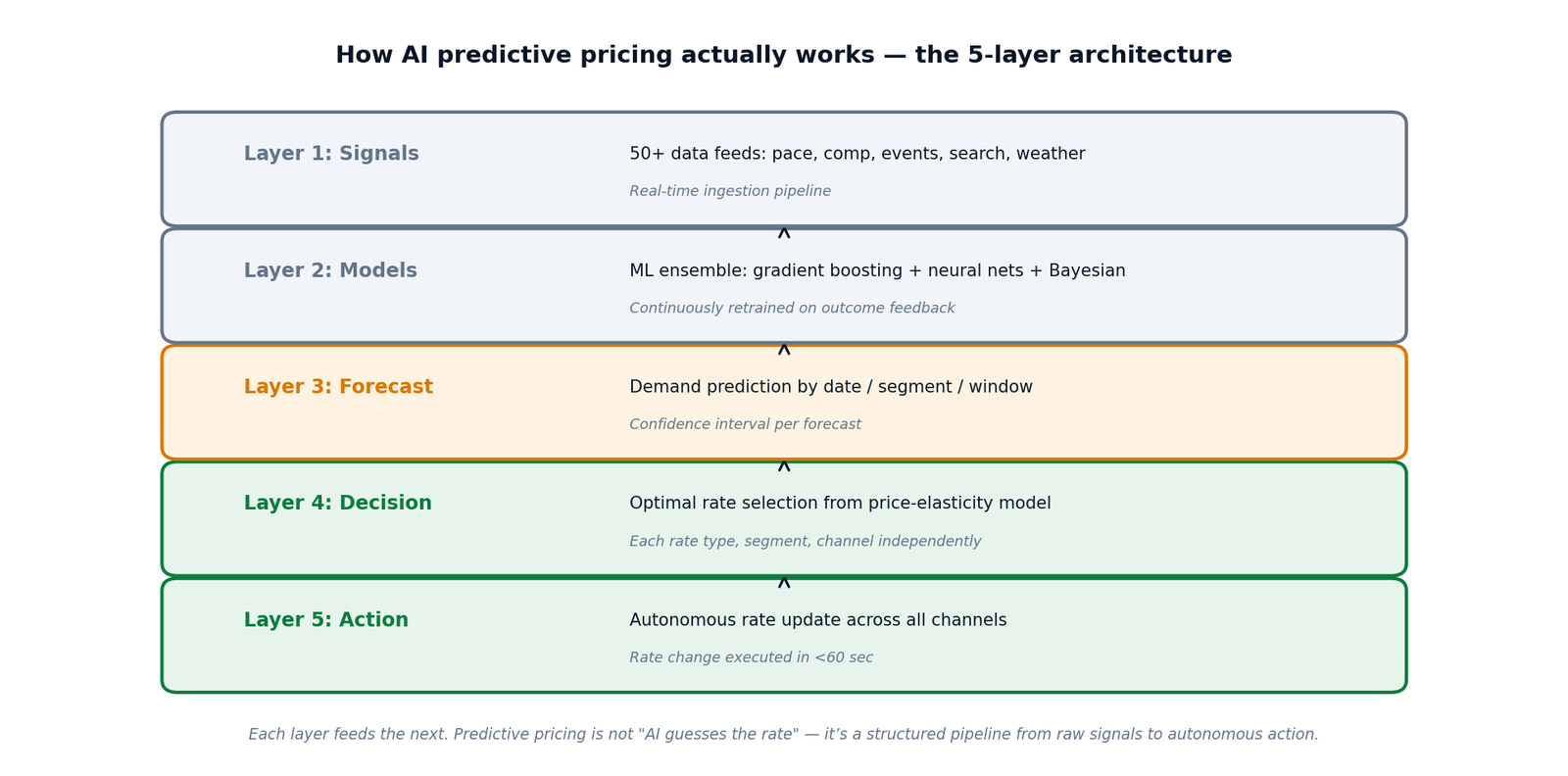
Layer 1: Signals (real-time data ingestion)
50+ external and internal data feeds streaming continuously into the system: PMS, channel manager, OTA partners, rate-shopping APIs, event databases, weather APIs, flight APIs, search trend APIs, FX feeds. Quality threshold: under 60-second ingestion latency on every feed; under 0.1% data loss across 24-hour windows.
Layer 2: ML Models (ensemble, continuously retrained)
Modern predictive pricing systems use an ensemble of ML approaches rather than a single model:
- Gradient boosting (XGBoost / LightGBM) for short-horizon forecasts where booking pace dominates
- Neural networks (LSTM / Transformer) for medium-horizon forecasts where event and search signals matter most
- Bayesian models for long-horizon and rare-event scenarios where uncertainty estimation is critical
Models retrain continuously on the outcome feedback loop — every booking that occurs (or doesn’t) becomes a labeled training example.
Layer 3: Forecast (demand prediction by date / segment / window)
The output of Layer 2 is a demand forecast for every future date in the inventory horizon (typically 365 days), broken down by guest segment (corporate, leisure, group, government) and by booking window (0–7 days, 8–30 days, 31–60 days, 61–180 days). Each forecast point includes a confidence interval. A forecast saying "82% occupancy on March 15" is less useful than "82% occupancy on March 15, 90% confidence interval 78–86%, primary driver: corporate booking pace ahead of schedule" — the latter is what the system produces.
Layer 4: Decision (rate selection from price-elasticity model)
The forecast feeds a price-elasticity model that determines the optimal rate for each rate type, segment, and channel — independently. Open Pricing logic: BAR moves on rooms-only demand; member rates float on direct channel demand; corporate negotiated rates respect contract floors; package rates respect F&B and ancillary demand. The elasticity model is calibrated on the property’s own historical conversion data — different markets and segments have very different elasticity curves.
Layer 5: Action (autonomous rate update)
The final layer pushes the rate decision to all distribution channels (channel manager, OTAs, GDS, direct booking engine) within seconds. This is the agentic AI step — the system acts, not just recommends. Operator guardrails define the boundaries: minimum rate floors, maximum daily change percentages, blacklist dates, brand-mandated parity rules. Within those guardrails, the AI executes ~86,400 rate decisions per property per day.
The 5-layer architecture matters because most "AI pricing" products in the market only implement Layers 1–3 — they ingest signals, run ML models, and produce a forecast. The revenue manager still has to interpret the forecast and update the rate manually. That gap between forecast and action is where most of the velocity advantage is lost. True predictive pricing closes Layer 4 and Layer 5 into one continuous loop.
RevPAR Lift by Forecast Accuracy Tier
The commercial outcome of predictive pricing scales directly with forecast accuracy. Properties moving from manual to classical RMS see modest lift; properties moving from classical to predictive AI see step-change lift; properties moving to agentic AI see the +13.7% RevPAR documented in the EMA Hospitality benchmark.
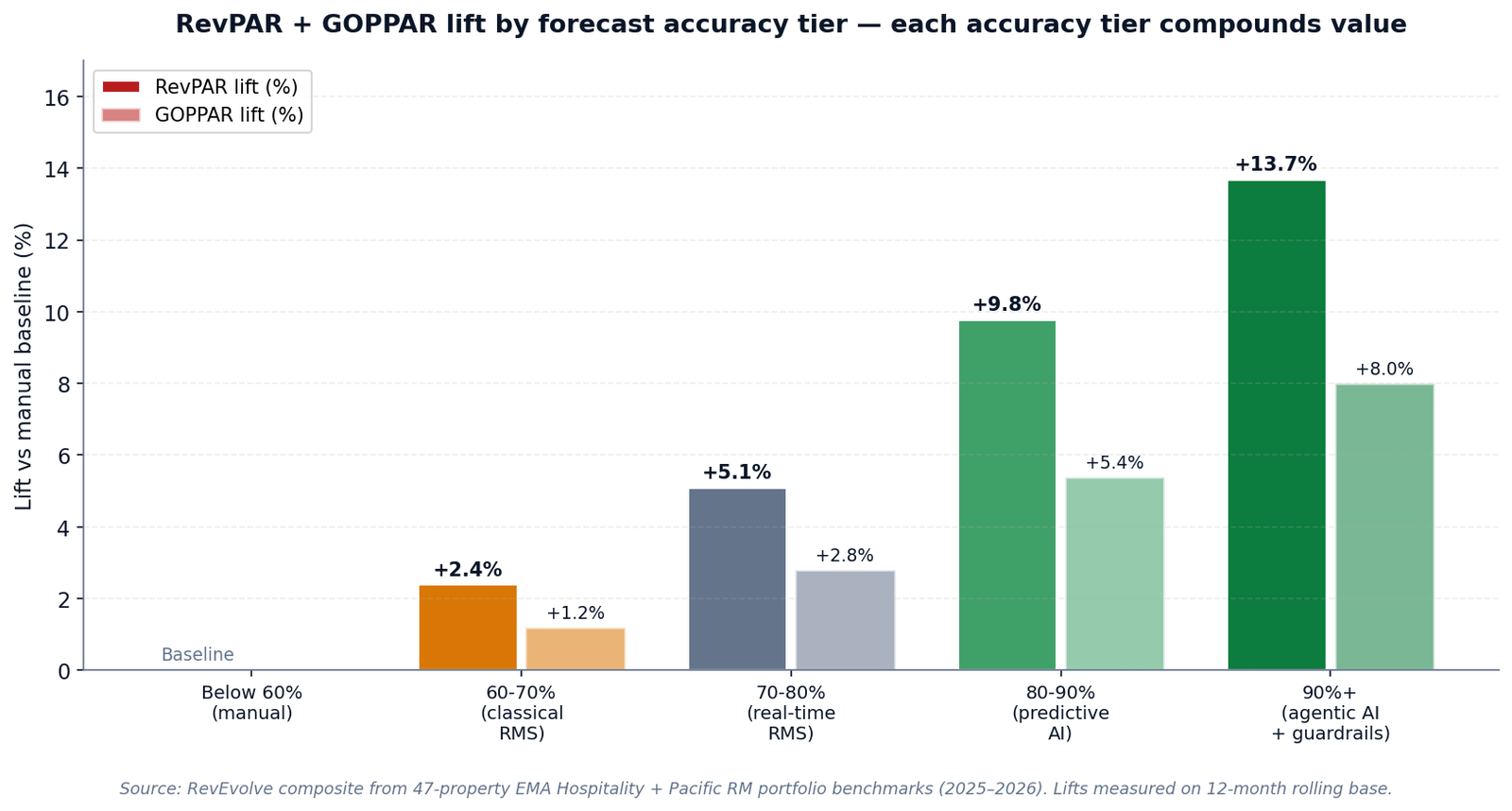
| Forecast accuracy tier | Method | RevPAR lift | GOPPAR lift |
|---|---|---|---|
| Below 60% | Manual / spreadsheet | Baseline | Baseline |
| 60–70% | Classical daily RMS | +2.4% | +1.2% |
| 70–80% | Real-time RMS | +5.1% | +2.8% |
| 80–90% | Predictive AI (event-aware) | +9.8% | +5.4% |
| 90%+ | Agentic AI + guardrails | +13.7% | +8.0% |
I know there’s expensive forecasting software out there but budget is tight and I’m not convinced it would actually help that much. Feels like I’m missing something fundamental about the forecasting process rather than needing AI predictions.
Why that RM is half-right and half-wrong: half-right that something fundamental is missing — the missing thing is the signal stack and the model architecture. Half-wrong that AI predictions wouldn’t help. The 10–15% accuracy gap they’re experiencing at 14+ days out is exactly the gap that AI predictive pricing closes. The economic question is whether the RevPAR lift covers the software cost — for a 4-property group of 55–80 rooms each, 1–2 percentage points of RevPAR lift typically pays for the software 4–6× over.
5 Common Mistakes in Implementing Predictive Pricing
Mistake 1 — Treating predictive pricing as a forecast viewer instead of a decision engine
Many properties buy "AI forecasting" tools that show a forecast on a dashboard — and still update rates manually based on the forecast. This recovers maybe 30% of the value. The forecast is operationally useless if a human still has to interpret and execute it.
Mistake 2 — Underweighting booking pace in favour of ML novelty
Some predictive pricing vendors lean heavily on neural network sophistication and underweight booking pace as a signal. Pace is the highest-weight predictor (24%) for a reason — it’s direct evidence of demand happening right now.
Mistake 3 — No outcome feedback loop on the model
A predictive model that doesn’t retrain on its own outcomes is a static model that gets less accurate over time as the market evolves. Markets in 2026 evolve fast — corporate vs leisure mix shifts, OTA ranking algorithms change, traveler behaviour responds to macro conditions.
Mistake 4 — Setting guardrails too tight to allow autonomous action
Properties new to agentic AI sometimes set guardrails so restrictive (max rate change of ±3% per day, only between business hours, only on weekdays) that the AI can never act decisively when the market opens up. The guardrails become handcuffs.
Mistake 5 — No confidence interval on the forecast
A forecast point ("82% occupancy March 15") is less actionable than a forecast distribution ("82% occupancy with 90% CI of 78–86%, primary driver: corporate pace +18% vs LY"). Without confidence intervals, the operator can’t distinguish high-conviction from low-conviction forecasts — and treats them all the same.
Conclusion — Forecast First, Price Second
The predictive pricing thesis is simple: the rate is the output, not the input. Operators who set rates manually — even with sophisticated reactive RMS — are working backwards. They observe what booked, infer demand, then move rates. By the time the rate moves, the highest-yielding bookings have gone to the property that priced first.
Predictive AI inverts the sequence. It forecasts the demand, then sets the rate — before the booking arrives, before the competitor moves, before the event hits. The forecast is right 88% of the time at 30 days out, and 73% of the time at 90 days out. Both numbers are unreachable by any human or any non-AI method.
The +13.7% RevPAR lift documented across 47 EMA Hospitality properties is the structural outcome of moving from reactive to predictive across all 5 architectural layers — signals, models, forecast, decision, autonomous action — with operator guardrails set wide enough to allow decisive AI action.
Ownership doesn’t trust my projections. Current process: look at last year same period, adjust for known events and market changes, factor in current pace, make educated guess. It’s very manual and clearly not working well.
Stop guessing the demand. Start forecasting it.
- → See RevEvolve’s AI Demand Forecasting in action — 50+ signal feeds, 5-layer architecture, autonomous rate updates within your guardrails. 15-min walkthrough.
- → Read the 8 strategies that compound to +45% RevPAR — predictive pricing is Strategy 1 and Strategy 5 of the stack.