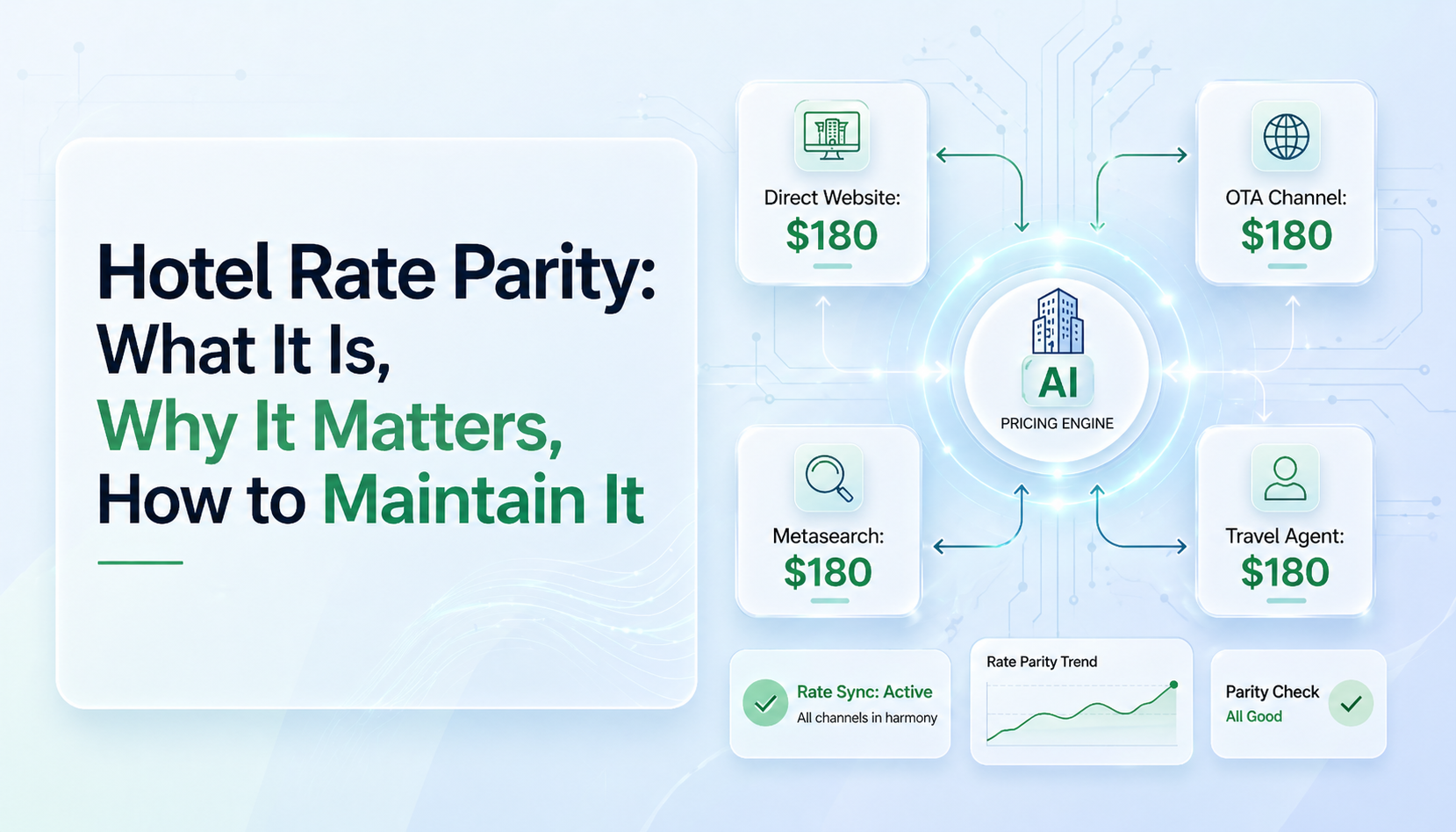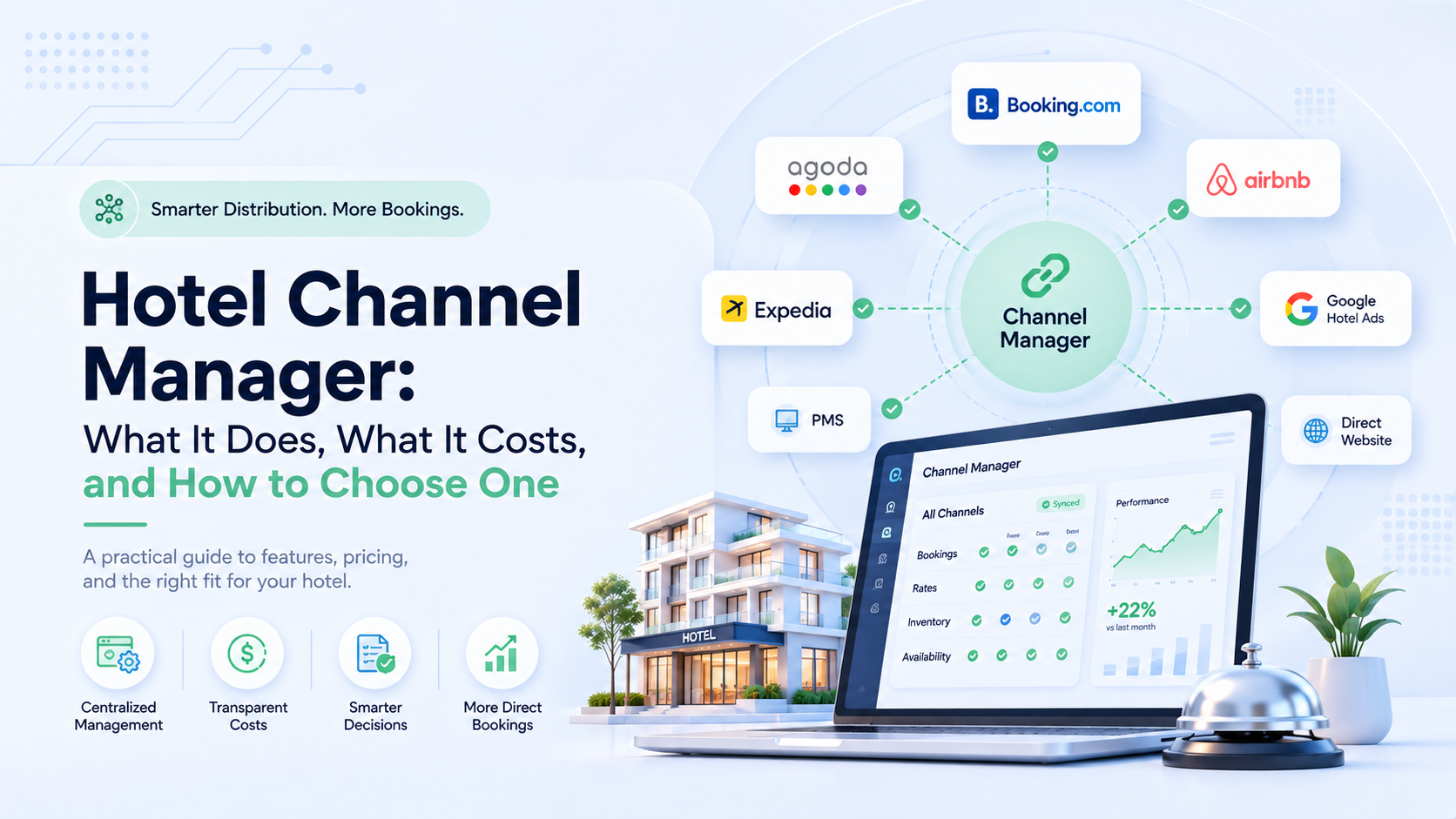
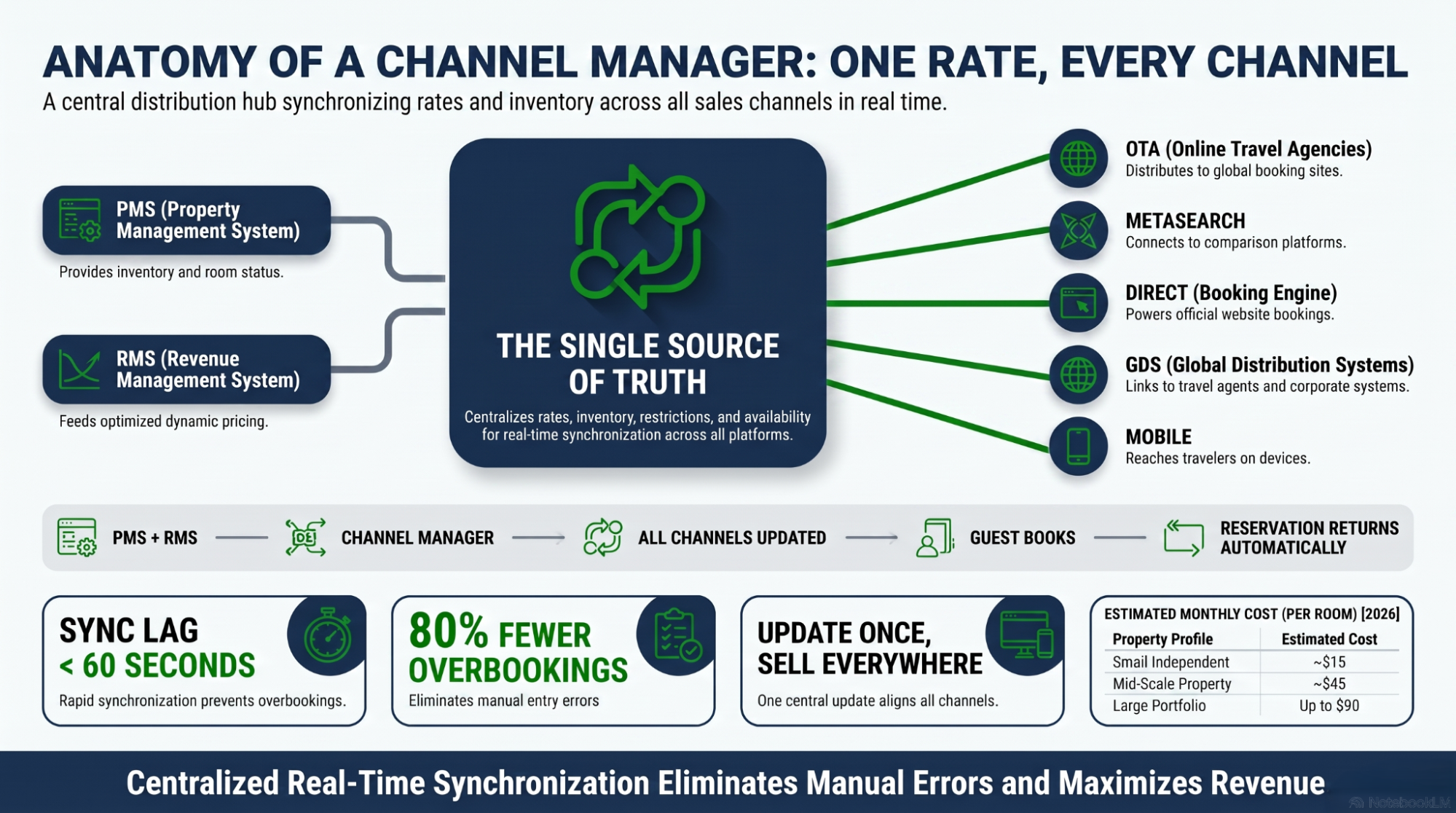
QUICK ANSWER — A hotel channel manager is software that syncs your room rates, availability, and inventory across every booking channel — OTAs, the GDS, metasearch, and your own website — from one dashboard, in real time. When a room sells on any channel, it instantly updates everywhere else, which prevents overbookings and rate-parity breaks. Expect to pay roughly $15–$90 per room per month in 2026, depending on property size and connection count.
You dropped your BAR $15 on Booking.com at 9 a.m. By noon a walk-in mentions they saw a cheaper rate on Expedia — the one you forgot to update. Now you’re out of parity, an OTA is threatening to demote you, and somewhere in the mix two guests booked the same room. This is the exact mess a hotel channel manager exists to prevent.
Every ranking guide on this topic is written by a company selling one. This isn’t. RevEvolve doesn’t sell a channel manager — so here’s the straight version: what it does, what it actually costs in 2026, how it differs from your PMS and your RMS, and how to pick one without getting upsold.
Key takeaways
- A channel manager’s one job is synchronization — same rate, same availability, everywhere you sell, updated the moment anything changes.
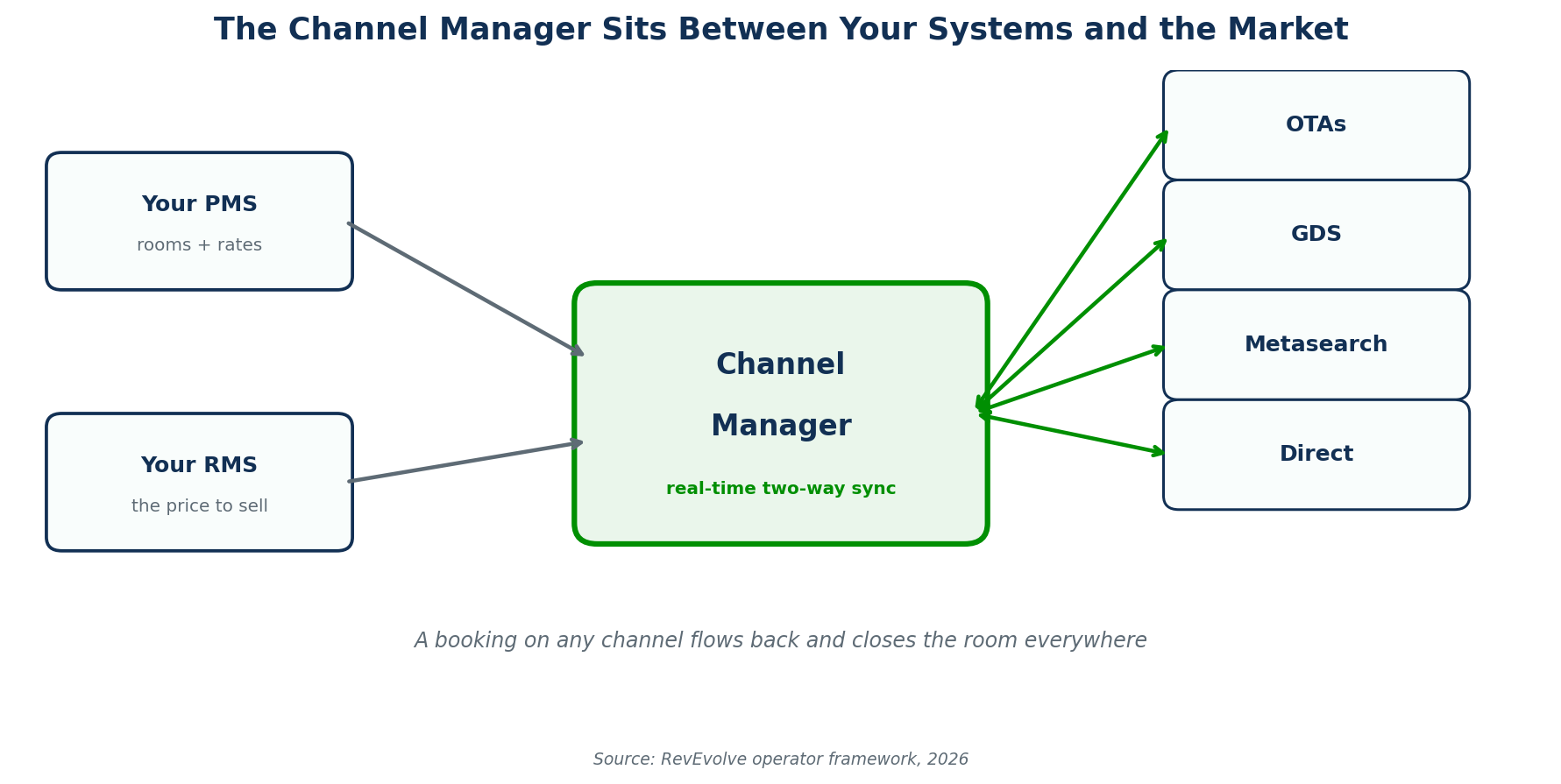
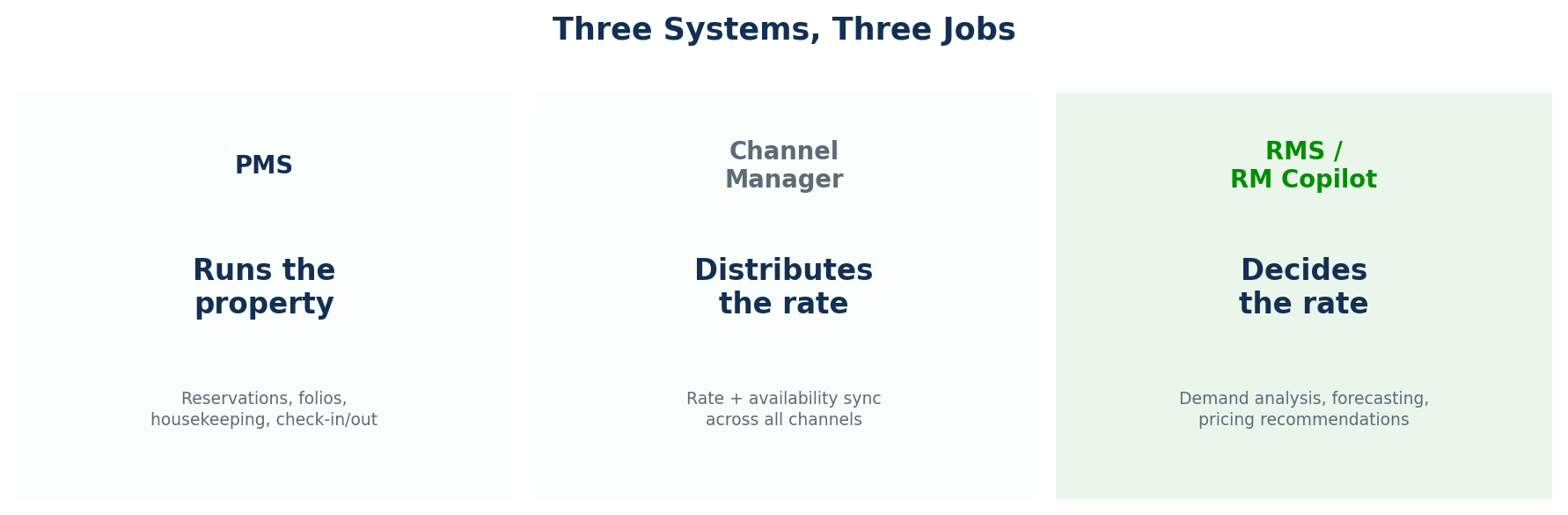
- It is not your PMS and not your RMS. The PMS runs the property, the RMS decides the price, the channel manager distributes it.
- 2026 pricing runs roughly $15–$90 per room per month; connection count and two-way sync matter more than the sticker price.
- Two-way (XML) connectivity is non-negotiable — one-way sync still lets overbookings through.
- The channel manager moves your rate; something still has to decide what the rate should be. That’s the revenue-management job it can’t do.
I spent a whole weekend chasing a rate discrepancy across four channels before I realised my channel manager connection had silently dropped. Never again.
What Is a Hotel Channel Manager?
Think of it as the switchboard between your hotel and the open market. On one side sits your inventory. On the other sit the dozens of places people can book you: OTAs like Booking.com and Expedia, the GDS (Amadeus, Sabre, Travelport), metasearch (Google Hotel Ads, Trivago), and your own direct booking engine. The channel manager makes all of them show the same thing at the same moment.
Before channel managers, this was manual. You logged into each extranet, updated rates one at a time, and prayed you didn’t miss one. Miss one and you either sold a room you didn’t have or left a rate out of parity. The channel manager killed that workflow — which is why nearly every hotel selling on more than two channels runs one.
How a Hotel Channel Manager Works
The mechanics are simpler than the vendors make them sound. Four moving parts:
1 · It connects to your PMS
The channel manager pulls your live room inventory and rates from your property management system. This connection is the foundation — if it’s one-way or unreliable, everything downstream breaks.
2 · It pushes to every channel
Rates and availability go out to all connected channels at once. Change a rate in one place, it updates everywhere in seconds instead of the hours manual updates used to take.
3 · It pulls bookings back
This is the half people forget. When a room sells on Expedia, the channel manager instantly reports it back and closes that room on Booking.com, the GDS, and your site. That two-way flow is what actually prevents double-bookings.
4 · It holds parity
Because every channel reads from one source, your rates stay consistent — the core of rate parity. No more one channel quietly showing a stale, cheaper rate.
Channel Manager vs PMS vs RMS: What Does What
These three get confused constantly, and vendors don’t help by bundling them. Here’s the clean split — three different jobs that hand off to each other.
| System | PMS | Channel Manager | RMS / RM Copilot |
|---|---|---|---|
| Its one job | Run the property | Distribute the rate | Decide the rate |
| Handles | Reservations, folios, housekeeping, check-in/out | Rate + availability sync across channels | Demand analysis, forecasting, pricing recommendations |
| Answers | “Who’s staying and what do they owe?” | “Is my rate the same everywhere?” | “What should the rate be tomorrow?” |
| Without it | Chaos at the front desk | Overbookings + parity breaks | You’re pricing on gut and last year |
| Decides price? | No | No — it moves whatever it’s given | Yes — recommends it; your team applies |
What Does a Hotel Channel Manager Cost in 2026?
Pricing is usually per-room, per-month, and scales with how many channels you connect. Here are the honest 2026 ranges — vendors rarely publish these, so treat them as planning brackets, not quotes.
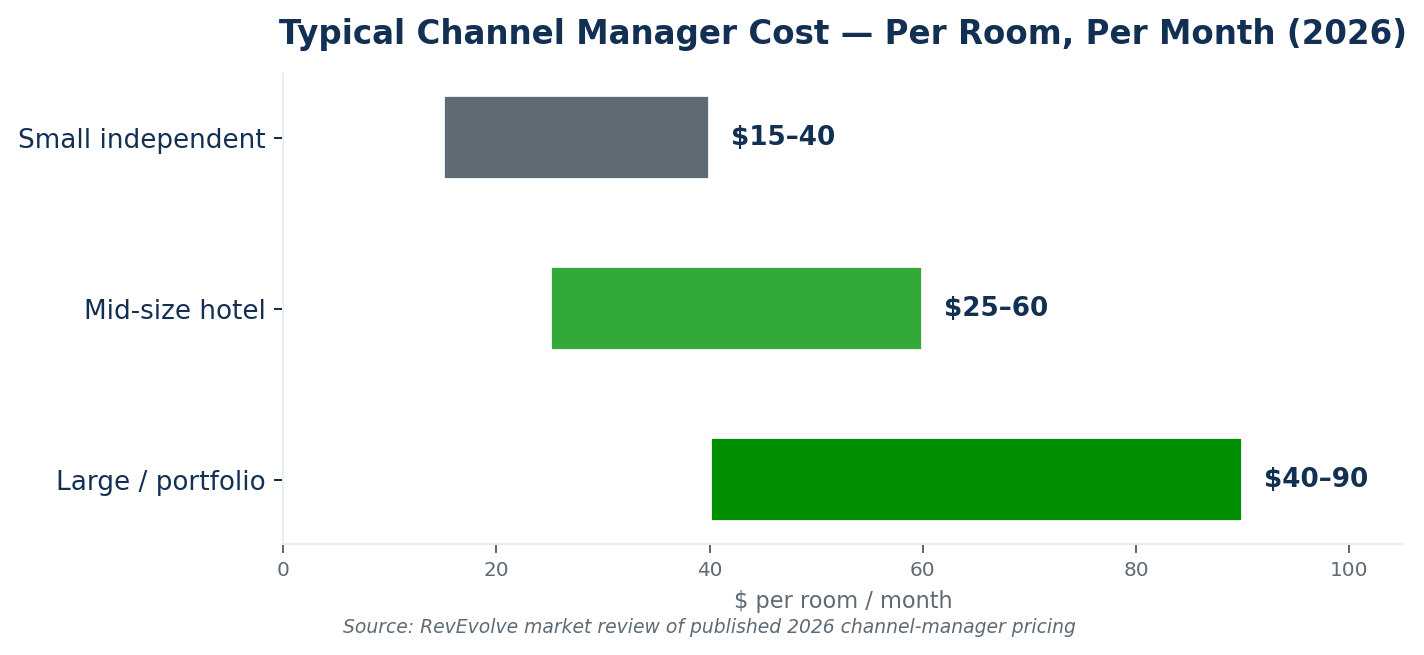
What moves the number: how many channels you connect, whether you need two-way (XML) sync versus cheaper one-way, whether a booking engine or GDS access is bundled, and property size. A 30-room independent on three OTAs sits at the low end. A 200-room property distributing across 40+ channels sits at the top — and a portfolio negotiating one contract across many hotels can often push the per-room rate back down.
Where Channel Managers Quietly Go Wrong
The tool is mature, so failures are rarely dramatic. They’re silent — which makes them expensive. Four to watch:
1 · One-way connections
A cheaper one-way connection pushes your rates out but doesn’t pull bookings back fast enough. That lag is exactly when double-bookings happen. If a connection is one-way, it’s a false economy.
2 · Silent connection drops
A channel connection fails and nothing tells you. The channel keeps selling at a stale rate or stale availability until a guest — or an angry OTA — flags it. Alerting on dropped connections is a feature worth paying for.
3 · Sync lag
“Real time” varies. Sixty seconds is fine; ten minutes on a compression night means you sell rooms you’ve already sold elsewhere. Ask for the actual sync interval, not the marketing adjective.
4 · Mistaking distribution for strategy
The biggest one. A channel manager syncs your rate flawlessly — but it has no idea whether the rate is any good. Broadcasting the wrong price to fifty channels efficiently is still broadcasting the wrong price.
How to Choose a Hotel Channel Manager
Skip the feature-checklist theatre. Six questions separate a good fit from an expensive mistake:
- Does it connect two-way (XML) to the channels you actually use? Not the 2,000 in the brochure — the 5–15 that matter to you.
- How fast is the real sync interval, and does it alert you when a connection drops?
- Does it integrate cleanly with your existing PMS? A shaky PMS connection undermines everything.
- What’s the all-in first-year cost, setup fees included — not the headline per-room rate?
- Can it scale to your portfolio under one contract if you run (or plan to run) multiple properties?
- What happens to the rate before it hits the channel manager? Because that’s the part the channel manager can’t help with.
The Gap Every Channel Manager Leaves
Here’s what no channel-manager vendor will tell you, because it’s not their job: the channel manager is only as good as the rate you feed it. It’s a distribution layer, not a decision layer. It will sync a rate that’s $30 too low across every channel just as fast as it syncs a good one.
That decision — what the rate should be, on which date, for which segment — is revenue management. It’s the layer above the channel manager. RM Copilot works there: it analyzes demand across your PMS data, recommends the rate with the reasoning attached, lets you simulate the impact, and your team applies it. Then your channel manager does what it does best — broadcasts that decision, correctly, everywhere.
Some AI tools in hospitality are guest-facing — chat and messaging that help you talk to travelers. RM Copilot is operator-facing: it works with your revenue team on the pricing decision itself. Pair a solid channel manager with a revenue system that gets the number right, and both do their real job.
Common Questions From the Buying Committee
Keep going: Direct bookings vs OTAs · Hotel rate parity explained · What RM Copilot does.