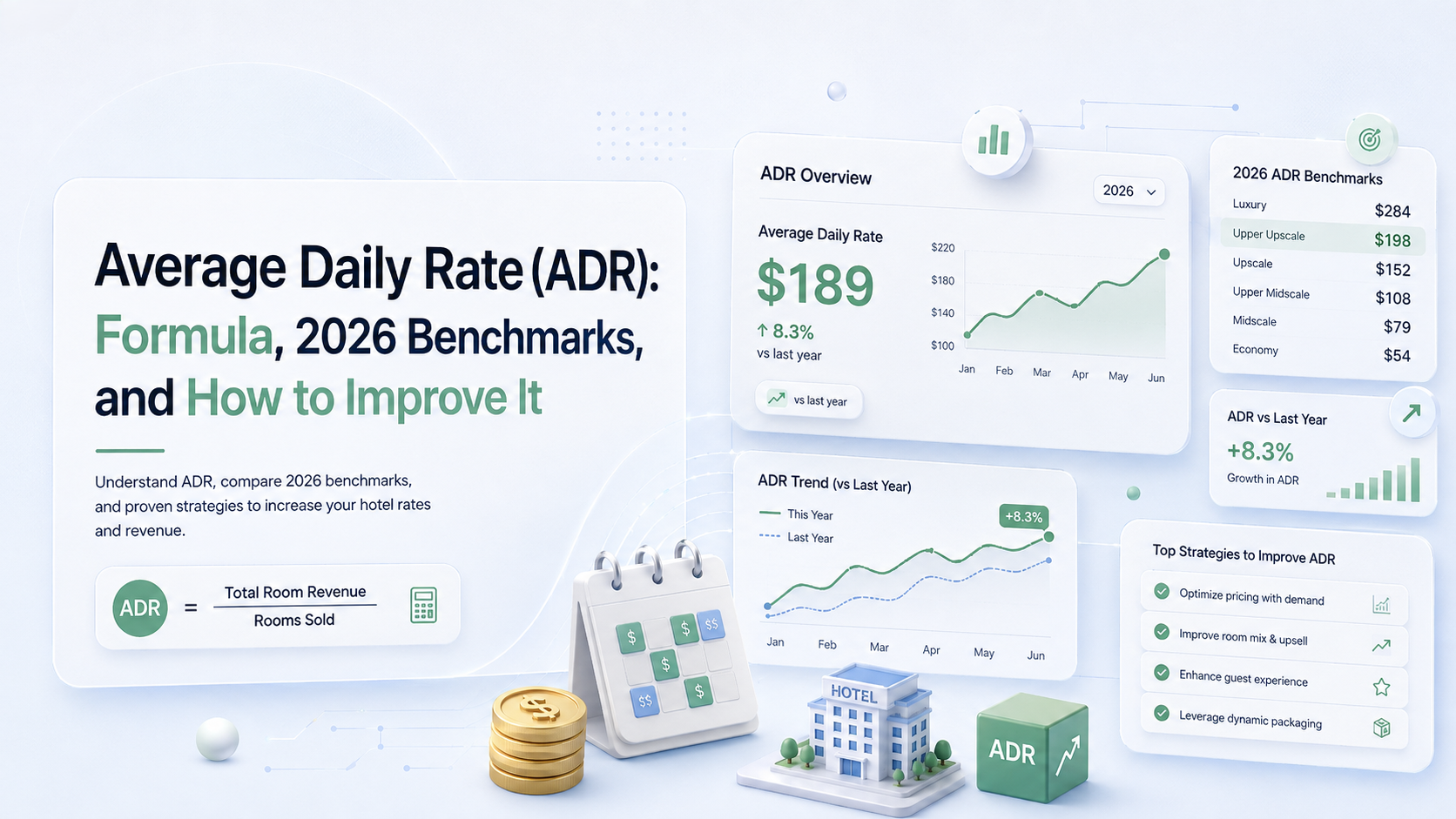
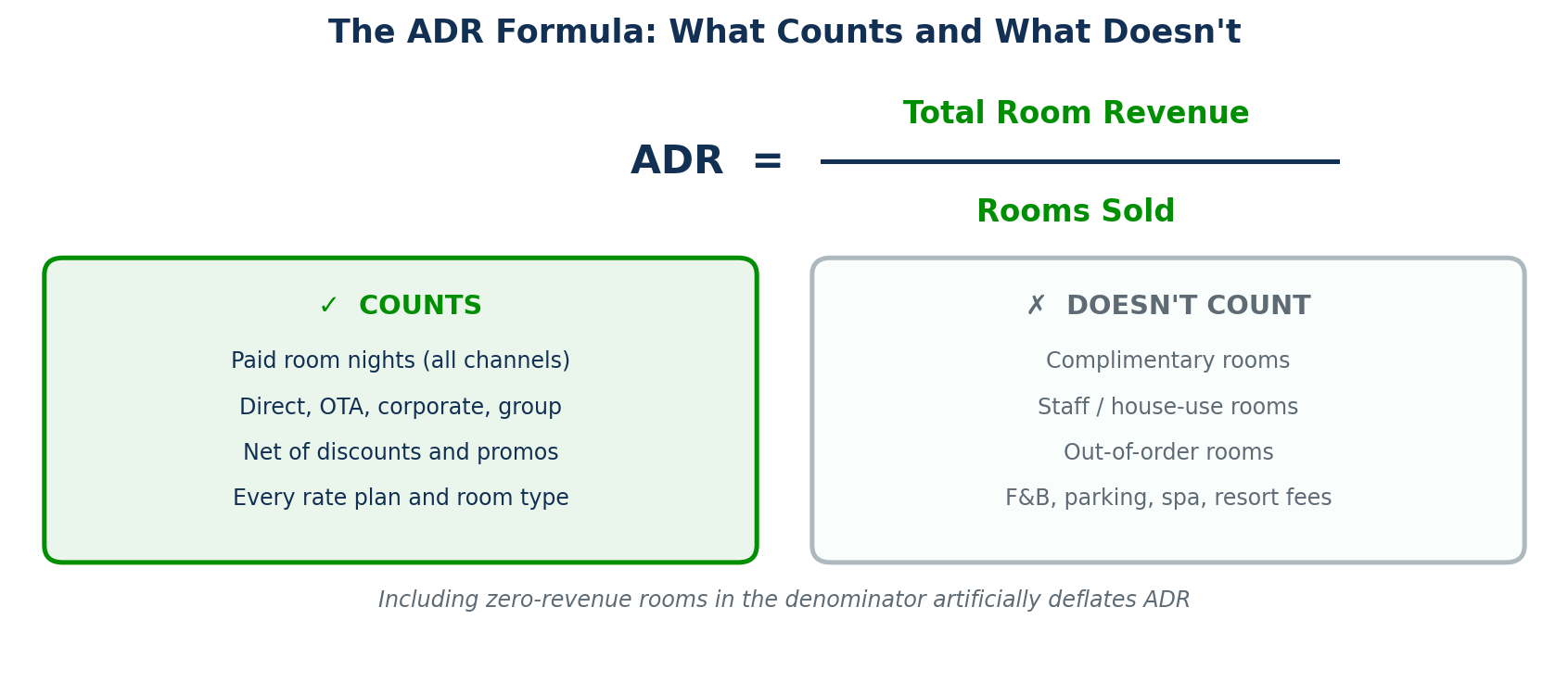
QUICK ANSWER — Average Daily Rate (ADR) is the average revenue earned per occupied room per night. The formula is ADR = Total Room Revenue ÷ Rooms Sold. It counts only paid, occupied rooms — complimentary rooms, staff rooms, and out-of-order rooms are excluded, and non-room revenue like F&B and parking never enters the calculation. A hotel earning $20,000 from 100 rooms sold has an ADR of $200.
Your ADR came in $14 lower than last month. Before the meeting starts, somebody will say the market softened, somebody else will say you discounted too hard, and a third person will suggest raising rates next month. All three could be wrong — because it’s entirely possible nobody changed a single rate.
ADR is the easiest hotel metric to calculate and one of the easiest to misread. This guide covers the formula and what belongs in it, what the 2026 U.S. numbers actually look like, the mix effect that moves ADR without any pricing decision, and the ways to raise it that don’t just trade occupancy for rate.
Our ADR dropped and the owner wanted to know why we cut rates. We hadn’t. We’d just picked up two group blocks.
Key takeaways
- ADR = Total Room Revenue ÷ Rooms Sold. Rooms revenue only, paid rooms only — comps and house-use rooms stay out of the denominator.
- ADR measures rooms you sold; RevPAR measures rooms you had. The gap between them is your occupancy story.
- ADR can move without a single rate change. A shift in segment mix does it on its own — the most common misdiagnosis in the revenue meeting.
- There is no universal good ADR. The only benchmark that means anything is your comp set and your own trend.
- 2026 U.S. ADR growth is concentrated at the top — luxury just below +6% YTD through April, select-service around +2% (CoStar/STR).
What Is Average Daily Rate (ADR)?
One distinction worth getting straight immediately: ADR is not your rack rate, and it is not the price a guest sees on a booking site. Those are individual rate points. ADR blends every occupied room — direct, OTA, corporate negotiated, group block, promotional — into one average. Two hotels advertising the same $249 rate can post wildly different ADRs depending on how much of their business actually books at it.
It is one leg of the metric triad every revenue team runs on: ADR (what you charged), occupancy (how many you filled), and RevPAR (what the two produced together). Read alone, each one lies. Read together, they diagnose.
The ADR Formula and How to Calculate It
The calculation needs two numbers and no judgment — provided you put the right things in each half.
Worked example
A 120-room hotel sells 90 rooms on a Tuesday and takes $16,200 in room revenue. ADR = $16,200 ÷ 90 = $180. Note what did not enter the math: the 30 unsold rooms (they belong to RevPAR, not ADR), the two comped rooms for a service recovery, the one house-use room for the on-call engineer, or the $2,400 the restaurant did that night.
What counts as room revenue
Gross room revenue net of discounts and promotions, across every channel and rate plan. Corporate negotiated rates count. Group block rates count. OTA bookings count at the rate the guest paid.
What does not count
Non-room revenue — F&B, parking, spa, resort fees, in-room purchases — stays out entirely. So do complimentary rooms, staff and house-use rooms, out-of-order rooms, and barter arrangements. Including a zero-revenue room in the denominator drags the average down and makes your pricing look worse than it is.
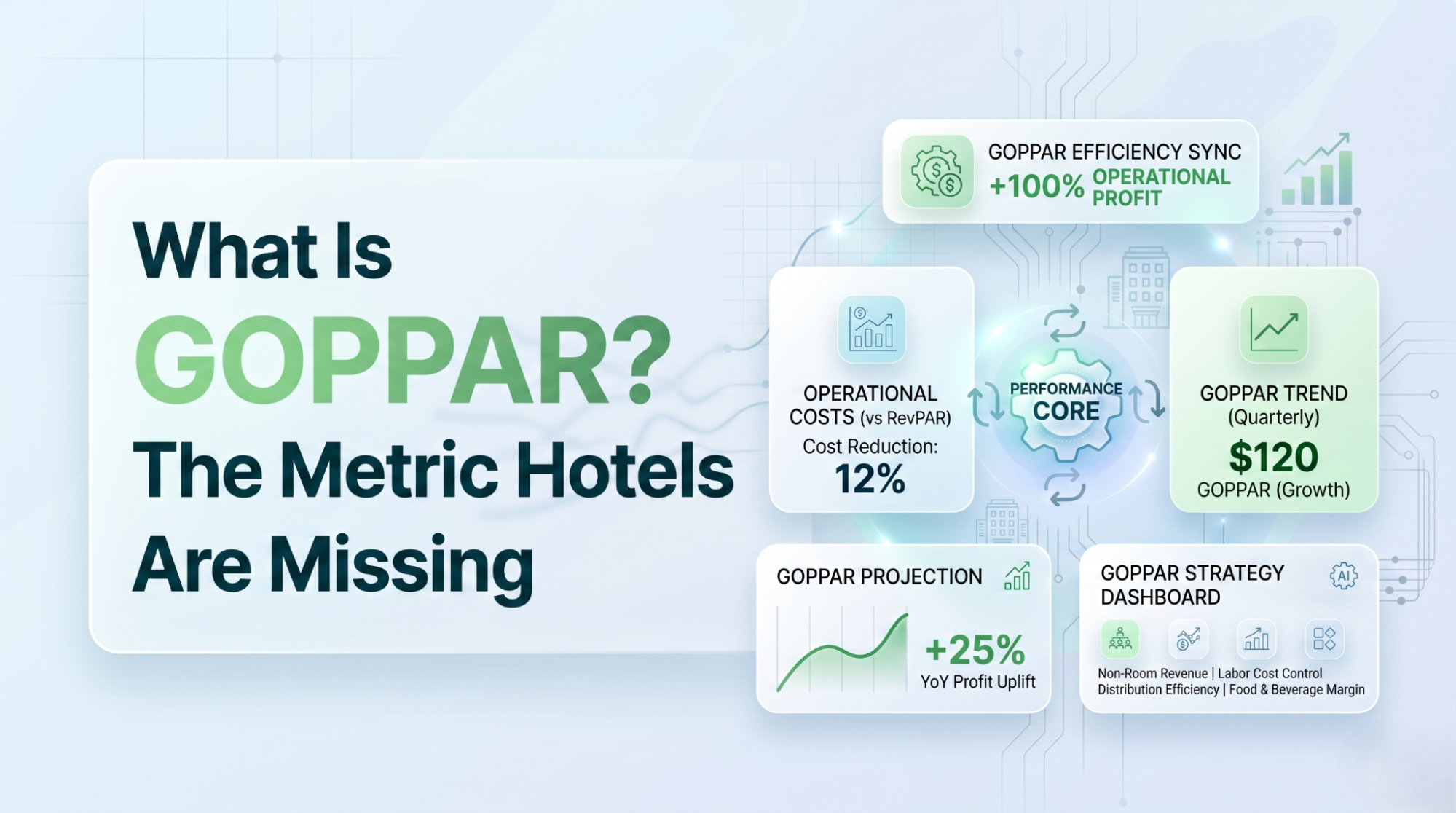
If you want the profit-side view of the same period — what actually reached the owner after operating costs — that is GOPPAR, and it tells a different story than ADR does.
ADR vs RevPAR: The Difference That Trips People Up
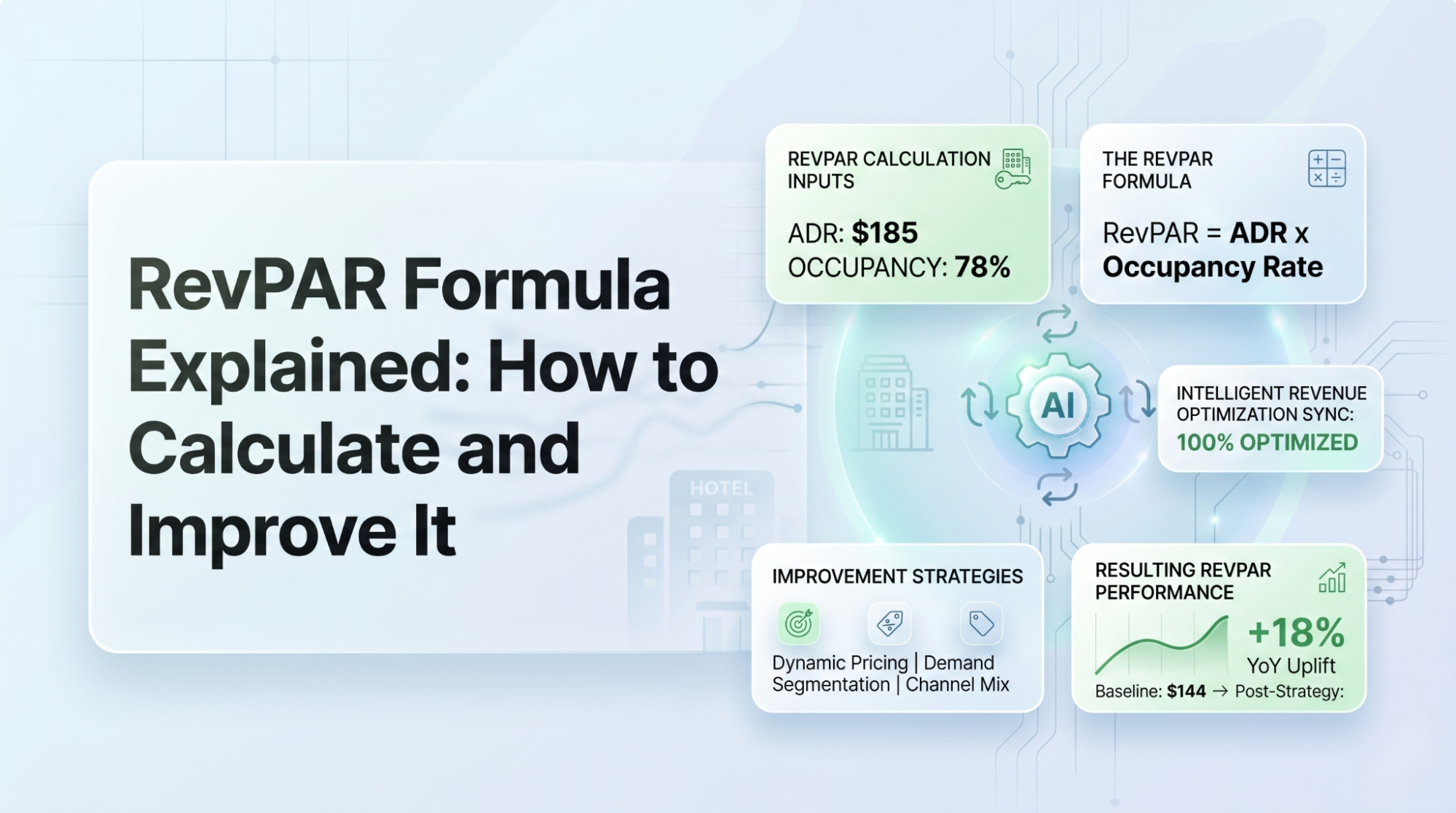
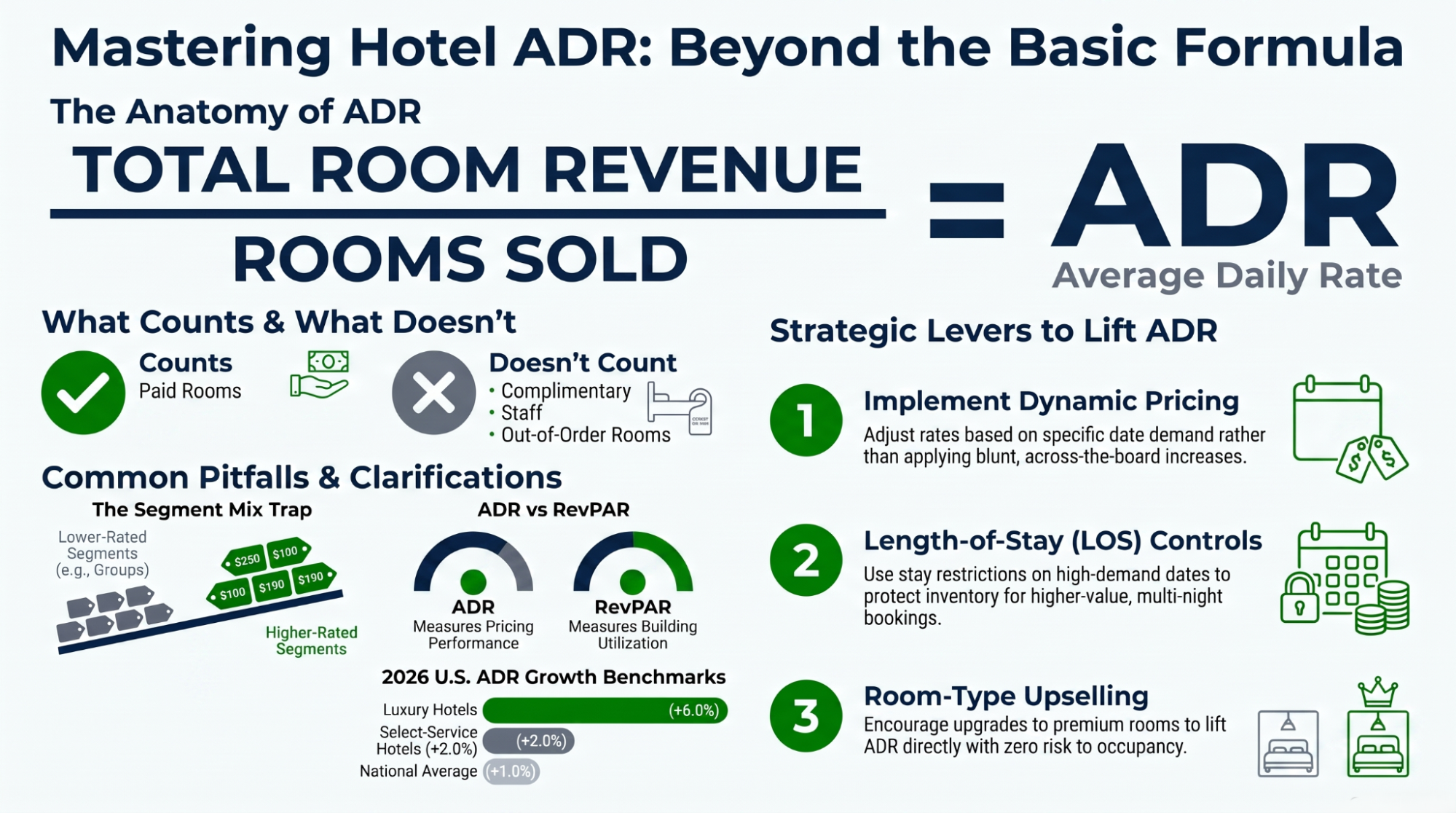
These two get used interchangeably in meetings, and they measure genuinely different things. ADR divides by rooms sold. RevPAR divides by rooms available. That single change in the denominator is the whole distinction.
| ADR | RevPAR | |
|---|---|---|
| Formula | Room revenue ÷ rooms SOLD | Room revenue ÷ rooms AVAILABLE |
| Also written as | — | ADR × Occupancy |
| Measures | Pricing performance | Total revenue performance |
| Ignores | Empty rooms | Nothing — empty rooms count against you |
| Answers | “What did we charge?” | “How well did we use the whole building?” |
The consequence is that ADR can rise while revenue falls. Price aggressively, sell fewer rooms, and your ADR looks excellent on a shrinking base. Here is what that trade looks like on a 100-room property.
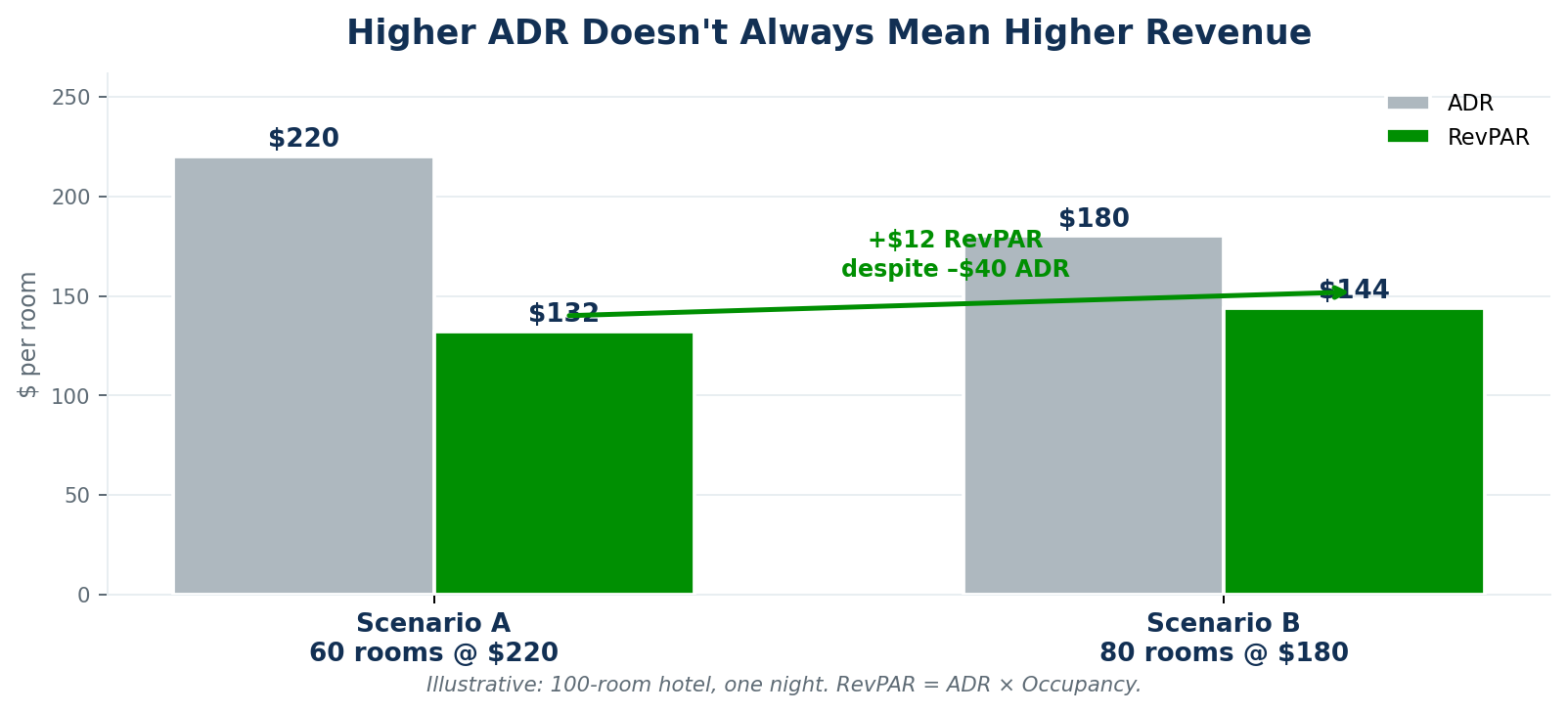
Scenario A charges $220 and fills 60 rooms: $13,200 in revenue, RevPAR $132. Scenario B charges $180 and fills 80: $14,400, RevPAR $144. The lower ADR made more money. That does not mean discounting wins — it means the right answer depends on how much demand exists at each price point, which is a forecasting question, not an ADR question.
The Mix Effect: When ADR Moves and Nobody Changed a Rate
This is the section most ADR guides skip, and it is the one that will save you an awkward ownership call.
ADR is an average, and averages move when the weighting moves. If your corporate share falls and your group share rises, your ADR drops — even if every single rate plan is priced exactly as it was last month.
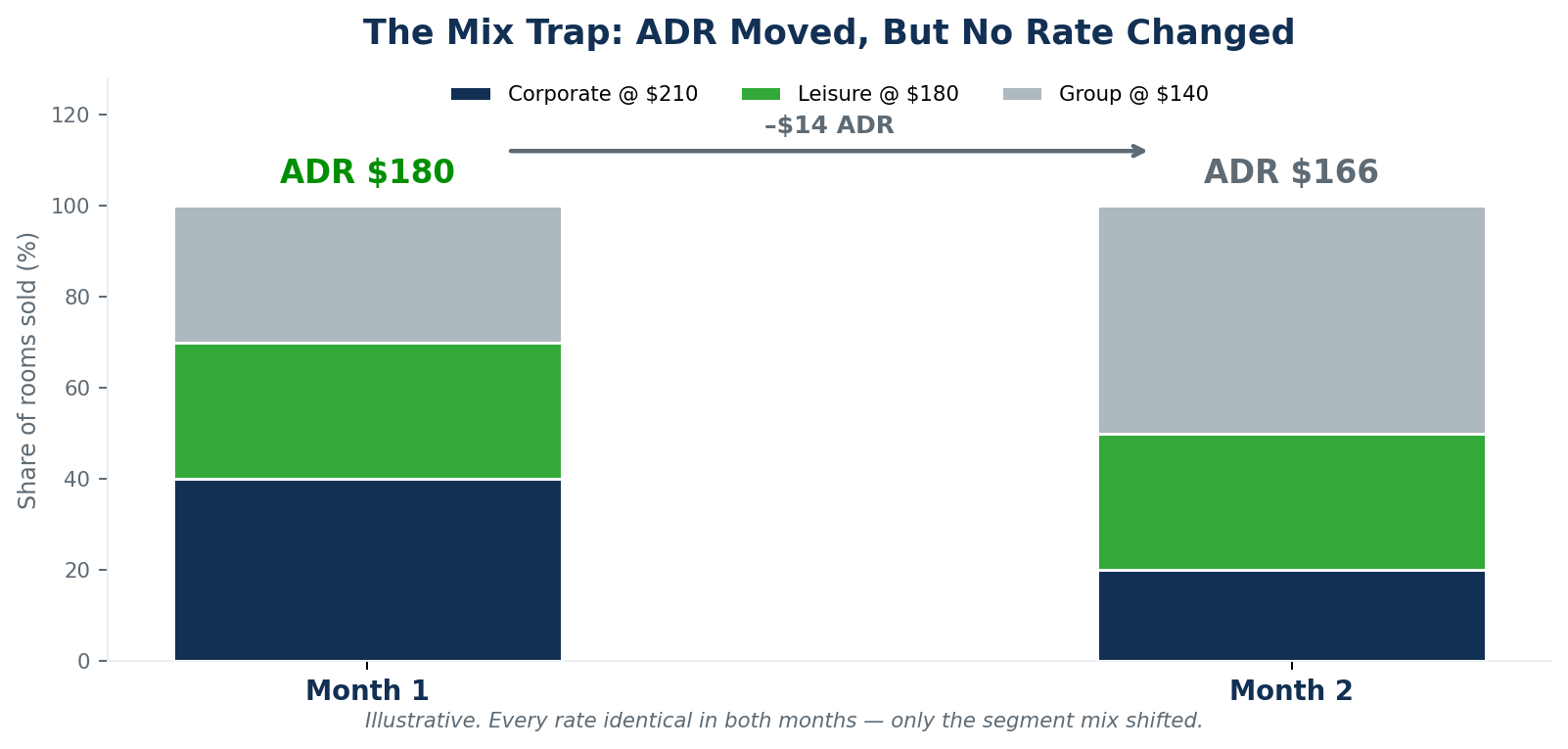
In Month 1 the hotel runs 40% corporate at $210, 30% leisure at $180, and 30% group at $140 — a blended ADR of $180. In Month 2 corporate drops to 20% and group rises to 50%, with leisure unchanged. Same rates, every one of them. New ADR: $166.
Nothing went wrong with pricing. What changed was who booked. If you respond to that −$14 by raising transient rates, you will damage the segment that was already performing while doing nothing about the one that actually shifted.
What Is a Good ADR? The 2026 Benchmarks
There is no universal good ADR, and any guide that gives you one number is selling something. A luxury resort and a roadside select-service property have no business being compared. Location, chain scale, season, and market all move the goalposts.
What you can benchmark against is your comp set and your own trend line — and directionally, the market. Here is where U.S. ADR actually sat in 2026.
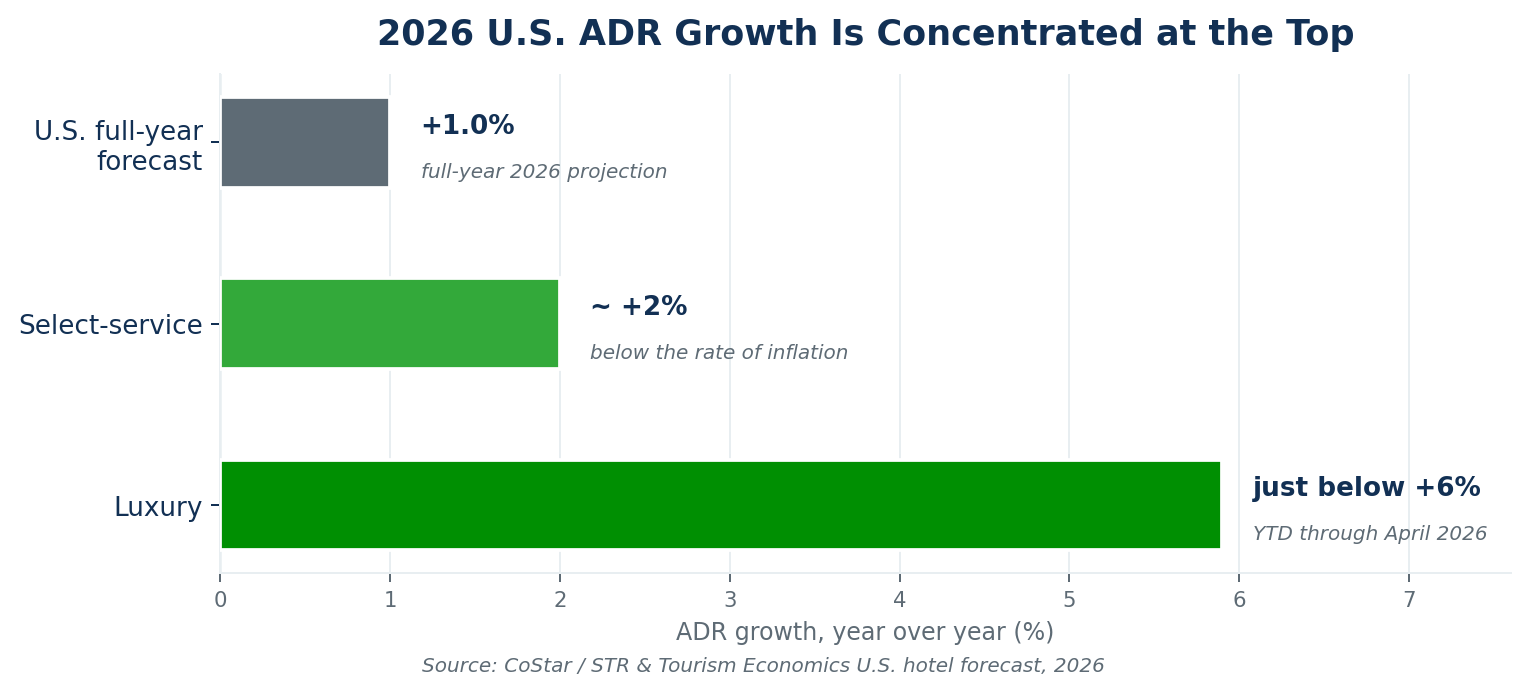
CoStar and Tourism Economics projected U.S. ADR growth of roughly 1% year over year for full-year 2026, with occupancy around 62.1%. Through April, the picture was better than forecast: RevPAR ran +4.0% year to date and the full-year RevPAR projection was revised up to 2.8%, helped by more than 8 million additional room nights of demand versus the prior year.
The important detail is the split. Luxury ADR ran just below +6% through April, while select-service sat around +2% — below the rate of inflation. Rate growth in 2026 concentrated at the top of the market; lower-tier properties saw demand gains without the pricing power to convert them. Context worth remembering: 2025 saw U.S. RevPAR fall 0.3%, the first non-recessionary RevPAR decline on record.
How to Improve ADR Without Just Raising Rates
“Raise your rates” is technically correct and practically useless — it works right up until occupancy collapses and RevPAR follows. These are the levers that lift ADR without buying it with volume.
- Price to demand, date by date. Blanket increases are blunt. Compression nights, city-wide events, and shoulder dates each support different rates, and a flat BAR leaves money on all three. This is what dynamic pricing is for.
- Fix the mix before you fix the rate. If low-rate segments are growing, shifting the mix does more for ADR than repricing. Tighten group ceilings on high-demand dates and protect inventory for higher-rated transient.
- Use length-of-stay controls instead of blunt closures. On compression dates, a minimum-stay restriction protects rate far better than closing out. It keeps you selling while filtering out one-night bookings that would block a higher-value multi-night stay.
- Build rate fences that hold. Advance purchase, cancellation terms, and package inclusions let you serve price-sensitive demand without leaking your best rate. A discount without a fence is just a lower rate.
- Sell up at the room-type level. Upgrades and premium room types raise ADR directly, one booking at a time, with no rate change and no occupancy risk.
- Stop reacting to a single competitor. Matching one competitor’s cut usually starts a race that flattens the whole market’s ADR. Check whether demand actually moved before you move with them.
Four Common ADR Mistakes
1 · Putting comped rooms in the denominator
Every zero-revenue room you count as sold drags the average down. Service recovery comps, staff rooms, and house-use rooms belong out of the calculation — otherwise you will diagnose a pricing problem that is actually a bookkeeping one.
2 · Treating ADR as a target on its own
An ADR goal detached from occupancy is an invitation to price yourself empty. The target belongs on RevPAR; ADR is one of the two levers you pull to get there.
3 · Ignoring the mix
Covered above, and worth repeating because it is the single most common misread in the revenue meeting.
4 · Benchmarking against the wrong set
Comparing your ADR to a national average, or to hotels guests would never choose between, produces confident conclusions from meaningless comparisons. Benchmark against the properties that actually compete for your guest.
Where the Rate Decision Actually Gets Made
Everything above is diagnosis. ADR tells you what you charged and, read with occupancy and mix, why it landed where it did. What it cannot tell you is what to charge next Tuesday.
That is a forecasting problem — how much demand exists on that date, from which segments, at which price points. RM Copilot works there: it analyzes demand and mix across your own PMS data, recommends the rate with the reasoning attached, and lets you simulate the projected occupancy and revenue impact before committing. Your team reviews the recommendation and applies it.
Then next month’s ADR tells you how the call went — and because the recommendation history logs why each rate moved, you can separate a mix shift from a pricing decision without reconstructing it from memory.
Worth separating two things people conflate: some hospitality AI is guest-facing — chat and messaging that help you talk to travelers. RM Copilot is operator-facing, working with your revenue team on the pricing decision itself.
Questions From the Revenue Meeting
Keep going: RevPAR formula explained · What is GOPPAR? · Dynamic pricing · Revenue management glossary.