SNIPPET DEFINITION — Hotel attrition is the shortfall between the rooms a group contracts for and the rooms it actually uses. Most contracts allow 10–20% slippage; below that floor, the group owes an attrition fee on the unfilled rooms. For the hotel, the real cost is the fee plus the transient revenue displaced to hold the block.
A sales manager books a 60-room block for a regional conference. The rate looks great on paper. Two months out, pickup sits at 41 rooms. The cutoff date passes. Now someone has to explain a five-figure attrition invoice to the client — and explain to the GM why the hotel turned away transient business to hold rooms that never sold.
That scene plays out every week in group-heavy hotels. Attrition is where a good group rate quietly becomes a bad revenue decision. Most operators only look at the penalty and never at the displacement behind it. This guide covers what hotel attrition means, the exact formula, real contract-clause language, and a playbook to stop slipped blocks from eating your best dates.
We collected the attrition fee and still lost money on the date — we’d walked $12k of transient to protect a block that came in 30% short.
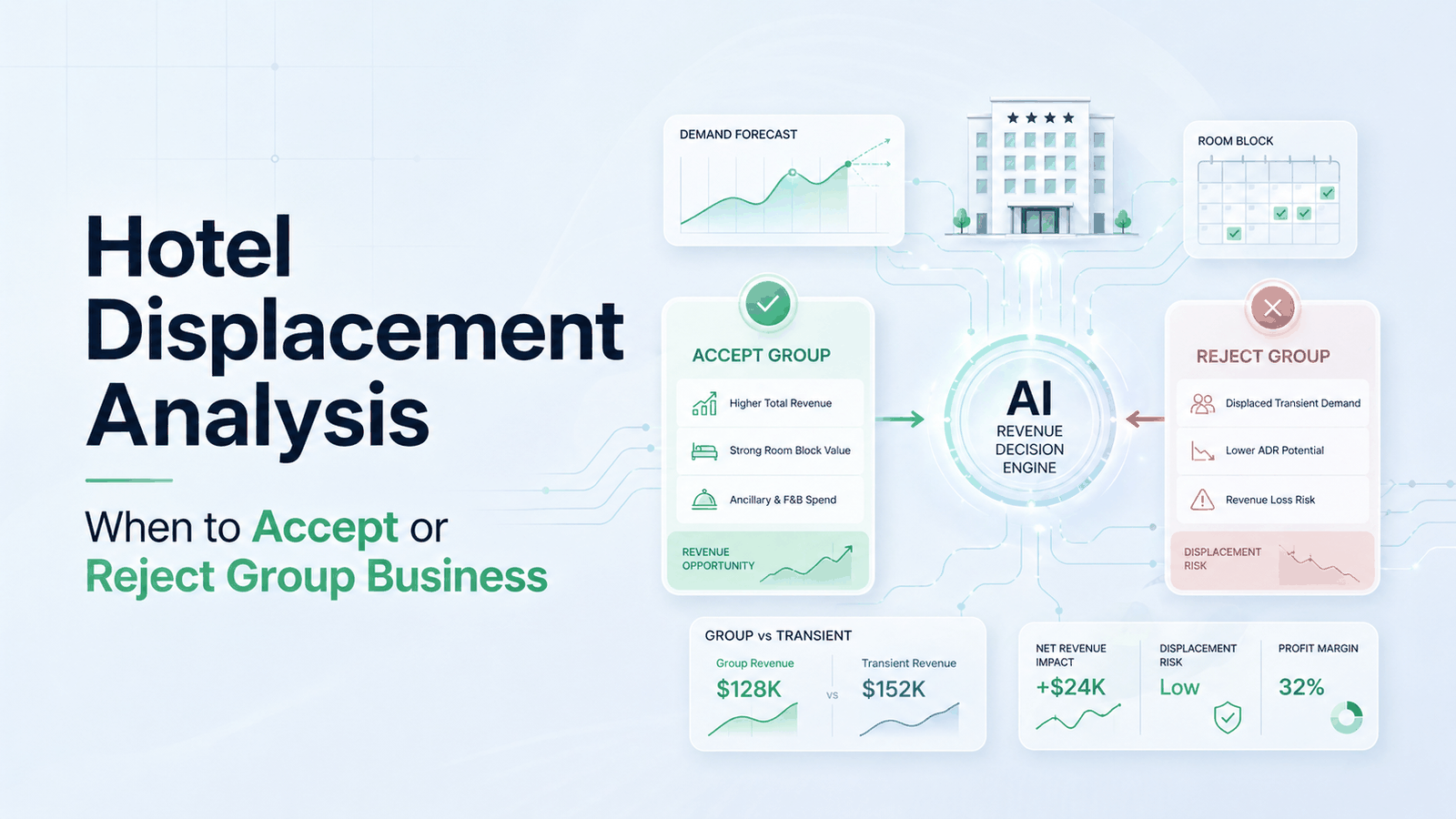
This post explains what attrition means and how to calculate it. For the group-vs-transient displacement decision itself — when a block is worth holding at all — see the linked guide.
Key takeaways
- Attrition = contracted room block minus actual pickup, measured at the cutoff date.
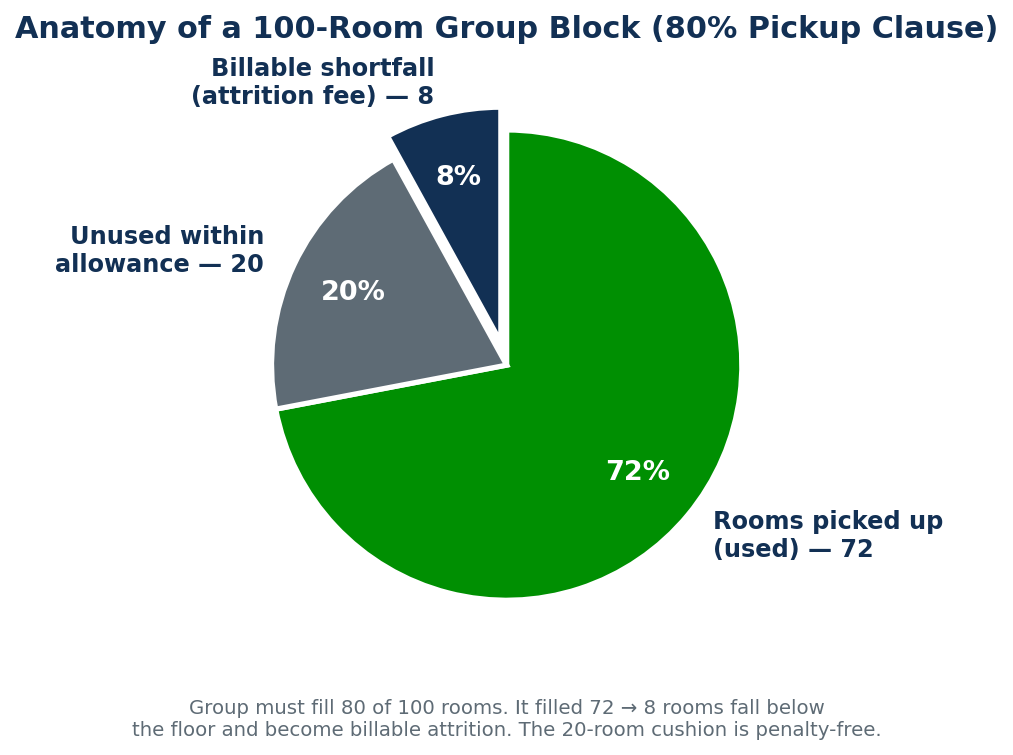
- An “80% clause” means the group must fill 80% of the block; the other 20% is a penalty-free cushion.
- Fees are billed on lost revenue or lost profit — the basis changes the number a lot.
- The real cost to a hotel is the fee minus the transient business displaced to hold rooms.
- Right-sizing the block and running displacement math up front prevents most disputes.
What is hotel attrition?
The clause exists to protect the hotel. You held those rooms at a set rate and turned away other demand to do it. Attrition is the contract’s way of covering that risk when a group over-promises and under-fills.
You’ll see the same idea called “room block attrition,” “group attrition,” or just “slippage.” The mechanics are identical: a block, a pickup floor, a cutoff date, and a fee if the group lands underneath it.
How does a hotel attrition clause work?
A group signs for a block of rooms at a negotiated rate. The contract sets how many of those rooms the group has to actually fill — the pickup floor — and a cutoff date when anything unbooked releases back to general inventory. If pickup lands below the floor at cutoff, attrition kicks in.
Here’s the vocabulary that shows up in every group contract:
| Term | What it means | Why it matters |
|---|---|---|
| Room block | Rooms held for the group at a set rate | The commitment both sides are measured against |
| Attrition allowance | % of the block the group can drop penalty-free (often 10–20%) | Sets the pickup floor |
| Pickup | Rooms actually reserved by the cutoff | The number that triggers or clears attrition |
| Cutoff date | When unbooked rooms release to general inventory | Locks in the pickup count |
| Courtesy block | Rooms held with no financial liability | Lower risk, but no rate guarantee and earlier release |
| Slippage | Block minus pickup | The raw gap before the allowance is applied |
| Attrition fee | Charge on rooms below the floor | The penalty itself |
How to calculate hotel attrition (the formula)
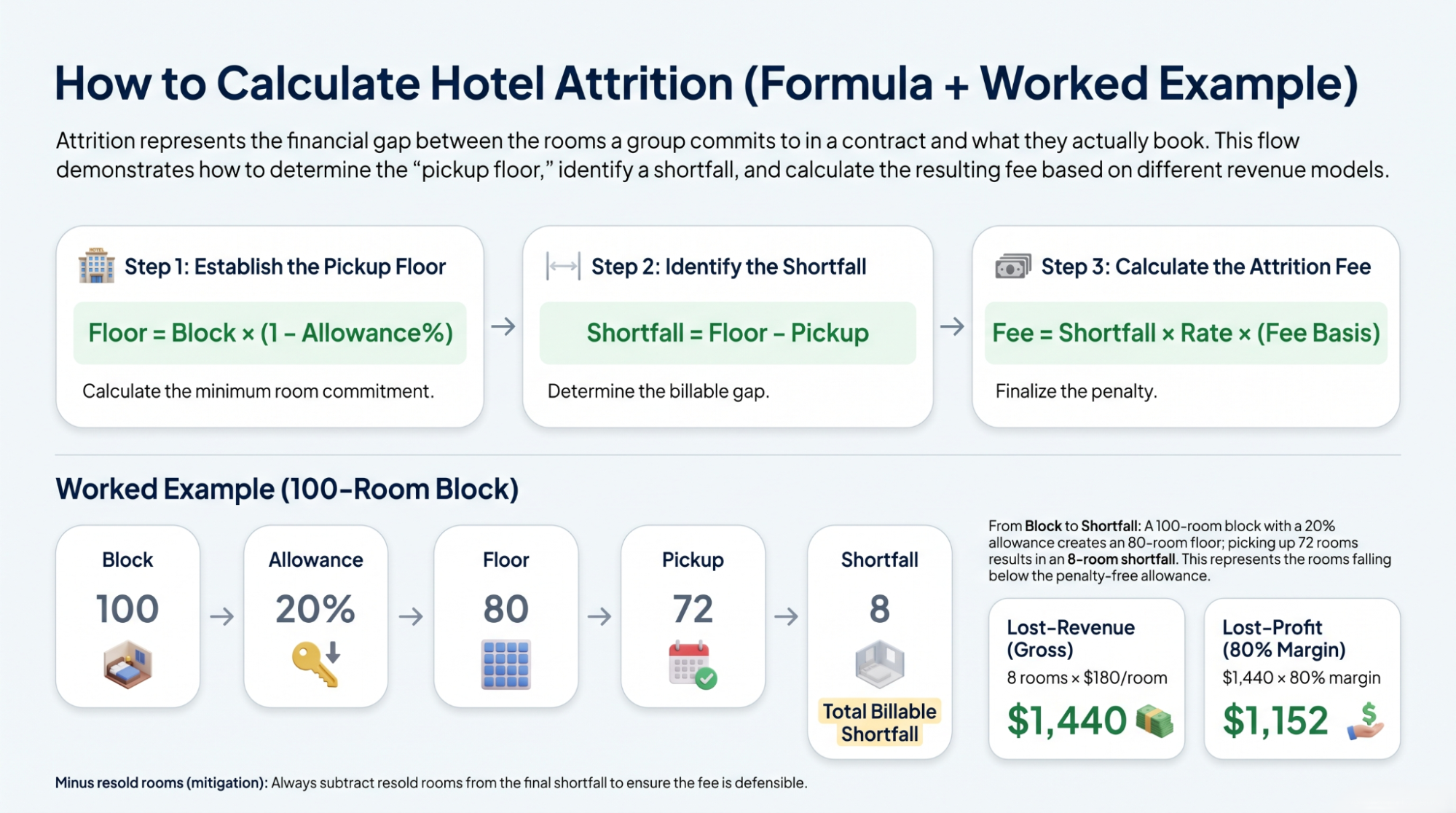
Four steps take you from a signed block to the fee. Use a 100-room block with a 20% allowance and an $180 rate as the running example.
- Find the pickup floor. Floor = block × (1 − allowance). 100 × (1 − 0.20) = 80 rooms.
- Compare actual pickup to the floor. The group picked up 72. 72 is below 80, so attrition applies.
- Count the shortfall. Floor − pickup = 80 − 72 = 8 room-nights.
- Apply the fee basis. Lost-revenue basis: 8 × $180 = $1,440. Lost-profit basis at 80% margin: 8 × $180 × 0.80 = $1,152.
How are hotel attrition fees actually calculated?
The shortfall is the easy part. The number people actually argue about is the basis — what the hotel is allowed to charge for each unfilled room.
Lost revenue vs lost profit
- Lost-revenue basis: shortfall × the contracted rate (gross). Hotel-favorable and simplest to write.
- Lost-profit basis: shortfall × rate × margin, netting out variable costs you never incurred — housekeeping, amenities, commissions. Group-favorable and closer to true loss.
Mitigation and enforceability
Two principles keep an attrition charge defensible. First, mitigation: once rooms release at cutoff, the hotel is generally expected to try to resell them, and the fee should reflect what it couldn’t recover. Second, an attrition charge has to read as a reasonable estimate of loss, not a punishment — a clause written as a pure penalty is the kind that falls apart in a dispute.
Sample clause language
Allowance + floor:
“Group may reduce the room block by up to twenty percent (20%) without penalty. Actual pickup below eighty percent (80%) of the contracted block will incur attrition damages.”
Mitigation + basis:
“Attrition damages shall equal the contracted rate less variable costs for each unsold room below the floor, reduced by any rooms resold by the Hotel for the affected dates.”
What does attrition really cost a hotel?
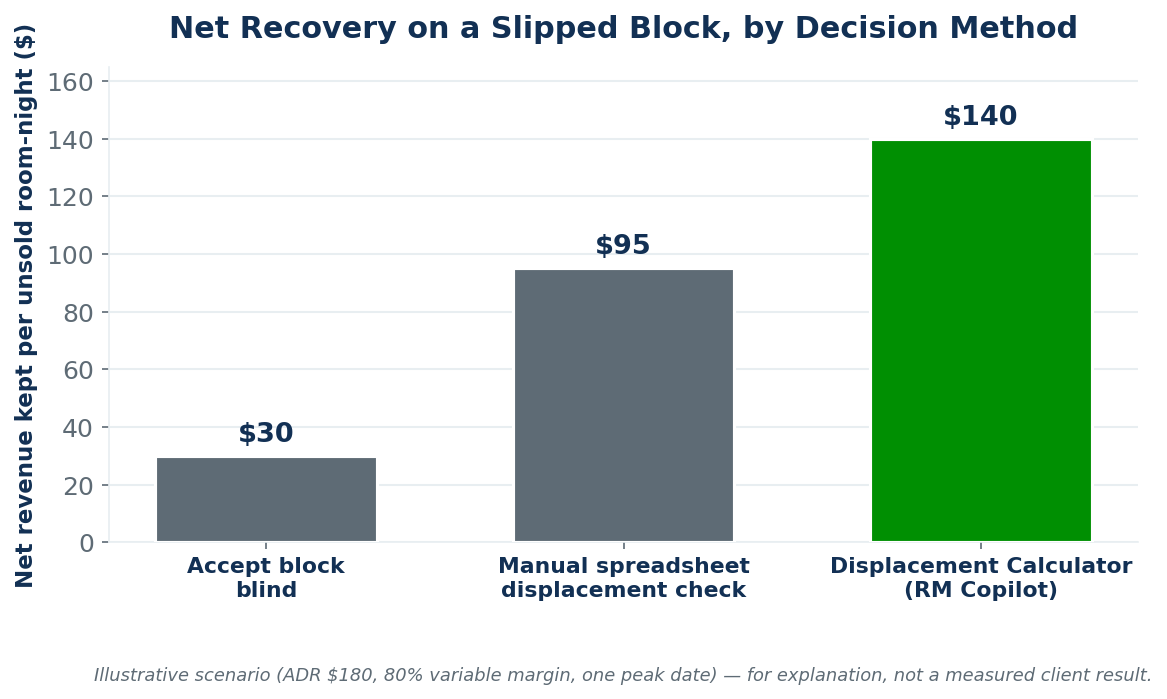
Here’s what the ranking definitions miss. The attrition fee is not the cost of a slipped block — displacement is.
When you hold 100 rooms for a group, you stop selling those rooms to transient guests on the same dates. On a strong date, that transient business would have paid more than the group rate. If the group then slips, you lose twice: the rooms went unsold, and you already walked the higher-paying demand to hold them.
Net cost of the slip = displaced transient revenue − attrition fee recovered. A block that looked profitable at the group rate can post a loss once you price in the transient you turned away. That is exactly the group-vs-transient displacement call revenue teams need to make before signing, not after the invoice.
Where hotel attrition math goes wrong
Four mistakes cause most attrition losses — and none of the top-ranking definitions warn you about them.
- Sizing the block to the group’s ask. Clients pad their estimate. Size to the group’s real pickup history, not the number on the RFP.
- Reading the allowance backwards. “80% attrition” is a pickup floor, not permission to drop 80%. This one error drives half of all disputes.
- Ignoring the mitigation clause. Billing gross when you resold half the rooms invites a fight you’ll usually lose.
- Judging the block on rate alone. A great group rate on a peak date can still be a bad decision once displacement is priced in.
The hotel attrition avoidance playbook
You can’t eliminate attrition, but you can stop it from surprising you. Five steps, in order.
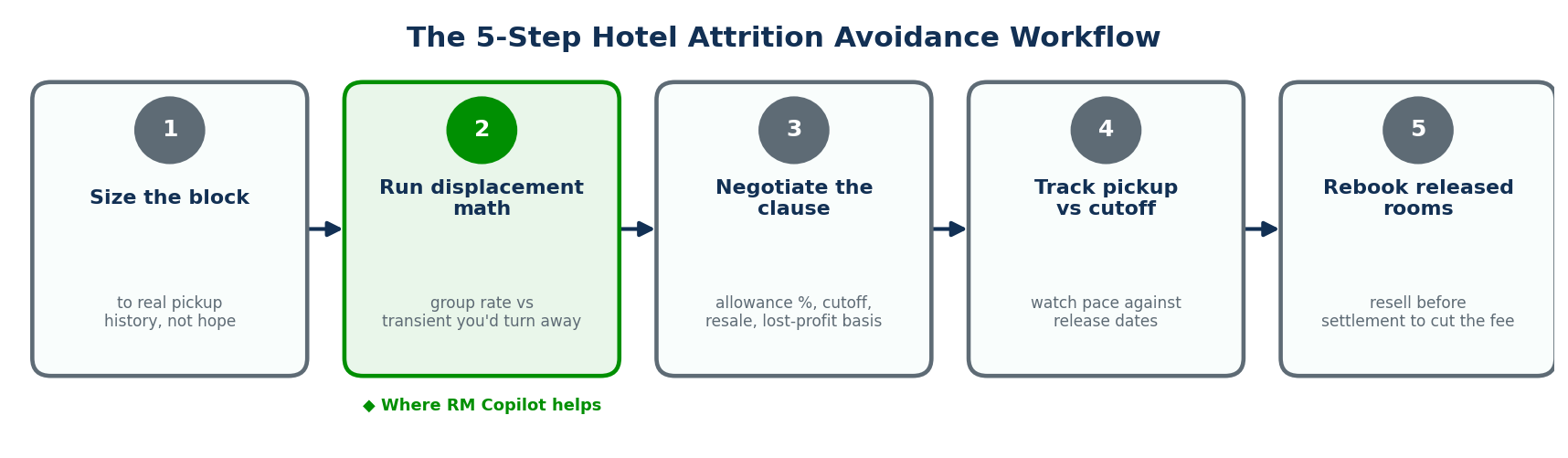
- Size the block to pickup history. Anchor the number to what this group (or one like it) actually filled last time.
- Run displacement math before you sign. Compare the group rate against the transient revenue you’d turn away on those dates.
- Negotiate the clause, not just the rate. Set the allowance, cutoff, resale/mitigation terms, and a lost-profit basis in writing.
- Track pickup against the cutoff. Watch pace weekly so a shortfall is visible while you can still act on it.
- Rebook released rooms early. Resell before settlement to cut the billable shortfall and keep the fee defensible.
Manual vs spreadsheet vs Copilot
| Capability | Manual / gut feel | Spreadsheet model | RM Copilot |
|---|---|---|---|
| Sees live pickup pace | No | Stale snapshot | Yes |
| Prices displaced transient | Rarely | If you build it | Built in |
| Flags risky blocks pre-signature | No | Manual | Recommended, with reasoning |
| Scales across a portfolio | No | One sheet per property | One view, many properties |
| Who decides | You | You | You — Copilot recommends, you apply |
A displacement decision, done right
EMA Hospitality runs a multi-property portfolio where group business collides with peak transient demand constantly. Before RM Copilot, each group-vs-transient call was a spreadsheet exercise done under time pressure — or skipped.
With displacement and what-if modeling surfacing the transient cost of each block up front, EMA’s revenue managers recovered 18 hours per week and hit a 6-month payback. Across RevEvolve’s base, RM Copilot users report +5–8% RevPAR and cover 22+ properties per RM seat. The Copilot recommends the call; the RM reviews the reasoning and applies it.
How RevEvolve helps you avoid attrition surprises
Attrition is a decision problem long before it’s a billing problem. RM Copilot puts the three pieces of that decision in one place:
- Displacement modelling — weighs the group rate against the transient revenue you’d turn away on those dates.
- What-If Simulator — model a proposed block and see projected occupancy, ADR, and revenue impact before you sign.
- Demand calendar — surfaces the city events and need dates that make a block worth protecting, or worth declining.
Common objections from revenue teams
The bottom line on hotel attrition
Back to that 60-room block. The invoice wasn’t the real damage — the transient the hotel walked to hold rooms that never sold was. Attrition punishes hotels that price a block on rate alone and never on displacement.
Define it, size it to real pickup, negotiate the clause, and run the group-vs-transient math before you sign. Do that and attrition stops being a surprise invoice and becomes a decision you made on purpose.
Keep going: Hotel displacement analysis · Inventory control strategies · More RM fundamentals.