SNIPPET DEFINITION — The hotel RFP process is the annual cycle — typically September to November, with rates live January 1 — in which corporate travel buyers solicit negotiated rate bids from hotels, usually through a platform like Lanyon or Cvent. Pricing a corporate negotiated rate well isn’t about matching last year or maximizing roomnights; it’s a displacement decision: estimate what the account will actually produce, run displacement on its date pattern, and set a rate that clears what it pushes out plus a fair contribution.
It’s fall, which means your inbox is filling with corporate RFPs — dozens, maybe hundreds of accounts asking for next year’s negotiated rate. Sales wants you to win them all. The easy move is to default to last year’s numbers and bid low to keep the volume. And that’s exactly how hotels end up locked into a year of corporate business that quietly displaces higher-rate guests on their best nights.
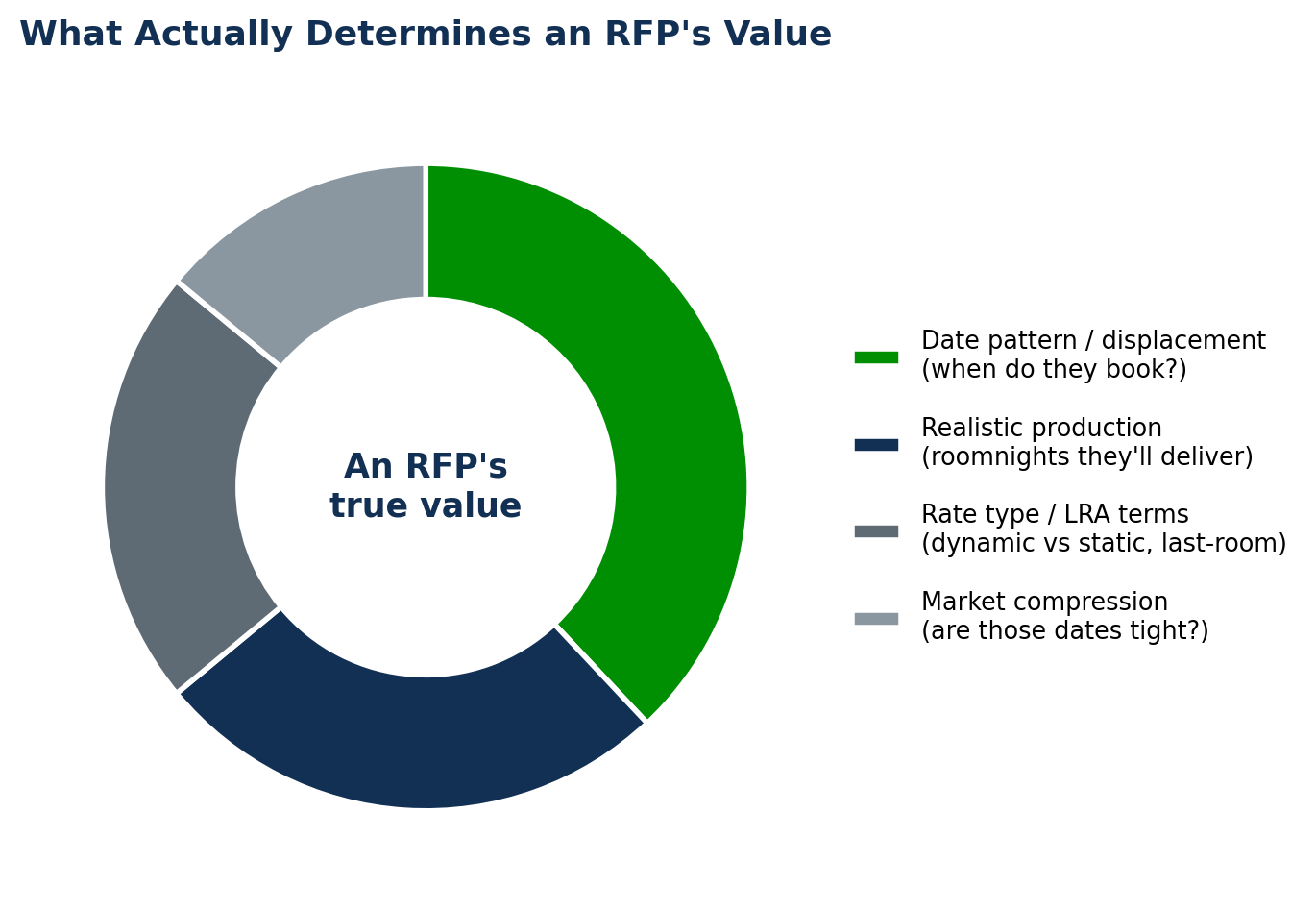
Pricing an RFP well isn’t about the rate in isolation, or the roomnight total. It’s a displacement decision: what does this account push out, and is what it brings in worth more than what it replaces? Get that reframe right and RFP season becomes a lever, not a flood.
We won a big corporate account and it books almost entirely on our sold-out weekends. Sales celebrated the roomnight total; it’s actually costing us money.
Quick scope note: RFP pricing is a specific application of displacement analysis — read that guide for the general method, and this one for how to apply it to corporate negotiated rates. We’re focused on corporate negotiated (transient) rates here, not group blocks, which are a different decision.
Key takeaways
- RFP season: RFPs arrive Sep–Nov; negotiated rates go live Jan 1.
- The real question isn’t the rate — it’s what the account displaces.
- Two accounts with the same roomnights can have very different net value.
- Dynamic (percentage-off-BAR) rates protect you better than static ones.
- Run displacement before you bid — decline or counter accounts that book your peaks.
What is the hotel RFP process?
For a revenue manager, RFP season is a once-a-year batch of high-stakes pricing decisions arriving all at once — which is exactly why a method beats defaulting to last year.
When is RFP season? The annual calendar
RFP season runs on a predictable calendar. Knowing it lets you prepare instead of react.
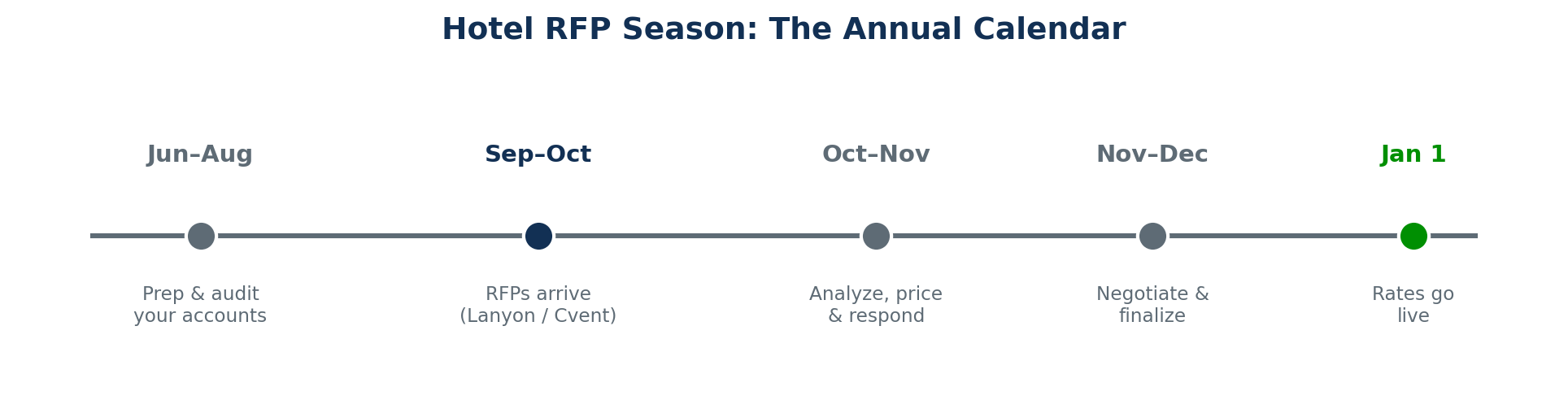
The most valuable window is the one most hotels skip: the summer prep. Auditing last year’s accounts — who actually delivered, who booked your peaks, who under-produced — before the RFPs land is what lets you respond fast and well when the flood arrives.
How corporate negotiated rates work
A corporate negotiated rate (often an LNR, or local negotiated rate) is a discounted rate a hotel offers a specific company in exchange for that company’s travel volume. It sits below your best available rate — that’s the point, it rewards committed volume — but how far below, and under what conditions, is the whole negotiation.
The catch is that the promise is just a promise. Many negotiated accounts deliver far fewer roomnights than the RFP claimed, and some book exclusively on the dates you least want them. That’s why the rate can’t be set on the headline volume alone.
The real RFP question: does this account displace better business?
Here’s the reframe that changes everything. The value of a corporate account isn’t its roomnights × its rate. It’s that number minus the revenue those roomnights displace. If an account books on your soft need dates, it displaces almost nothing — it’s close to pure gain. If it books on your compressed peak dates, every corporate roomnight pushes out a higher-rate transient guest, and the net value collapses.
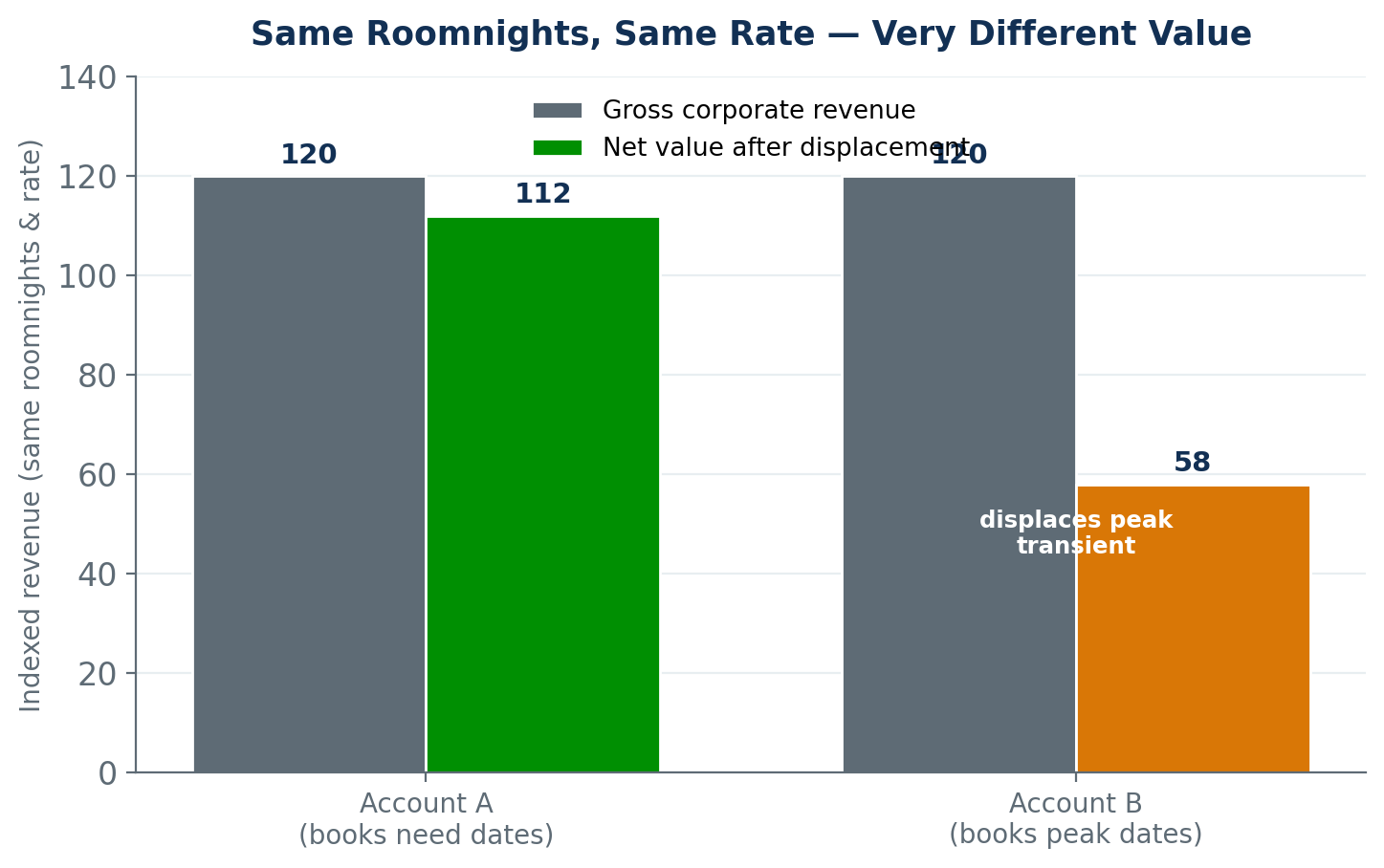
This is why RFP pricing is fundamentally a displacement analysis. Two accounts can look identical on the RFP — same roomnights, same requested rate — and be worth wildly different amounts to your hotel depending on when they book.
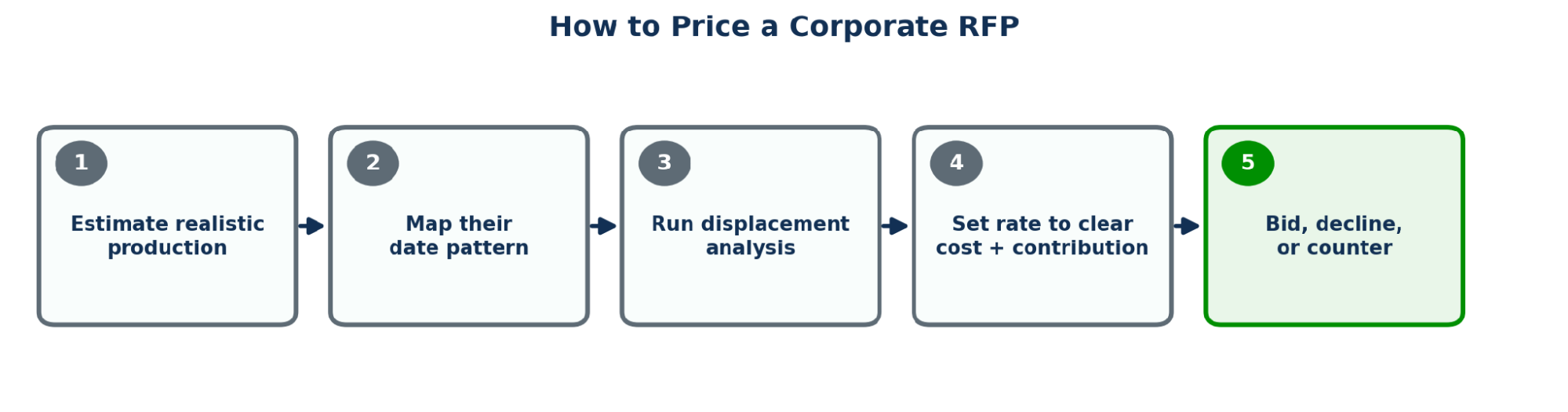
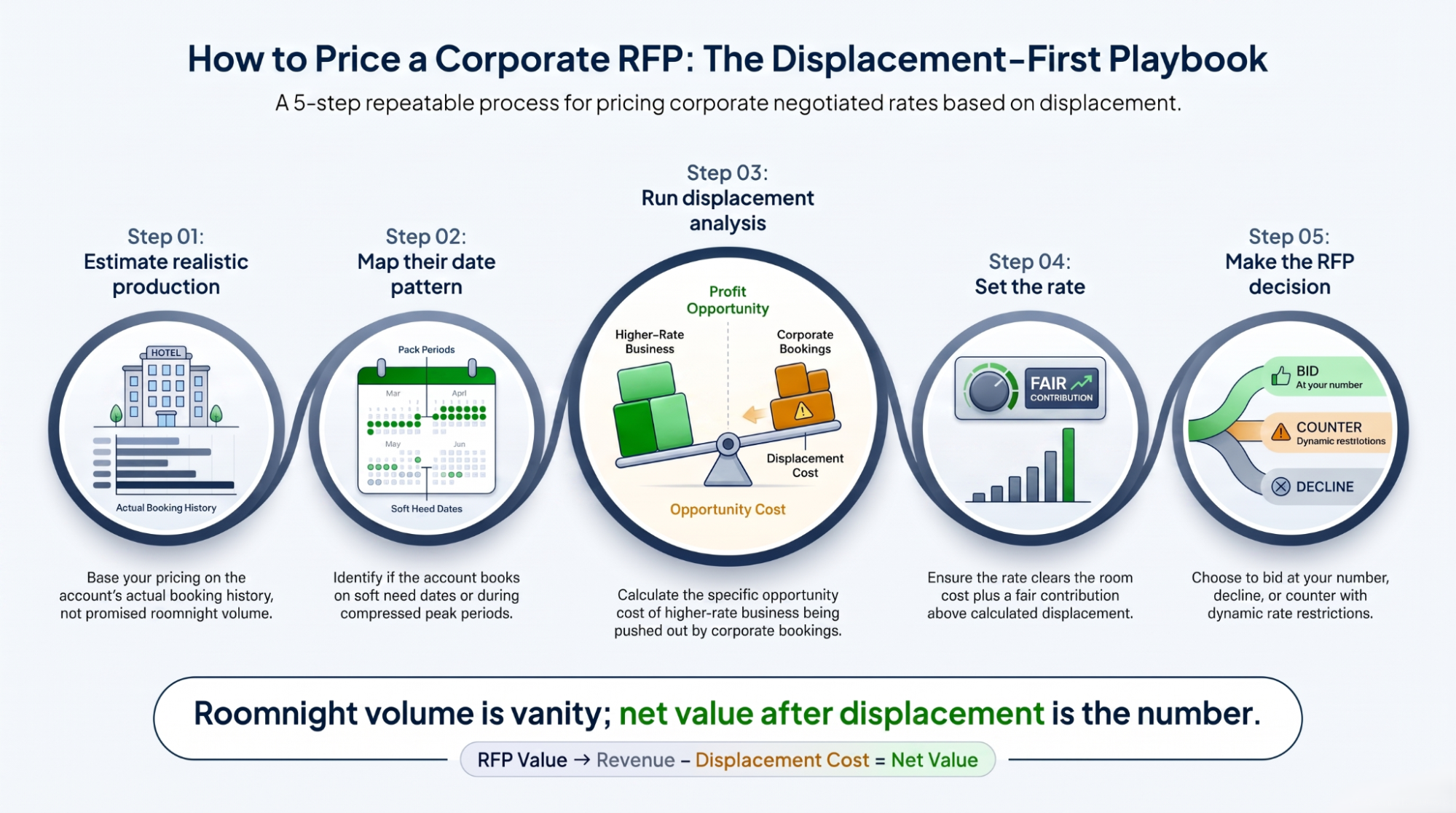
How to price a corporate RFP
Pricing an RFP is a five-step decision, and only the last step is about the rate. The work is understanding the account before you name a number.
- Estimate realistic production — use the account’s actual history, not the RFP’s promised roomnights.
- Map their date pattern — do they book your soft need dates or your compressed peaks?
- Run displacement analysis — what higher-rate business would those roomnights push out?
- Set the rate to clear cost plus a fair contribution above displacement — not just to ‘win’ the account.
- Decide: bid at your number, decline the account, or counter with a dynamic rate or date restrictions.
Dynamic vs static negotiated rates
How you structure the rate matters as much as the number. There are two main models, and the difference shows up most on your busiest dates.
| Static (fixed) rate | Dynamic (LRA / % off BAR) | |
|---|---|---|
| What it is | One flat rate all year | A percentage off BAR that moves with your rate |
| On peak dates | Locked low — you can’t recover | Rises with BAR — protects your rate |
| Last-room availability | Often unrestricted — risky | Can be capped / closed on peaks |
| Best for | Simple, predictable accounts | Compression-prone hotels & dates |
A static rate feels simpler, but it’s a bet that your peak dates won’t compress — and when they do, you’re locked into last year’s low rate on the nights you could have sold high. A dynamic rate that floats as a percentage off BAR, with last-room-availability controls on your best dates, keeps the account without surrendering your peaks.
Where RFP pricing goes wrong
1 · Bidding low to win volume
The point isn’t to win every account; it’s to win the profitable ones. A low rate that captures an account which displaces better business is a loss dressed up as a win.
2 · Pricing on promised, not actual, production
RFPs overstate roomnights routinely. Price on the account’s real history, and treat the promised volume as a ceiling, not a plan.
3 · Ignoring the date pattern
An account that books only your peaks is the most expensive business you can take. If you can’t restrict it to need dates, it should pay a rate that reflects the displacement — or get declined.
4 · Locking into static rates on compression dates
A fixed rate with no last-room-availability protection hands away your best nights. On compression-prone dates, dynamic rates and LRA controls aren’t optional.
How RevEvolve helps you price RFPs
RM Copilot is an operator-facing AI revenue copilot. During RFP season, its displacement modelling and What-If Simulator let you model a proposed corporate rate against an account’s realistic date pattern — showing the projected net value after displacement before you commit to a bid. It analyzes the account, simulates the impact, and recommends a rate or a counter with the reasoning attached. Then your team decides whether to bid, decline, or counter. It does not auto-submit rates or auto-accept accounts — you make every call.
RFP pricing: three objections
Price the RFP on value, not volume
RFP season rewards preparation and punishes autopilot. The hotels that come out ahead aren’t the ones that win the most accounts — they’re the ones that know which accounts to win. And that comes down to one question the RFP itself never asks: what does this account displace?
Audit your accounts before the flood, price on realistic production, run displacement on every date pattern, and structure the rate to protect your peaks. Roomnight volume is vanity; net value after displacement is the number that counts.
Keep going: Hotel displacement analysis · BAR & rate fences · GDS for hotels · RevPAR Index (RGI).