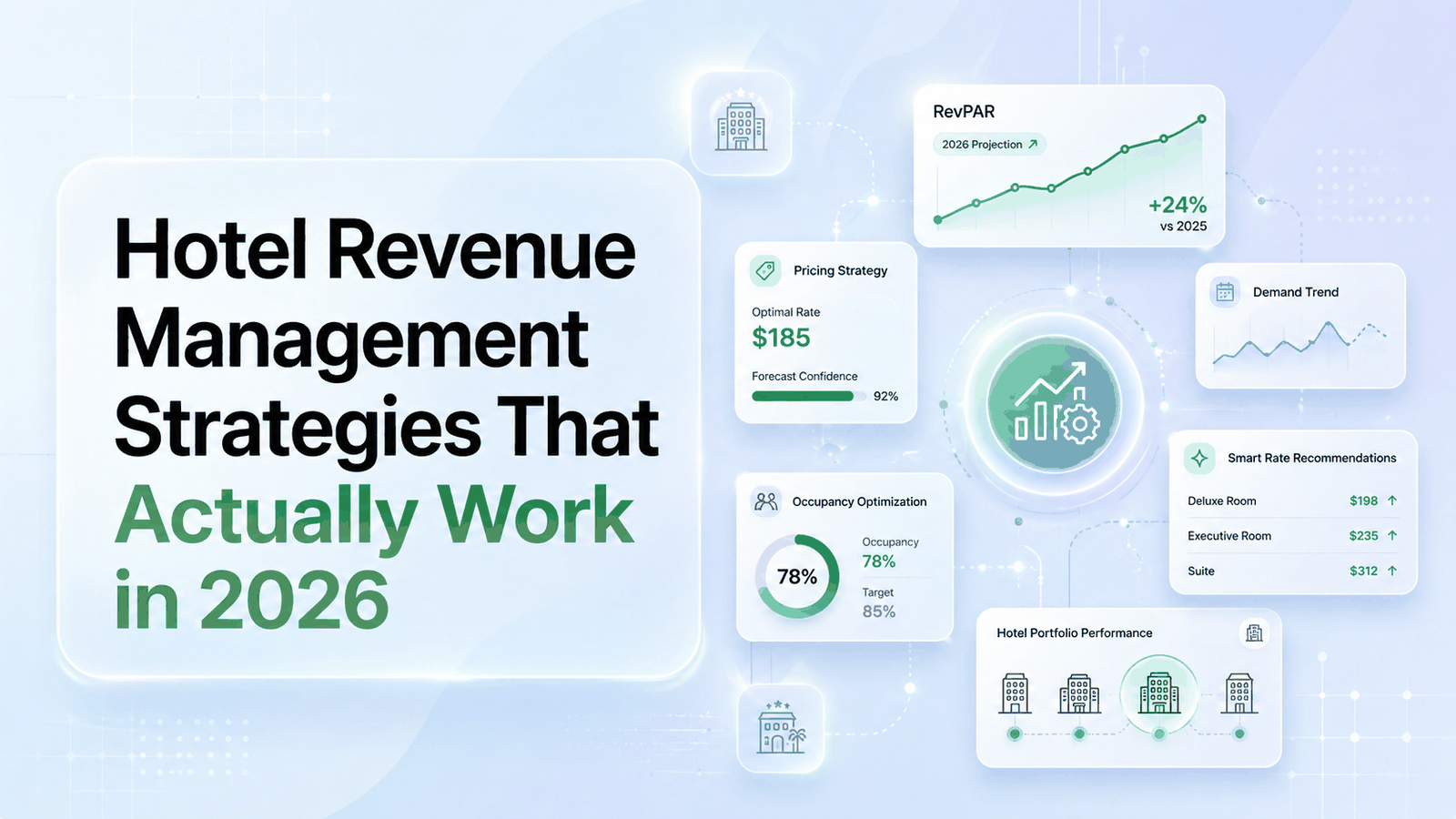
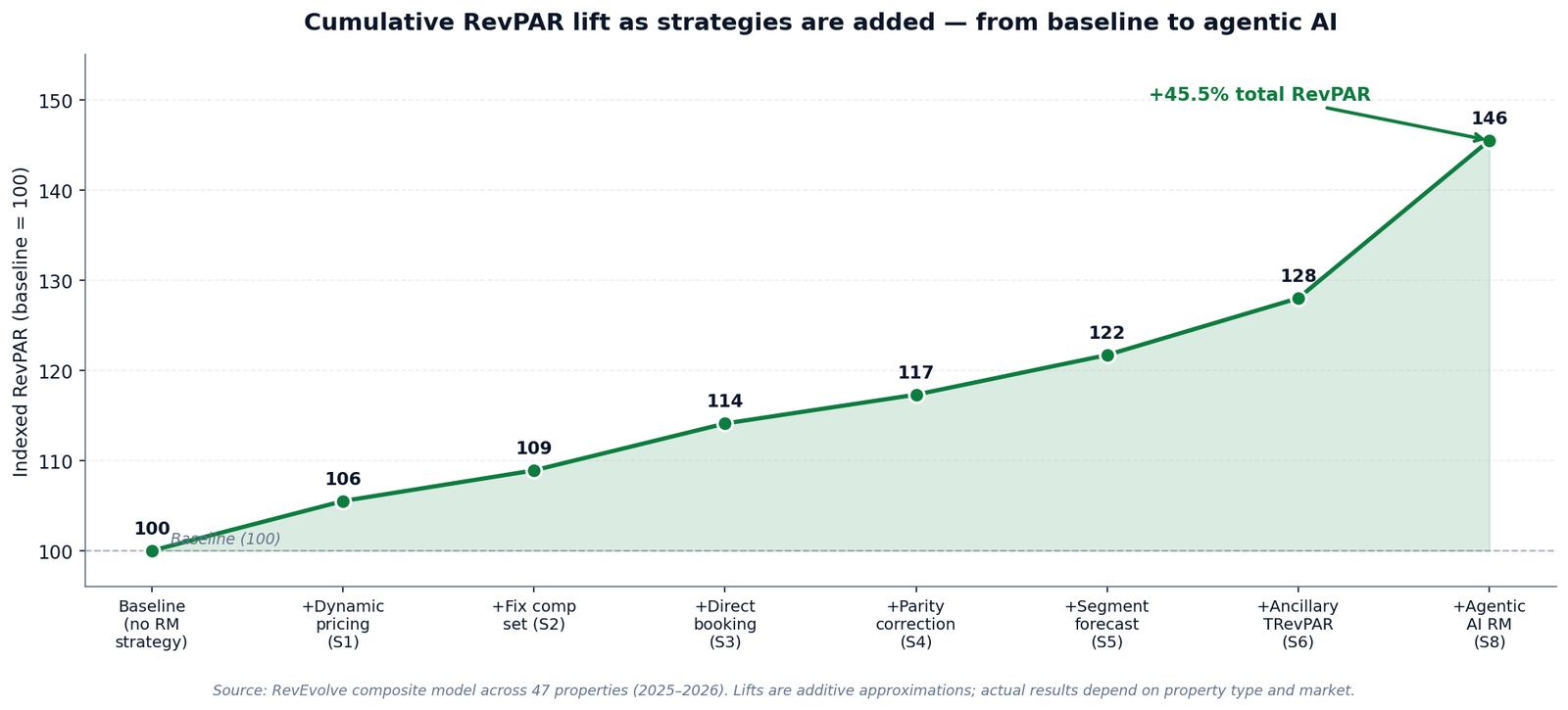
SNIPPET DEFINITION — The most effective hotel revenue management strategies in 2026 are: (1) dynamic pricing with Open Pricing logic, (2) quarterly comp set calibration, (3) structured direct-booking shift via closed-channel rates, (4) real-time rate parity correction, (5) booking-window segment forecasting, (6) TRevPAR-aware ancillary pricing, (7) GOPPAR-based owner reporting, and (8) agentic AI autonomous execution. Properties that implement all eight strategies compound a +45% RevPAR lift over baseline. Each strategy maps to a specific tool, a specific RevEvolve feature, and a quantified outcome.
Been managing revenue manually for 2 years now and hitting the limits of what I can do with spreadsheets. Booking pace tracking is manual, comp set rate shopping is manual, forecasting is basically educated guessing. Feel like I’m leaving money on the table by not having better tools for pricing decisions.
Key takeaways
- Over-discounting in shoulder season is the #1 source of recoverable RevPAR leakage (32%), followed by OTA commission on bookable-direct stays (24%).
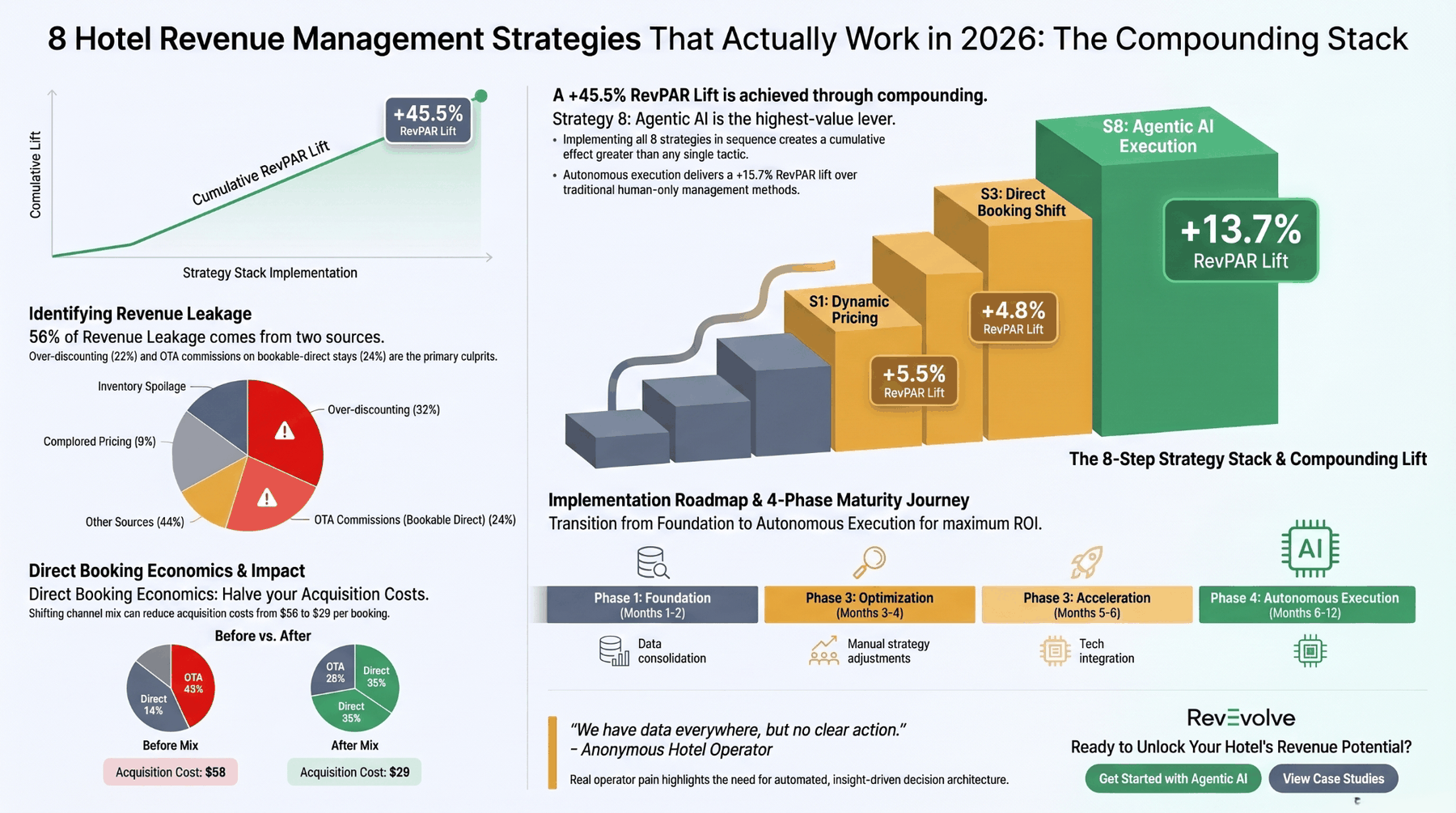
- A property implementing all 8 strategies compounds to +45.5% RevPAR vs a no-strategy baseline — not from luck, but from a structured sequence.
- The fastest ROI strategies are dynamic pricing (+5.5% RevPAR in first 90 days) and rate parity correction (+2.9% in first 30 days).
- The highest total-value strategy is agentic AI revenue management (+13.7% RevPAR vs human RM, per EMA Hospitality + Pacific RM benchmarks).
- Each of the 8 strategies maps to a specific RevEvolve feature, a specific implementation step, and a verified outcome range.
- The most common reason strategies fail: operators implement tactic without fixing the data foundation (comp set, forecasting, parity) underneath it.
→ Download the RevEvolve Revenue Management Strategy Playbook — all 8 strategies, tools, and outcome ranges in a printable 2-page PDF. Or request a live walkthrough.
Where Hotels Lose Recoverable Revenue in 2026
Before strategies, the diagnostic: most independent hotels are hemorrhaging recoverable RevPAR from six identifiable sources. The good news is that all six are operational — none of them require a market to improve, a competitor to disappear, or a renovation to complete. They are strategy gaps, and strategy gaps close when you close them.
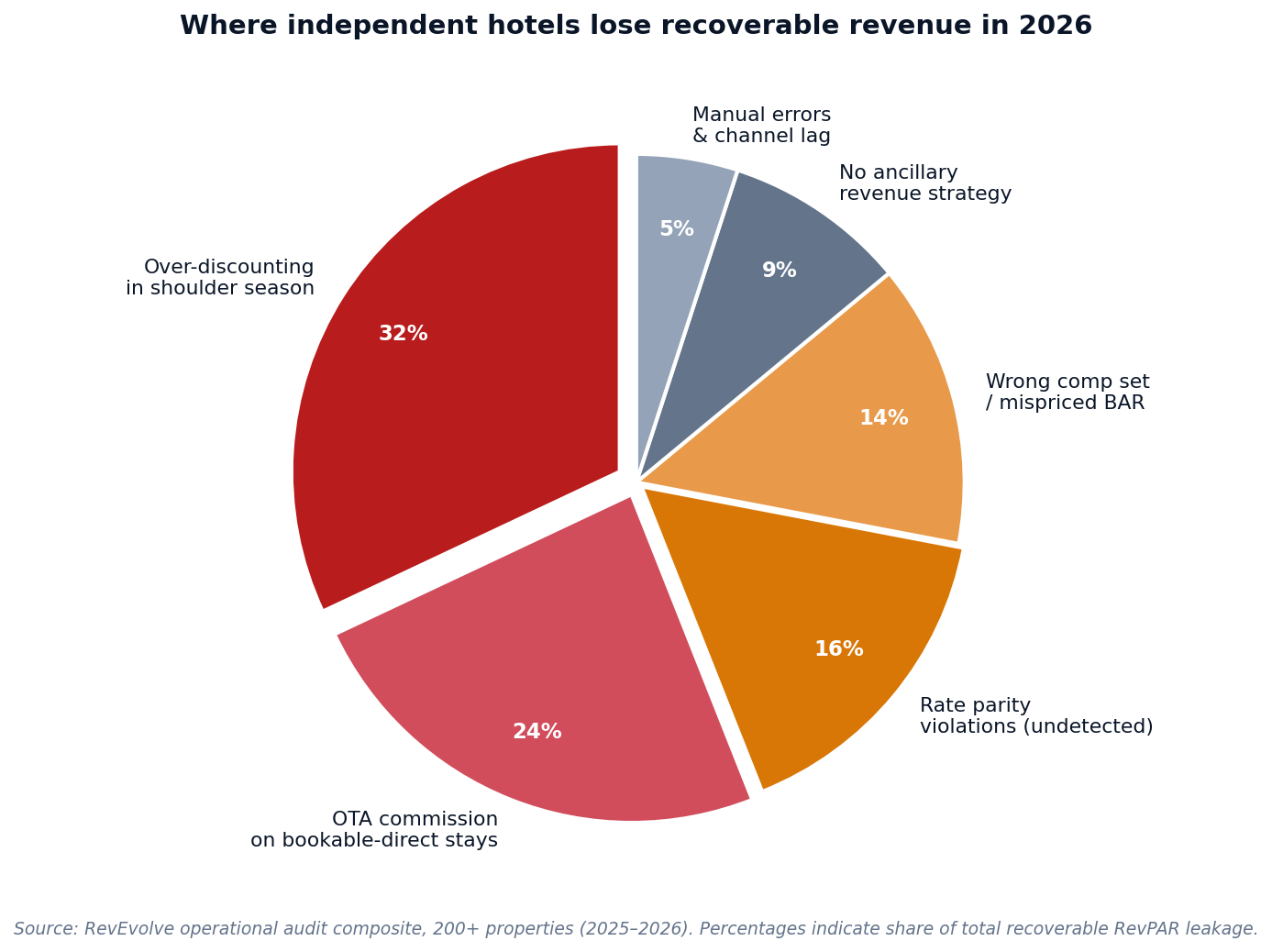
| Revenue leakage source | Share of leakage | Strategy that closes it |
|---|---|---|
| Over-discounting in shoulder season | 32% | Strategy 1 (dynamic pricing) |
| OTA commission on bookable-direct stays | 24% | Strategy 3 (direct booking shift) |
| Undetected rate parity violations | 16% | Strategy 4 (parity correction) |
| Wrong comp set / mispriced BAR | 14% | Strategy 2 (comp set calibration) |
| No ancillary revenue strategy | 9% | Strategy 6 (TRevPAR-aware pricing) |
| Manual errors + channel lag | 5% | Strategy 5 + Strategy 8 (AI) |
The operator who is losing most: the independent or boutique property running spreadsheet-based revenue management, 40%+ OTA mix, and no real-time rate monitoring. In 2026 that is still the majority of independent properties globally.
Been doing revenue management for 5 years and the reporting situation is getting worse not better. I pull data from PMS for occupancy, channel manager for OTA performance, Google Analytics for direct, 3 different rate shoppers, Excel for everything else. By the time I compile everything half the day is gone.
The 8 Strategies — Impact and Sequence
Eight strategies, each with a quantified RevPAR and GOPPAR lift, a RevEvolve feature it maps to, and an implementation complexity rating (1 = straightforward, 5 = requires sustained commitment).
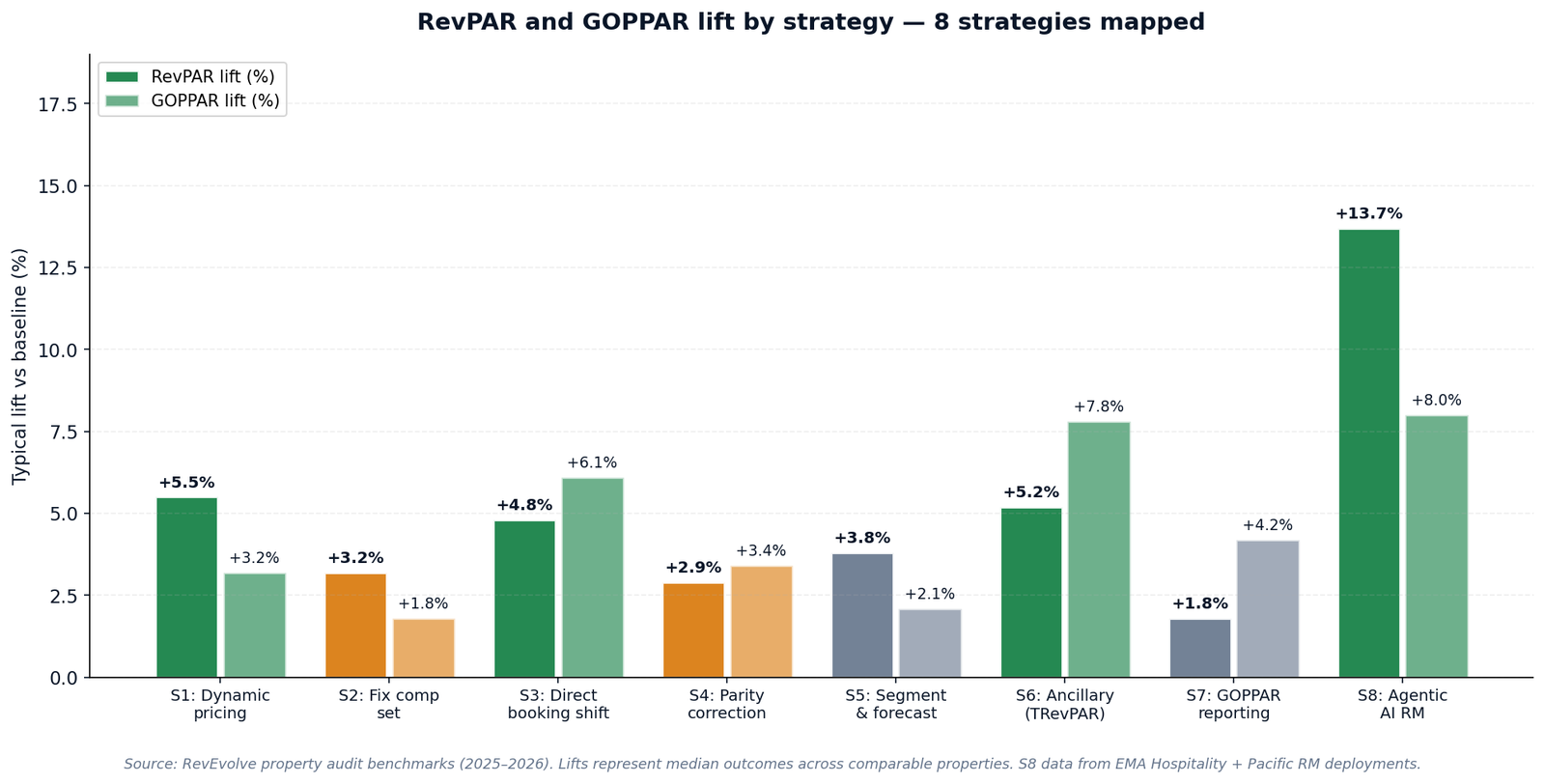
| # | Strategy | RevPAR lift | GOPPAR lift | Complexity |
|---|---|---|---|---|
| S1 | Dynamic pricing (Open Pricing) | +5.5% | +3.2% | 2/5 |
| S2 | Comp set calibration (quarterly) | +3.2% | +1.8% | 1.5/5 |
| S3 | Direct booking channel shift | +4.8% | +6.1% | 3/5 |
| S4 | Real-time rate parity correction | +2.9% | +3.4% | 2/5 |
| S5 | Booking-window segment forecasting | +3.8% | +2.1% | 2.5/5 |
| S6 | TRevPAR-aware ancillary pricing | +5.2% | +7.8% | 3.5/5 |
| S7 | GOPPAR-based owner reporting | +1.8% | +4.2% | 1/5 |
| S8 | Agentic AI autonomous execution | +13.7% | +8.0% | 4/5 |
Strategy 1 — Replace Static Rates with Dynamic Pricing (Open Pricing)
What it is: Dynamic pricing moves your BAR in real time based on demand signals, booking pace, competitor rates, and event data — instead of setting rates once a week (or once a season) and holding them. Open Pricing is the advanced form: every rate type (BAR, member, corporate, package) floats independently rather than moving in a locked ladder.
Why it recovers 32% of leakage: Over-discounting in shoulder season is the largest single source of recoverable RevPAR. Dynamic pricing replaces the human instinct to "fill rooms" at suboptimal rates with an algorithm calibrated on actual demand signals — including competitor pickup patterns and your own pace vs plan.
What it requires: a rate-shopping tool integrated with your channel manager, a defined BAR ladder, and either a daily RM review (minimum) or an agentic AI system (preferred). Without it, you will always over-discount in soft periods and under-price in demand spikes.
Strategy 2 — Fix Your Comp Set and Review It Quarterly
Need competitive pricing data but tools like STR and other comp set analyzers are insanely expensive for a small property group. We’re talking thousands per month when our total tech budget is maybe $3k. Currently just manually checking competitor websites which is time consuming and doesn’t give historical trends or proper analytics.
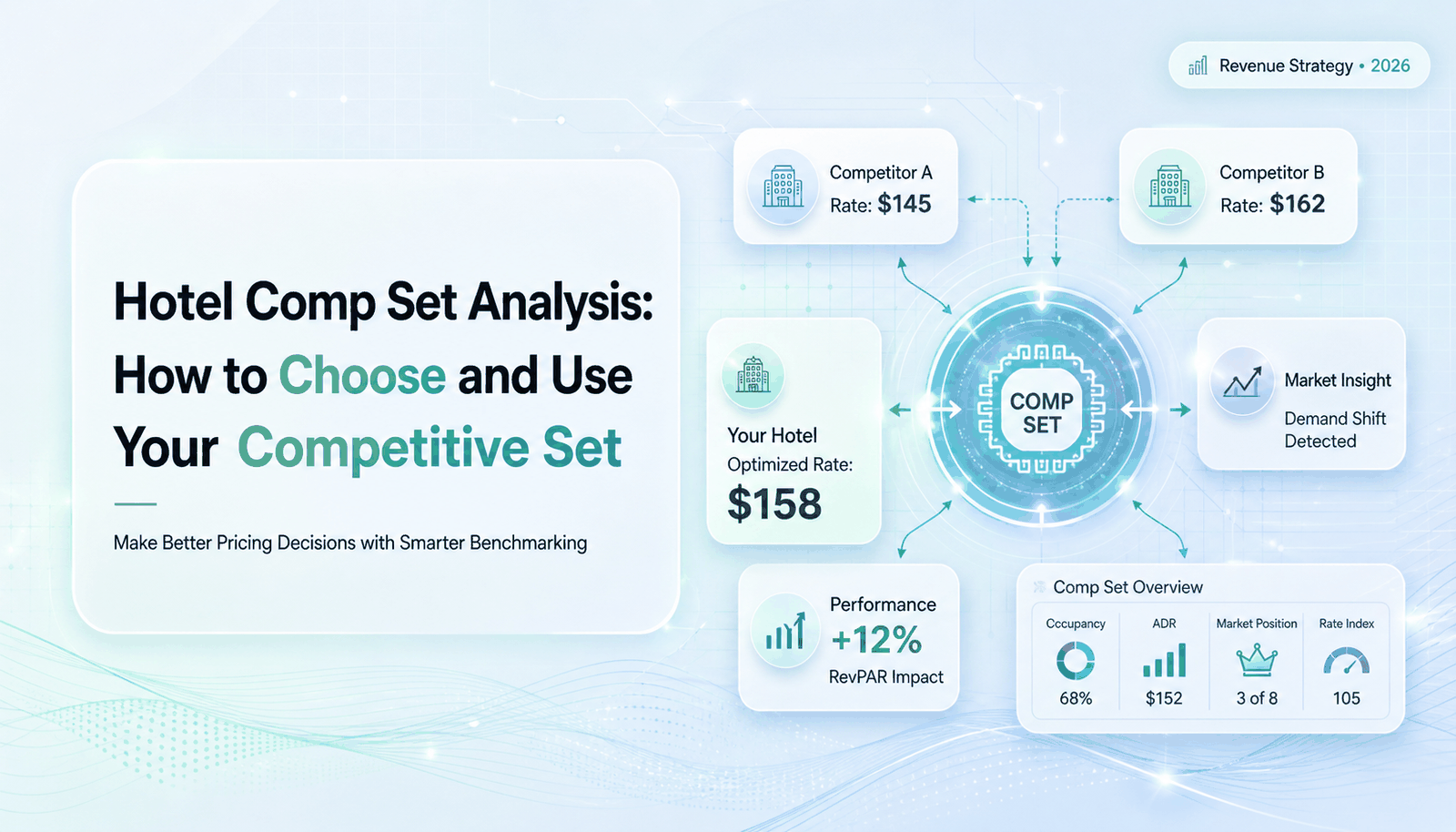
What it is: Ensuring the 5–7 hotels your RMS compares you against are the hotels guests actually substitute with — not the hotels your GM likes to think you’re competing with. Then reviewing that set every quarter as the market evolves.
Why it recovers 14% of leakage: A wrong comp set produces a wrong competitive signal, which produces a mispriced BAR — typically 5–9% below what the market supports. Hotels with ego-picked comp sets (aspirationals above their rate band) are systematically over-pricing and losing occupancy. Hotels with stale comp sets (12+ months unreviewed) are pricing against hotels that may have repositioned, closed, or dropped ADR.
See the dedicated comp set guide for the full 7-step selection process. The minimum: hold your primary comp set within ±25% ADR band and put a quarterly review on the calendar.
Strategy 3 — Shift 15–20 Percentage Points from OTA to Direct
If you book on Expedia, I have to pay them a percentage. This eats into my profits. If the guest calls Expedia or Booking.com and complains, they call us and say ‘can you do anything to make the guest happy?’ and we have to move them or give them a credit — because if we don’t they will deprioritize us in search results.
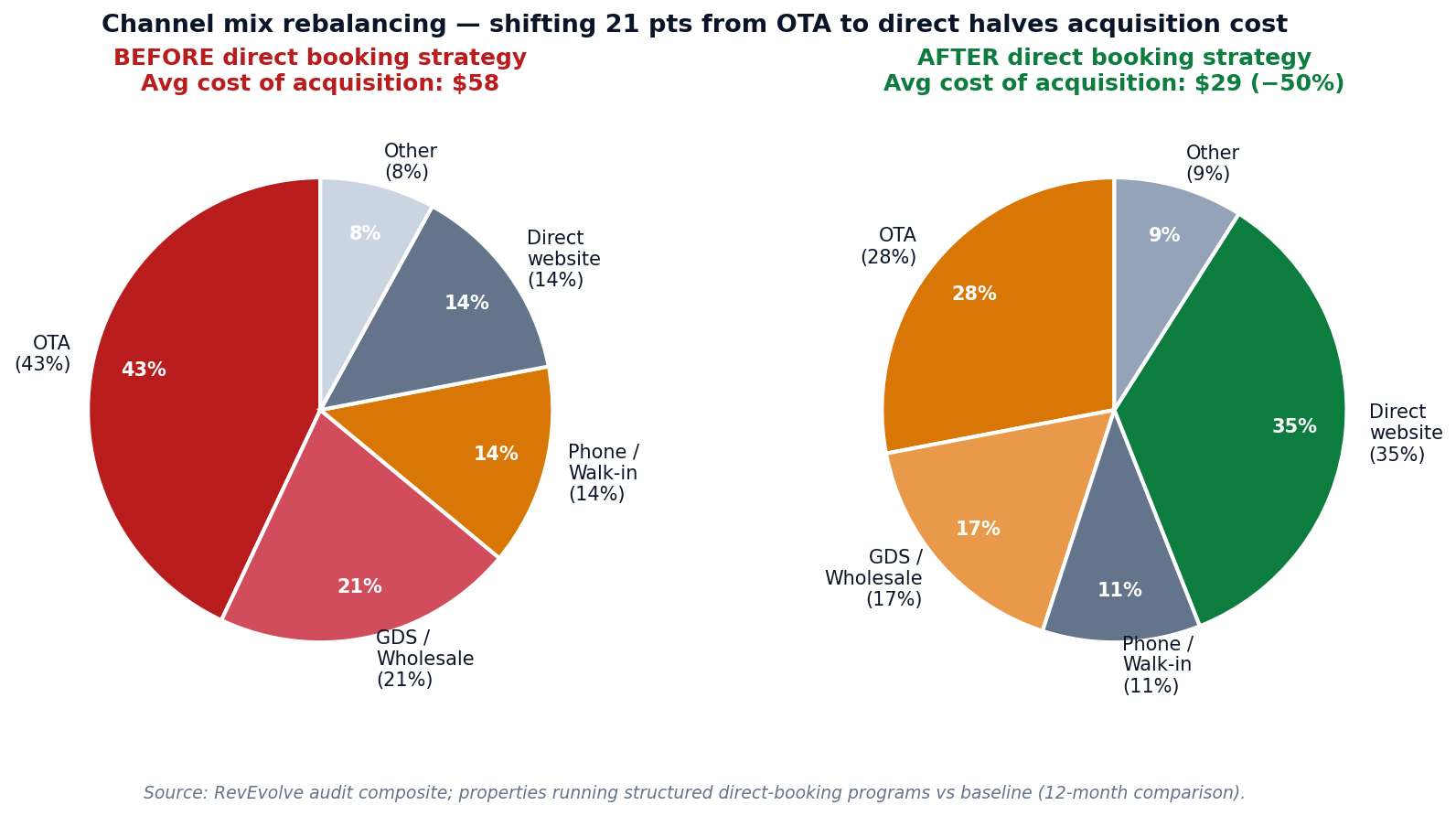
What it is: A structured program that shifts room revenue from OTA channels (18–25% commission) to your direct website (0–8% cost). The mechanism is closed-channel rates: member-only rates, mobile-app rates, package bundles, and corporate codes that OTA contracts legally cannot require you to match.
Why it recovers 24% of leakage and produces the highest GOPPAR lift: Every booking that moves from OTA to direct saves 10–17 percentage points of commission. On a 100-room hotel running 60% occupancy at $150 ADR, shifting 15 percentage points of bookings from OTA to direct saves ~$49,000 in annual commission — without changing a single rate.
Strategy 4 — Correct Rate Parity Violations at Source, Not Just Monitor Them
I handle pricing for a small independent hotel and lately I’ve noticed guests saying they found cheaper rates for our rooms on Booking/Expedia compared to our own website. I check manually sometimes, but it’s super time-consuming, and I’m worried I’m missing undercut rates. How do you all keep tabs on this without spending half the day refreshing OTA pages?
What it is: Moving from reactive parity monitoring (catching violations 4–24 hours after they appear) to autonomous correction (AI identifies the source of the violation, determines whether it’s auto-correctable, and acts within minutes).
Why monitoring alone isn’t enough: 78% of parity violations come from sources outside the hotel’s direct control (wholesaler leakage 28%, OTA-funded discounting 22%, metasearch opaque rates 16%). Detecting them is necessary but not sufficient — acting on them before they affect booking decisions is the value. See the full rate parity guide.
A parity violation that goes uncorrected for 48 hours drops direct booking conversion by ~38%, increases OTA share by ~15 percentage points, and triggers OTA ranking demotion risk. A daily rate-shopping tool catches it in 4 hours. Agentic AI catches it in 4 minutes and fixes it without a human.
Strategy 5 — Segment Demand by Booking Window, Not Just Total Occupancy
What it is: Building a demand forecast that segments by booking window (0–7 days, 8–30 days, 31–60 days, 61–180 days) AND by segment (corporate, leisure, group, government) — not just total occupancy vs prior year.
Why segment-window forecasting outperforms total-occupancy forecasting: Corporate demand books 7–14 days out; leisure books 30–60 days out; group blocks 90–180 days out. A hotel seeing "60% occupancy on pace" in early August doesn’t know if that’s corporate short-booking (last-minute, price-insensitive) or leisure early-booking (price-sensitive, should have been filled at discount). The right pricing decision is opposite in each case.
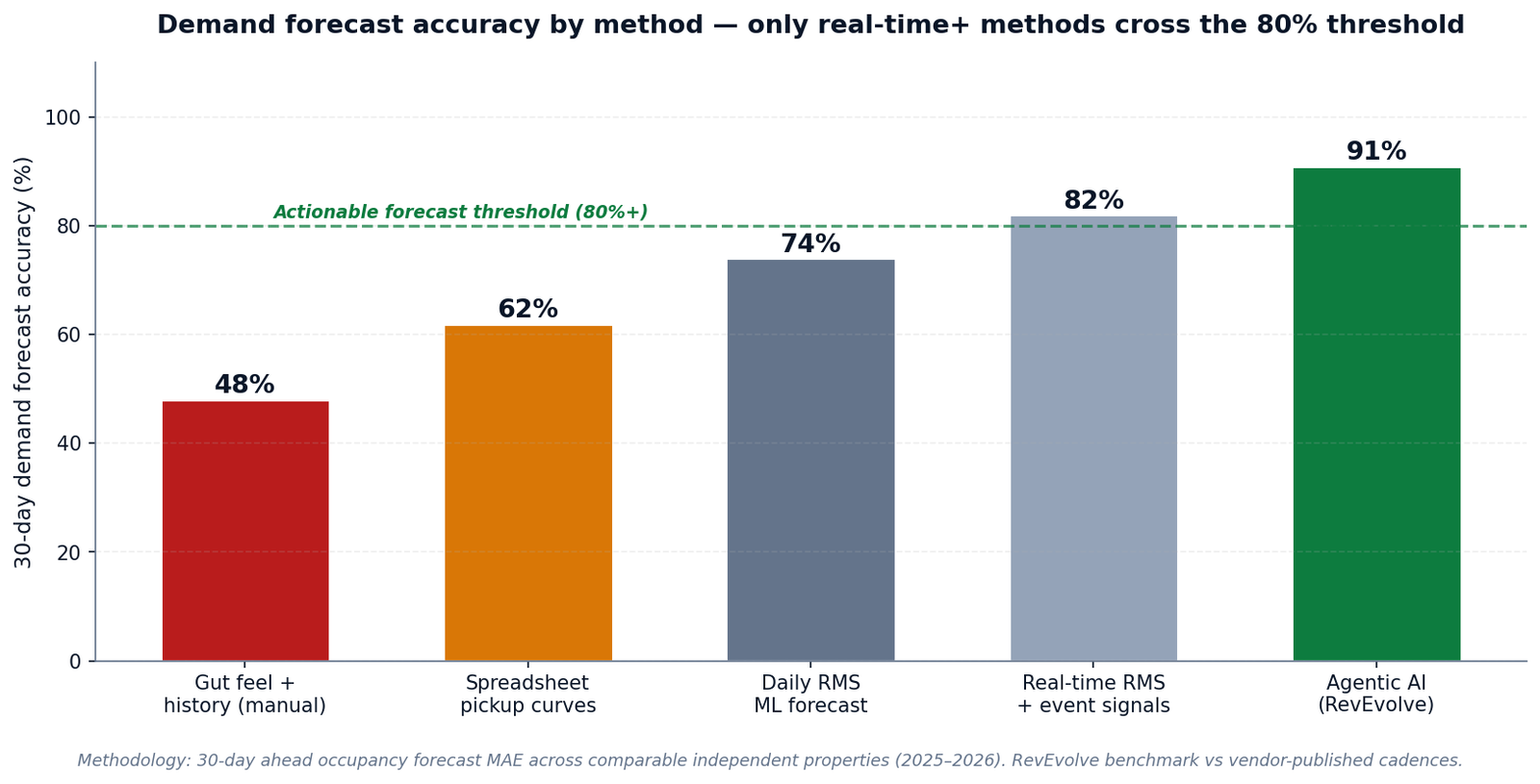
Manual forecasting accuracy for 30-day occupancy sits at ~48% (gut + history) to ~62% (spreadsheet pickup curves). Real-time RMS cross-referenced with event data reaches ~82%. Agentic AI reaches ~91%.
Strategy 6 — Price Ancillary Revenue as a Strategy, Not an Afterthought (TRevPAR)
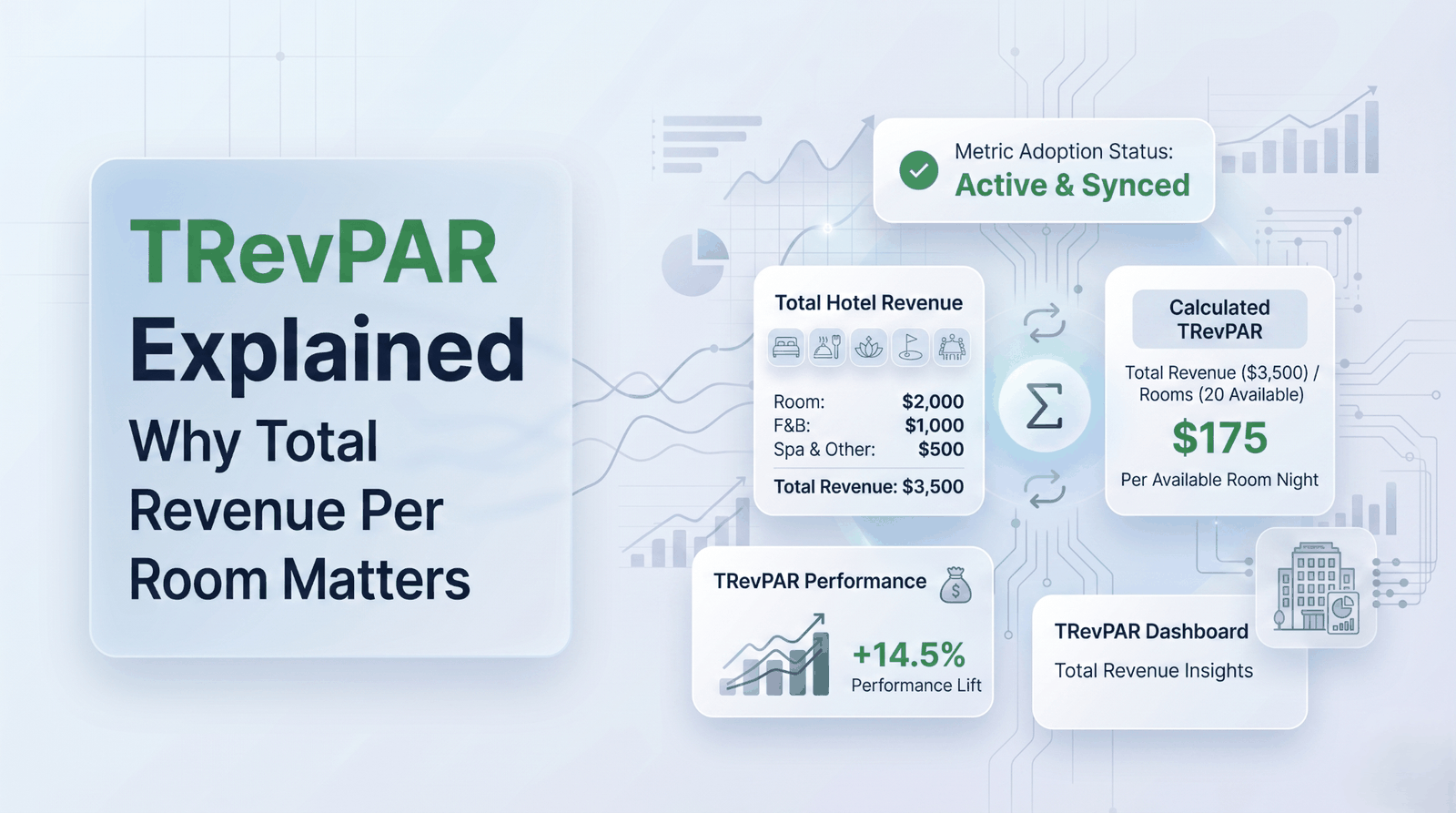
What it is: Treating F&B, spa, parking, resort fees, and package pricing as active revenue management decisions — not set-and-forget P&L lines. This means pricing ancillary products dynamically, building them into length-of-stay and segment strategies, and reporting TRevPAR alongside RevPAR in every owner conversation.
Why it delivers the highest GOPPAR lift (+7.8%) of any single strategy: Most ancillary revenue streams carry higher contribution margins than rooms (F&B: typically 60–75% gross margin; spa: 65–80%). Every dollar shifted from rooms revenue to ancillary revenue typically improves GOPPAR more than the same dollar of room revenue growth.
The operator implication: for any property where the TRevPAR-to-RevPAR ratio exceeds 1.4×, RevPAR-only revenue management is systematically leaving the highest-margin revenue on the table. A full-service resort running at 2.0× ratio that optimizes room rates but never touches F&B or spa pricing is managing half the property.
Strategy 7 — Replace RevPAR-Only Owner Reporting with GOPPAR
What it is: Switching your monthly owner reporting from RevPAR as the headline metric to GOPPAR (Gross Operating Profit Per Available Room) as the headline, with RevPAR as the supporting context. This single change forces every other decision in the stack to be justified on profitability, not just revenue.
Why it changes behaviour, not just vocabulary: When revenue managers are evaluated on RevPAR, they optimize for RevPAR. When they’re evaluated on GOPPAR, they optimize for profit per available room — which means they stop recommending discounts that fill rooms at below-break-even ADR, they start caring about OTA commission as a cost, and they start advocating for direct booking investment as a margin lever.
The GOPPAR reporting framework is simple: pull Gross Operating Profit from the USALI P&L (below departmental and undistributed expenses, above fixed charges). Divide by available rooms. Report alongside RevPAR and TRevPAR in a single 3-metric owner dashboard.
Strategy 8 — Move to Agentic AI Autonomous Revenue Management
What it is: Deploying an AI system that makes autonomous pricing, distribution, and parity decisions within operator-set guardrails — rather than recommending decisions for humans to execute. This is Tier 4 of the hotel pricing maturity model: ~86,400 pricing decisions per property per day, continuous parity monitoring and correction, autonomous response to competitor moves and demand events.
Why the lift is the largest of all 8 strategies: The gap between human RM and agentic AI is not intelligence — it’s velocity and granularity. A human revenue manager making 12–480 pricing decisions per day collapses micro-segment pricing into averages. Agentic AI making 86,400 decisions per day can price Tuesday’s last 3 deluxe rooms differently from Monday’s last 3 standard rooms at 2am during a demand spike when the human RM is asleep.
EMA Hospitality, 47 properties: +13.7% RevPAR in 10 days vs human RM baseline. 50% reduction in RGI variance across the portfolio. 18 hours per RM per week saved on manual pricing tasks. 6-month payback period.
The implementation path matters: most properties do not move directly to agentic AI. The typical sequence is spreadsheet → daily RMS → real-time RMS → agentic AI, with each tier delivering incremental lift and building the data and trust infrastructure for the next. RevEvolve RM Copilot is designed for the last jump — from Tier 3 (modern RM) to Tier 4 (agentic AI).
The Right Sequence — Don’t Start With Strategy 8
The most common implementation mistake: operators hear the +13.7% RevPAR figure from Strategy 8 and try to jump directly to agentic AI without the data foundation underneath it. Agentic AI is only as good as the comp set it benchmarks against, the rate parity it monitors, and the channel strategy it optimizes within. Build the foundation first.
| Phase | Timeline | Strategies | Expected cumulative RevPAR |
|---|---|---|---|
| Foundation | Month 1–2 | S2 (comp set) + S4 (parity) + S7 (GOPPAR reporting) | +5–8% |
| Activation | Month 2–4 | S1 (dynamic pricing) + S5 (segment forecast) | +10–15% |
| Channel optimization | Month 4–6 | S3 (direct booking) + S6 (TRevPAR ancillary) | +18–25% |
| Autonomous execution | Month 6–12 | S8 (agentic AI — all strategies under one architecture) | +30–45%+ |
RevEvolve RM Copilot is not a vendor swap from one RMS to another. It is a different decision architecture. Hotels that implement it as a feature upgrade miss the operating-model change. Hotels that implement it as a maturity-tier jump — after fixing comp set, parity, and channel strategy underneath it — see the +13.7% RevPAR outcome.
The 5 Most Expensive Implementation Mistakes
Mistake 1 — Implementing dynamic pricing without fixing the comp set first
Dynamic pricing optimizes relative to your comp set. If the comp set is wrong, dynamic pricing optimizes relative to the wrong benchmark. The RMS produces correct outputs given incorrect inputs — and the revenue manager blames the RMS.
Mistake 2 — Monitoring rate parity but not correcting it at source
A daily rate-shopping tool that shows you a violation 4 hours after it appeared is valuable. A tool that shows it but leaves correction to a manual escalation chain during business hours means the damage happens overnight, on weekends, and during peak demand windows when markets move fastest.
Mistake 3 — Running a direct booking program without building the member rate structure
A hotel that asks guests to book direct but offers the same rate as Booking.com will see no channel shift. Guests book where they have loyalty points or guaranteed best price — which is usually the OTA. The member rate is the incentive. Build it before the marketing campaign.
Mistake 4 — Reporting RevPAR to owners without GOPPAR context
A month where RevPAR grew 3% but OTA commission also grew (because direct booking share fell) can show RevPAR improvement alongside GOPPAR decline. Reporting RevPAR alone gives the owner a false positive. When GOPPAR declines and RevPAR doesn’t, the first question ownership asks is: why did you think we were winning?
Mistake 5 — Treating agentic AI as a Tier 2 RMS upgrade
Properties that deploy agentic AI expecting it to "just automate what my RM does" are disappointed. Agentic AI is a tier jump in decision architecture, not a feature upgrade in decision support. The operating model change — revenue manager as strategist, AI as tactician — requires owner alignment, clear guardrails, and a transition period.
Conclusion — Build the Stack, in Order
The 8 strategies in this guide are not independent tactics. They are a compounding stack: each one makes the next one more effective, and each one closes a specific, quantifiable leak in your RevPAR. Start with the foundation (comp set, parity, GOPPAR reporting). Activate rate strategy (dynamic pricing, segment forecasting). Optimize channels (direct booking, ancillary TRevPAR). Then add autonomous execution on top of a solid base.
The hotels compounding advantage in 2026–2030 are not the ones with the highest-end RMS. They are the ones who closed all six leakage sources, in the right sequence, and built an operating model where the AI executes and the revenue manager leads strategy. The +45.5% RevPAR outcome is the result of the stack, not of any single technology purchase.
You’re right that spreadsheets hit a wall fast once seasonality and demand swings get extreme. The biggest enterprise systems are usually overkill for an 80-room seasonal resort — but the gap between doing nothing and doing something is enormous.
Stop losing recoverable RevPAR to the same 6 leaks in 2026.
- → Download the RevEvolve Strategy Playbook PDF — all 8 strategies, tools, outcomes, and implementation sequence in a printable 2-page format.
- → Request a demo of RevEvolve — see all 8 strategies running as one autonomous stack across a real portfolio. 15-minute walkthrough.