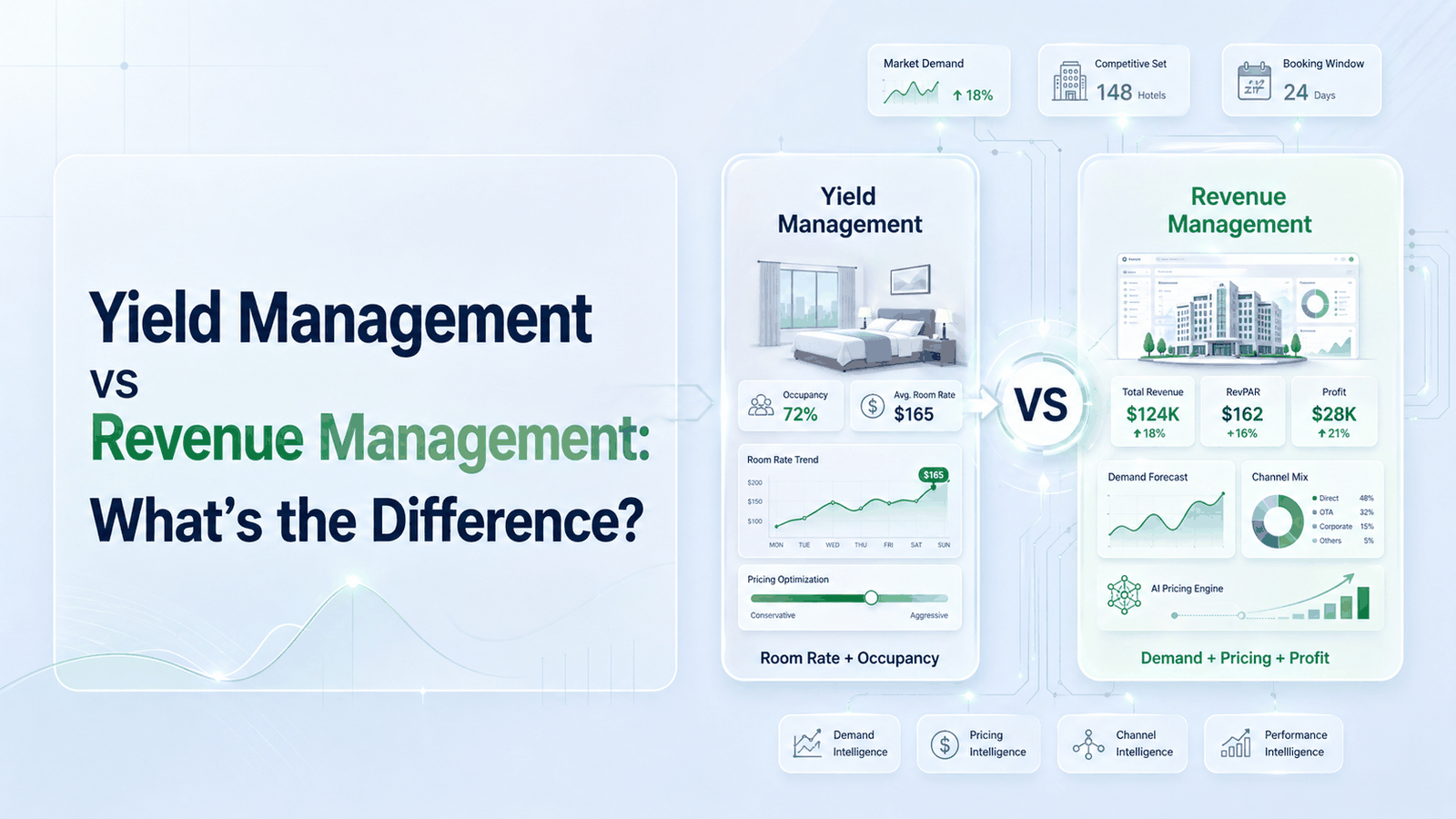
SNIPPET DEFINITION — Yield management is a 1980s pricing discipline — borrowed from the airline industry — focused on selling the right room to the right guest at the right price by managing inventory and rate as a "sell or hold" decision. Revenue management is the modern evolution that subsumes yield management and adds channel mix, segment mix, ancillary revenue, distribution strategy, and forecasting across all revenue streams. Yield management is what hotels did in the 1990s. Revenue management is what hotels actually do today. In 2026, the leading edge is agentic AI revenue management — autonomous pricing, distribution, and parity decisions executed by AI within operator-set guardrails.
Key takeaways
- Yield management asks one question: "Should I sell this room or hold it for a higher rate?" Revenue management asks five: rate, channel, segment, inventory, and ancillary.
- Yield management originated at American Airlines in the 1980s post-deregulation. Revenue management emerged at Marriott in the late 1990s as the airline framework was extended to hotels.
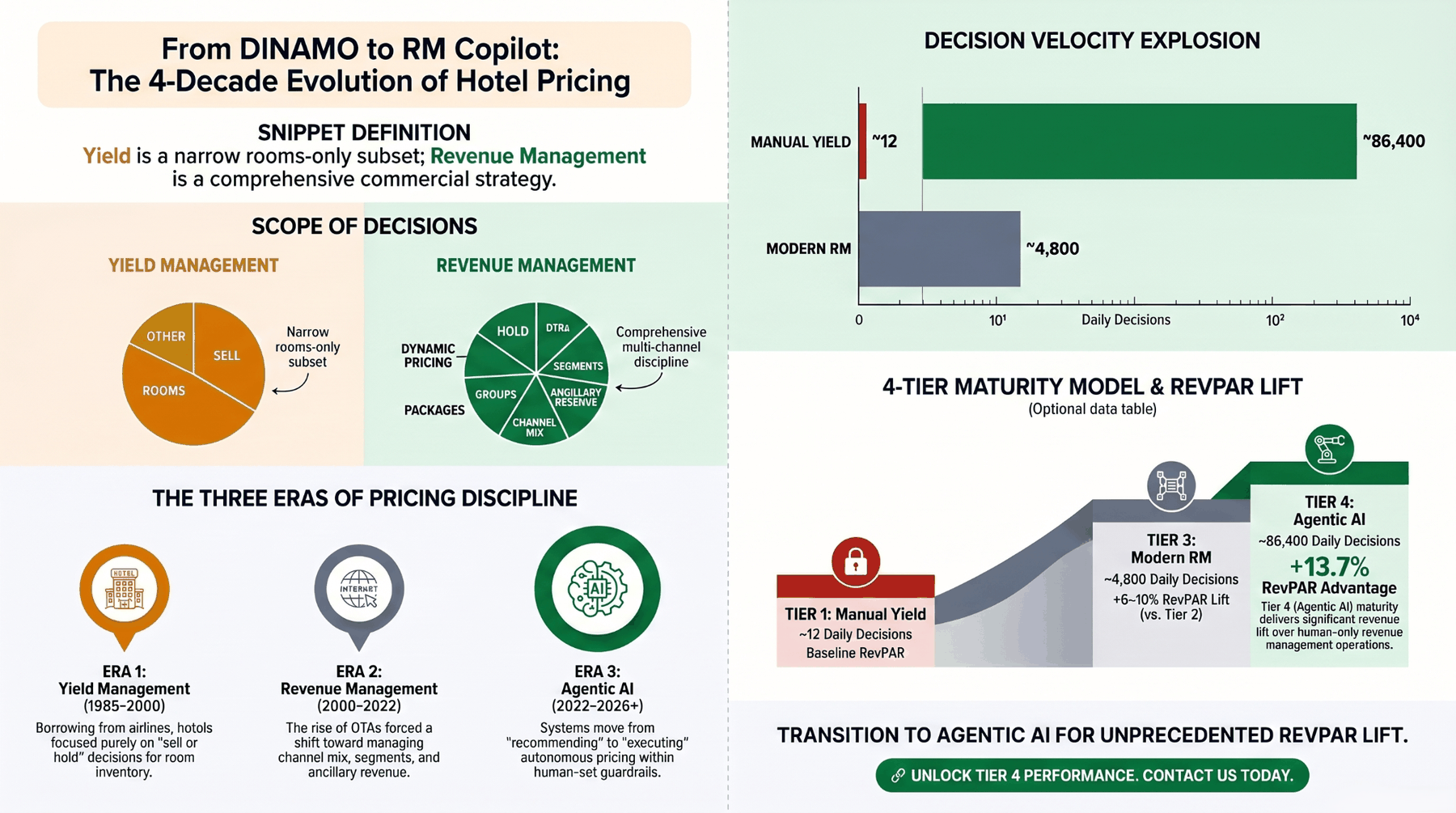
- Yield management decisions number ~12 per property per day (manual). Modern real-time RMS makes ~4,800 per day. Agentic AI revenue management makes ~86,400 per day — a 7,200× increase over yield management.
- Revenue management’s primary metrics are RevPAR, TRevPAR, and GOPPAR. Yield management’s primary metric was "yield" (revenue per available unit) — a forerunner of RevPAR.
- Most hotels saying "we do yield management" in 2026 are actually doing 1990s-style revenue management with old vocabulary. The discipline has moved on; the term hasn’t, in some markets.
- The 4-tier hotel pricing maturity model: Tier 1 (manual yield) → Tier 2 (classical RM, daily ML) → Tier 3 (modern RM, real-time multi-channel) → Tier 4 (agentic AI RM, autonomous). Each tier compounds 3–10% RevPAR lift over the prior.
→ Request a Demo of RevEvolve’s Dynamic Pricing — see Tier 4 agentic AI revenue management running on a portfolio in real time. 15-minute walkthrough at revevolve.ai/request-a-demo/.
What Is Yield Management?
Yield management is a pricing discipline that originated in the U.S. airline industry in the 1980s following deregulation, and was adopted by hotels through the 1990s. It is fundamentally a sell-or-hold discipline applied to perishable inventory: a hotel room (like an airline seat) generates zero revenue if it isn’t sold by check-in time, so the operational question is whether to sell each unit now at a given rate, or hold it for a higher-rate booking that may or may not arrive.
The classical yield management decision is a probability problem. Given:
- Current booking pace
- Historical pickup curves for similar dates
- Days-to-arrival
- Current rate vs. expected demand price elasticity
… what is the probability that holding this room produces a higher final rate than selling it now? If high, hold. If low, sell. The discipline scaled from airlines to hotels because both businesses share the underlying mechanics: fixed perishable inventory, demand variability, time-to-event optimization.
Yield management’s primary metric was "yield" — revenue per available unit. For airlines, this was revenue per available seat-mile (RASM). For hotels, the equivalent emerged as RevPAR — Revenue per Available Room — which initially was just the hotel-industry name for the yield concept, and later became the foundational metric for the broader revenue management discipline that grew out of yield management.
The real-world definition that matters: Yield management is one tool in the revenue management toolbox. It’s the inventory + rate management piece. Calling all of revenue management "yield management" today is like calling all of medicine "internal medicine" — technically a category, but not the whole discipline.
What Is Revenue Management?
Revenue management is the modern hospitality discipline that subsumes yield management and extends the pricing question across the property’s entire commercial surface. Where yield management asks one question (sell or hold rooms?), revenue management asks five:
- Rate — what price should we charge across each rate type, segment, and channel?
- Channel — which booking channels should receive which rates and inventory access?
- Segment — which guest segments (corporate, leisure, group, government) should we lean into and which should we constrain?
- Inventory — how should we allocate room inventory across channels, length-of-stay restrictions, and rate fences?
- Ancillary — how do we price F&B, spa, parking, fees, and packages to maximize total per-room revenue (TRevPAR)?
Revenue management’s primary metrics are RevPAR, TRevPAR, and GOPPAR — top-line, total-revenue, and operating-profit per available room respectively.
The discipline emerged at Marriott in the late 1990s as the airline yield management framework was extended to hotels and refined for the longer booking windows, multi-segment guest mixes, and ancillary revenue streams characteristic of the hotel business. By 2010, it was the standard operating discipline at branded full-service properties globally; by 2020, at most independent properties of 50+ rooms; by 2026, the leading edge had moved to agentic AI revenue management — autonomous pricing executed within operator-set guardrails.
Yield Management vs Revenue Management — Side-by-Side
This is the comparison most operators arrive at this article looking for:
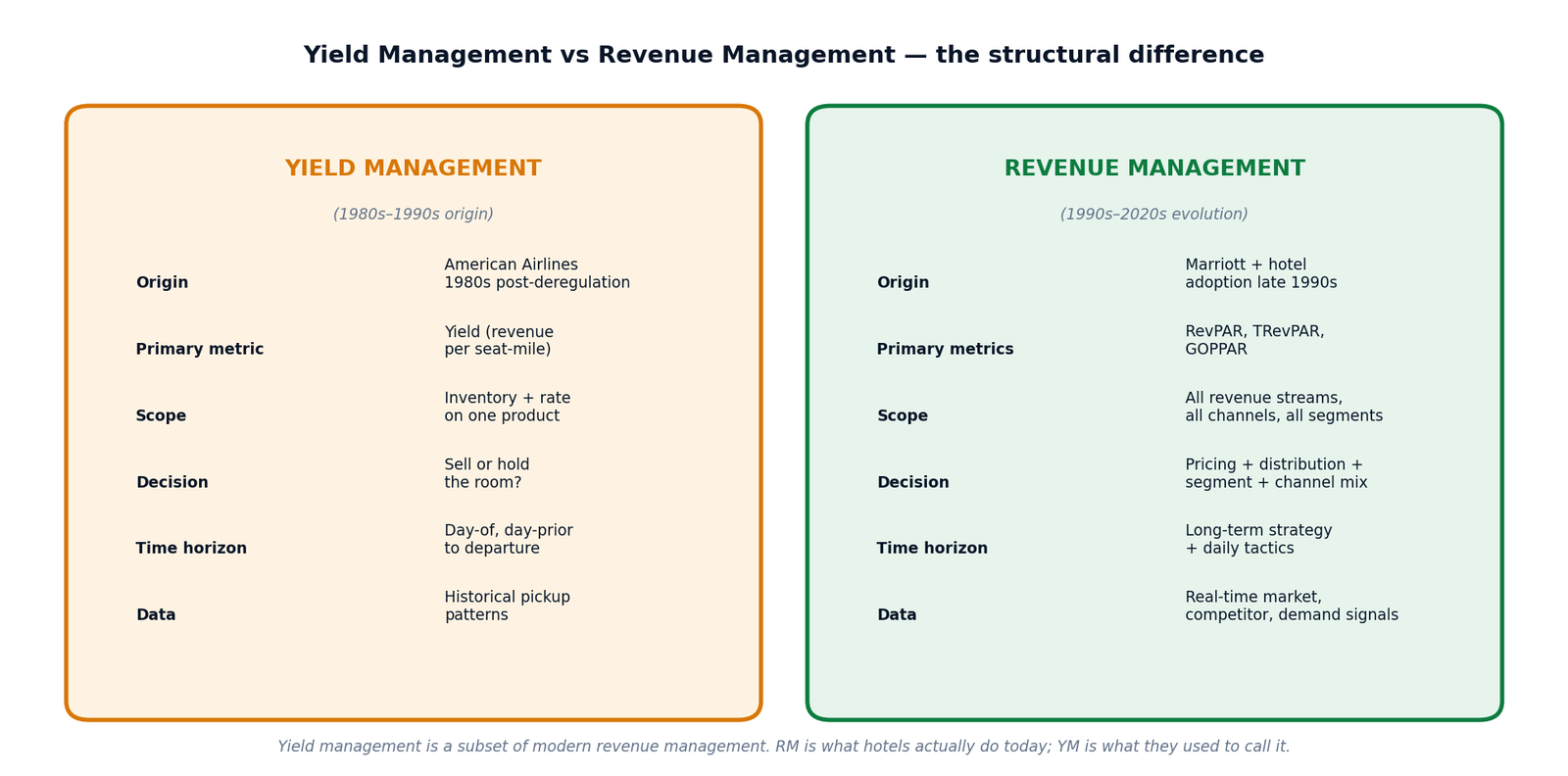
| Dimension | Yield Management | Revenue Management |
|---|---|---|
| Origin | American Airlines, post-deregulation (1980s) | Marriott + hotel adoption (late 1990s) |
| Era | 1985–2000 (peak) | 2000–present (active evolution) |
| Primary metric | Yield (revenue per available unit) | RevPAR, TRevPAR, GOPPAR |
| Scope | Inventory + rate on a single product | All revenue streams, all channels, all segments |
| Core decision | Sell or hold the room? | Rate, channel, segment, inventory, ancillary |
| Time horizon | Day-of, day-prior to departure | Long-term strategy + daily tactics |
| Data inputs | Historical pickup patterns | Real-time market, competitor, demand signals |
| Decision velocity | ~12/property/day (manual) | 480–86,400/property/day (RMS to agentic AI) |
| Tools | Spreadsheet + experience | RMS platform + AI + competitive rate intelligence |
| Owner | Front office / sales | Revenue manager / commercial team |
| Output | Rate cap or close-out by date | Open Pricing across all channels and segments |
| Mathematical foundation | Probability theory | Multivariate optimization + machine learning |
| F&B / ancillary scope | None | Core scope |
| Forecasting | Simple pickup curves | Multi-source demand forecast + ML |
| Distribution scope | Single channel | All channels, with parity logic |
The 30-second version
Yield management is a narrow discipline focused on the rooms-and-rate sell-or-hold question. Revenue management is a comprehensive discipline covering every commercial decision the property makes. Yield management is one of the tools revenue management uses; the inverse is not true.
If your hotel’s "yield manager" is making decisions about channel mix, ancillary pricing, segment strategy, distribution policy, and competitive rate intelligence — that person is doing revenue management. The job title hasn’t caught up to the work.
The 3 Eras of Hotel Pricing Discipline
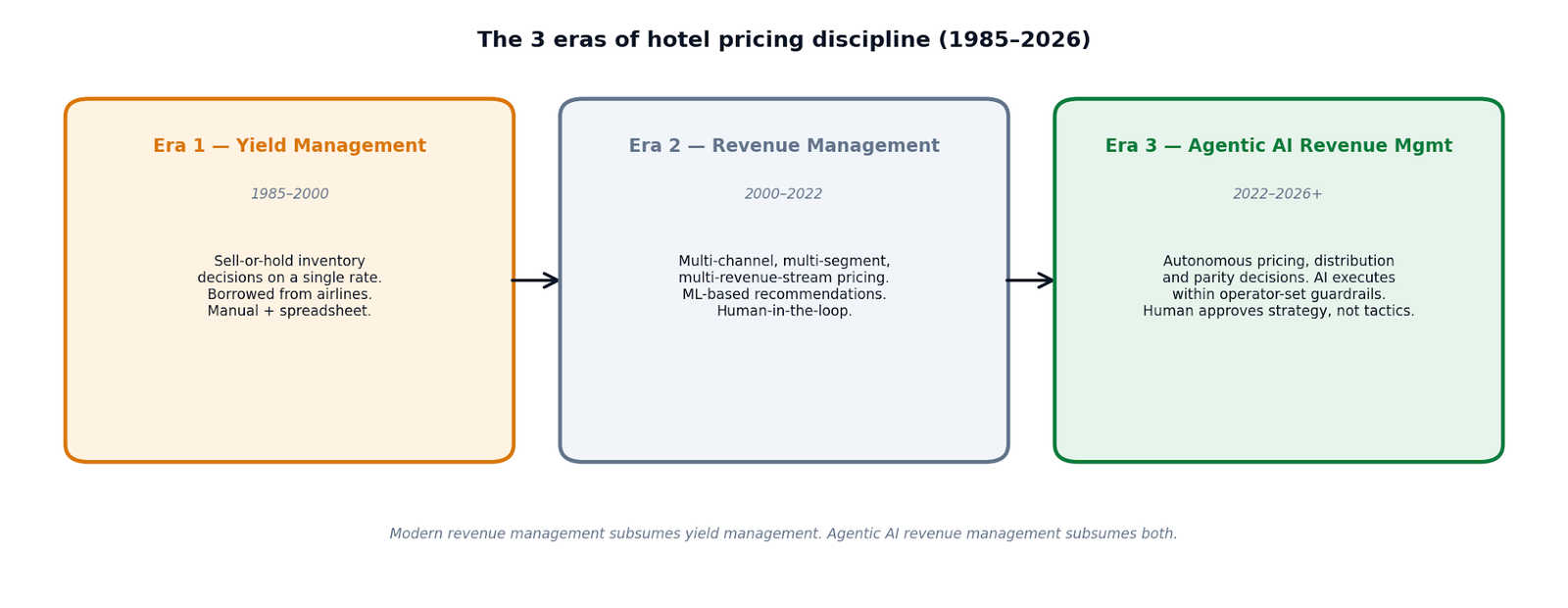
The vocabulary used in hotel pricing has evolved in three distinct eras, each defined by what was technically possible and what made commercial sense at the time.
Era 1 — Yield Management (1985–2000)
The yield management era began with American Airlines deploying Dynamic Inventory Allocation and Maintenance Optimizer (DINAMO) in 1985 in response to People Express’s discount pricing. Hotels followed in the 1990s, adopting yield management as a discipline to manage room inventory through pickup curve analysis and rate caps.
- Tools: Spreadsheets + early property management systems
- Decisions per day: ~12 per property
- Who owned it: Front office manager or sales director
- What it could not do: Channel mix, segment strategy, distribution decisions, ancillary pricing
Era 2 — Revenue Management (2000–2022)
The revenue management era was made possible by the rise of OTAs (which created multi-channel distribution complexity that yield management couldn’t handle) and the maturation of hotel-specific RMS platforms (IDeaS, EzRMS, Duetto, Atomize, and others). The discipline expanded from a tactical inventory function to a strategic commercial function reporting to ownership.
- Tools: Cloud-based RMS, channel manager integration, BI dashboards
- Decisions per day: 480–4,800 per property (depending on RMS sophistication)
- Who owned it: Dedicated revenue manager (or director of revenue management)
- What it added vs Era 1: Channel mix, segment mix, ancillary, multi-property forecasting
Era 3 — Agentic AI Revenue Management (2022–2026+)
The agentic AI era is defined by autonomous decision-making within operator-set guardrails. Where Era 2 systems recommended and humans executed, Era 3 systems execute — and humans set strategy, constraints, and review outcomes. This is not RPA-style automation of existing workflows; it is fundamentally different decision architecture in which the AI is making thousands of real-time pricing, distribution, and parity decisions per property per day.
- Tools: Agentic AI RMS (RevEvolve RM Copilot), continuous competitive intelligence, autonomous guardrails
- Decisions per day: ~86,400 per property
- Who owns it: Revenue manager sets strategy + guardrails; AI executes tactics
- What it adds vs Era 2: Velocity, consistency, 24/7 coverage, autonomous response to events
The hotels operating in Era 3 today (~5–8% of the global market) are demonstrating consistent +13.7% RevPAR vs human-RM-only operations (per RevEvolve’s published RM Copilot vs Human RM benchmarks).
Scope of Decisions — What Each Discipline Actually Covers
The simplest visualization of the difference: what categories of decision does each discipline cover?
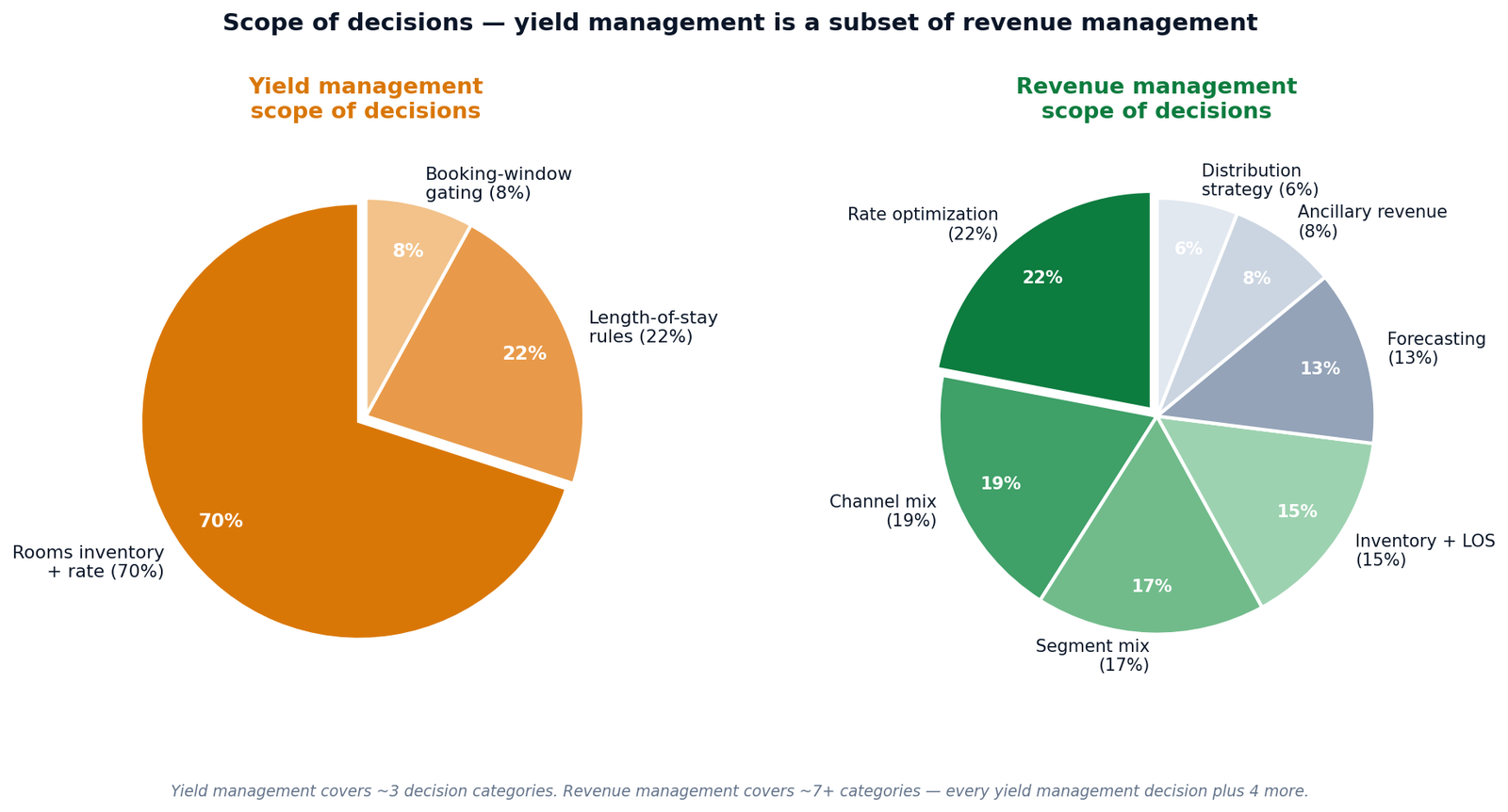
Yield management’s 3 decision categories
- Rooms inventory + rate (70%) — the core sell-or-hold question
- Length-of-stay rules (22%) — minimum-stay restrictions, weekend gating
- Booking-window gating (8%) — closing out rates within X days of arrival
Revenue management’s 7+ decision categories
- Rate optimization (22%) — multi-segment, multi-channel rate strategy
- Channel mix (19%) — direct vs OTA vs metasearch vs wholesale
- Segment mix (17%) — corporate, leisure, group, government allocation
- Inventory + length-of-stay (15%) — the original yield management territory
- Forecasting (13%) — demand prediction across multiple horizons
- Ancillary revenue (8%) — F&B, spa, packages, ancillary fees
- Distribution strategy (6%) — parity, contracts, OTA placement
Revenue management contains every yield management decision and four entire decision categories that yield management didn’t contemplate. Yield management is a subset of revenue management — not a synonym.
Pricing Decision Velocity — From 12/Day to 86,400/Day
A useful way to understand the evolution: count the number of pricing decisions each approach makes per property per day.
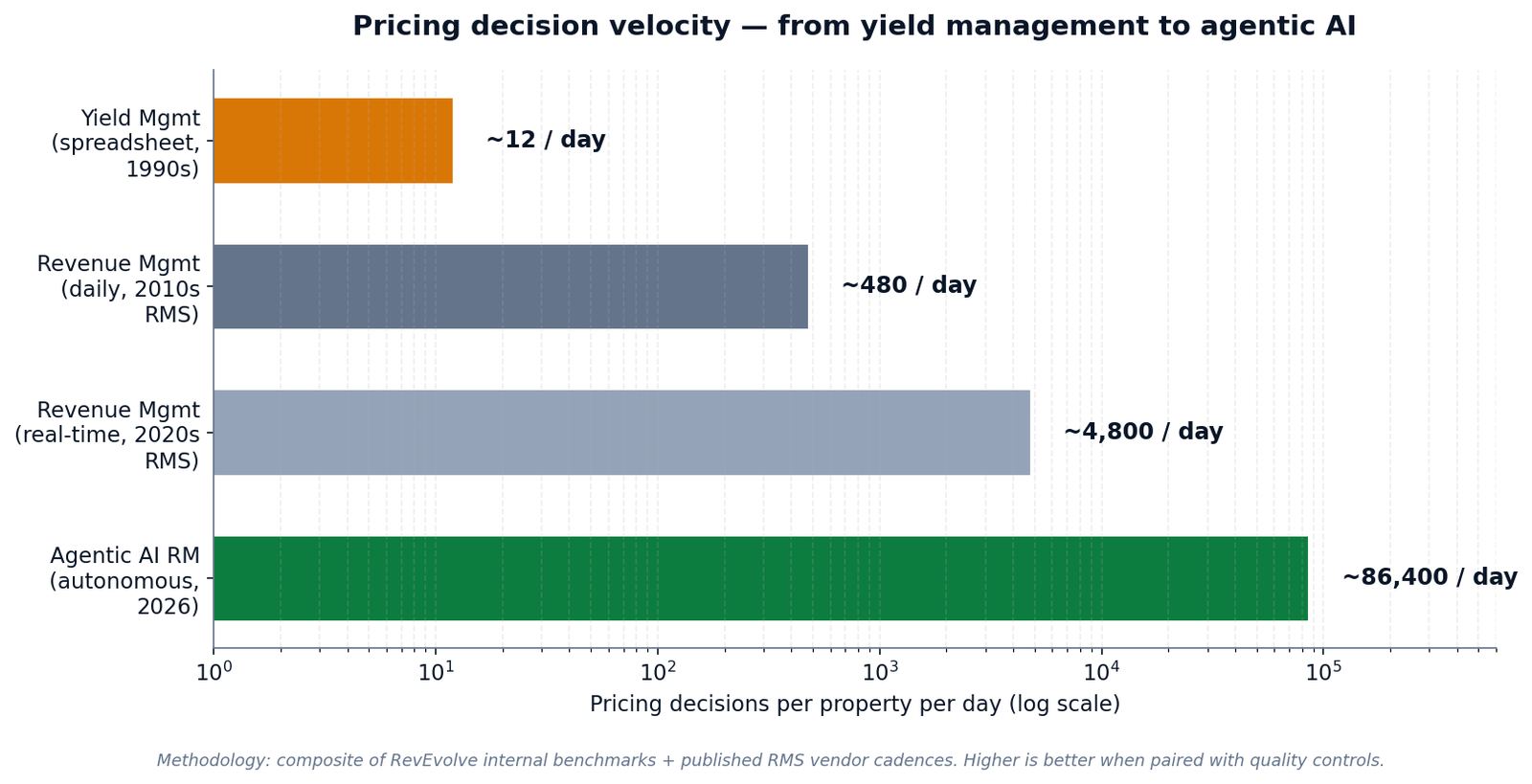
| Approach | Pricing decisions / property / day | Coverage hours |
|---|---|---|
| Manual yield management (1990s) | ~12 | Business hours (8–10 hrs) |
| Daily RMS (2010s) | ~480 | 24 hrs (batch overnight) |
| Real-time RMS (2020s) | ~4,800 | 24 hrs (rolling) |
| Agentic AI RM (2026) | ~86,400 | 24 hrs (continuous, ~1 decision/sec) |
Decision velocity isn’t just about reacting faster. It’s about pricing precision. An agentic AI making 86,400 decisions/day per property can match rate to micro-segment at a granularity that lower-velocity systems collapse into averages. The result is the +13.7% RevPAR lift documented in the RevEvolve RM Copilot benchmark — not because the AI is "smarter" but because it can act at a granularity humans physically cannot.
The 4-Tier Hotel Pricing Maturity Model
Where does your property sit today? The 4-tier model is the simplest diagnostic:
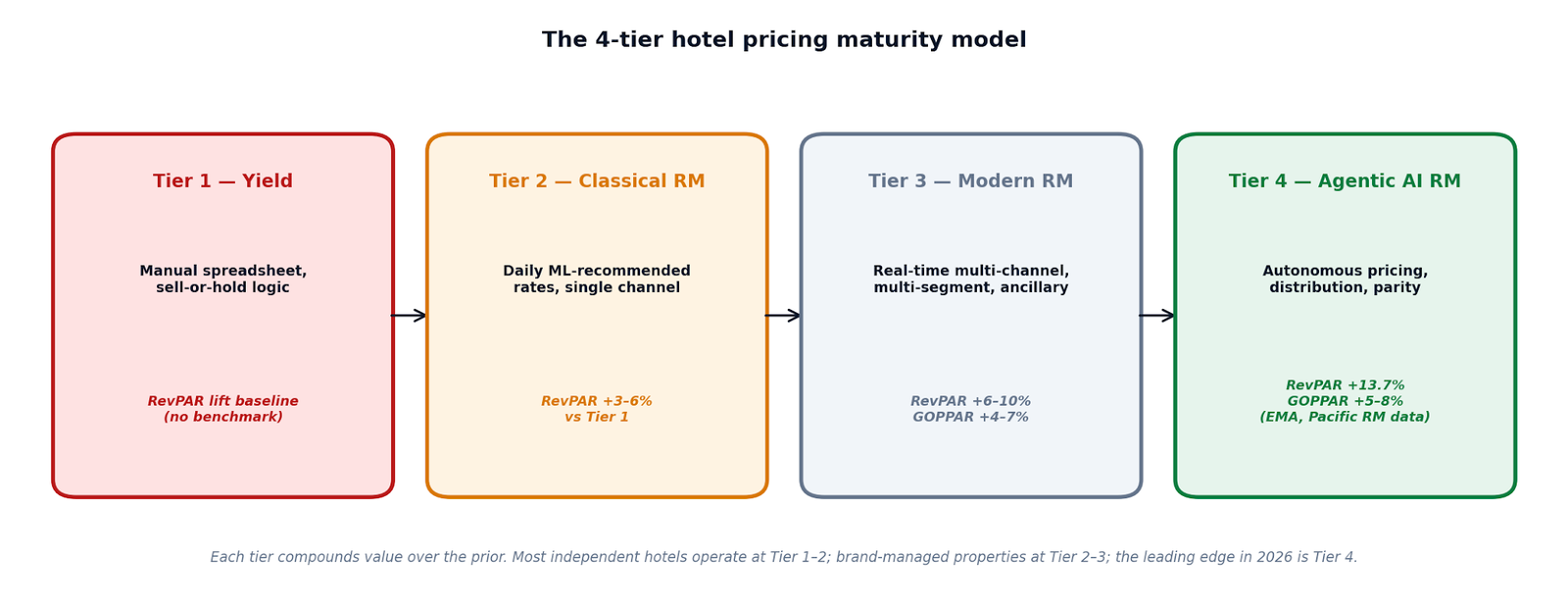
| Tier | Approach | Tools | Typical lift vs prior tier |
|---|---|---|---|
| Tier 1 | Manual yield management | Spreadsheets, sell-or-hold logic | Baseline |
| Tier 2 | Classical revenue management | Daily ML-recommended RMS, single channel | RevPAR +3–6% |
| Tier 3 | Modern revenue management | Real-time multi-channel, multi-segment, ancillary RMS | RevPAR +6–10%, GOPPAR +4–7% |
| Tier 4 | Agentic AI revenue management | Autonomous pricing, distribution, parity | RevPAR +13.7%, GOPPAR +5–8% (EMA, Pacific RM data) |
Where most properties operate today
- Independent hotels under 50 rooms: typically Tier 1 (manual yield) or low-Tier 2 (basic RMS)
- Independent hotels 50–200 rooms: typically Tier 2 (daily RMS)
- Branded full-service hotels: typically Tier 2 to Tier 3 (modern RMS)
- Luxury / soft-brand portfolios: Tier 3 (modern RM) with Tier 4 pilots
- Multi-property revenue management companies: the leading edge in 2026 is Tier 4 (agentic AI)
The compounding tier-jump
Each tier compounds value over the prior. A property moving from Tier 1 to Tier 4 in a single jump experiences the full stacked lift — typically 22–30% cumulative RevPAR over 12–18 months — but most properties move tier-by-tier as commercial trust, technical infrastructure, and team capability mature.
Why "Yield Management" Still Persists as a Term in 2026
If revenue management subsumes yield management, why does the older term still appear in job listings, SOPs, and management presentations across the hotel industry? Five reasons:
- Regional vocabulary. In several markets — particularly parts of EMEA, India, and Southeast Asia — "yield management" remained the dominant industry term well into the 2010s, even as the underlying work evolved into full revenue management. Job titles and SOP language follow vocabulary slowly.
- Tactical-vs-strategic split. Some hotels deliberately distinguish "yield management" (tactical, day-to-day inventory + rate decisions) from "revenue management" (strategic, longer-horizon channel and segment decisions) — using both terms to describe different parts of the same person’s work.
- Education curriculum lag. Hospitality management programs at universities globally still teach "yield management" as a foundational module. Graduates enter the industry with the term embedded; it takes years to migrate.
- Branded chain SOP inheritance. Some major hotel chains documented their commercial discipline as "yield management" in the 1990s and have not formally retitled it, even though the practice has expanded to include everything modern revenue management covers.
- Genuine narrowness. A small number of properties — typically very small independents with single-channel distribution and limited ancillary revenue — actually do operate at a yield-management-only scope. For these properties, "yield management" is an accurate description of the work; "revenue management" would overstate it.
The diagnostic: If your property uses an OTA, runs more than one rate type, has any F&B revenue beyond a continental breakfast, or makes any decisions about segment mix — you are doing revenue management, regardless of what the job title or SOP says.
Common Mistakes Hotels Make Around These Terms
Five recurring errors RevEvolve audit teams see:
Mistake 1 — Hiring a "yield manager" when the role is revenue management
Underprices the role, attracts narrower candidates, and the new hire ends up doing revenue management on a yield-management job description.
Mistake 2 — Buying a "yield management system" when modern revenue management is required
Some legacy RMS products are still marketed using yield management vocabulary even though they’re full revenue management platforms. Some narrow products are accurately described as yield management but are sold to properties that need more.
Mistake 3 — Reporting "yield management" as a separate discipline from revenue management to ownership
Owners increasingly want a single commercial KPI dashboard. Splitting yield management out as a sub-function muddies the reporting and obscures accountability.
Mistake 4 — Assuming yield management techniques are obsolete
They aren’t — they’re embedded inside modern revenue management. The pickup curves, rate caps, and length-of-stay rules from the 1990s yield management toolkit are still core to RM today. They’re just augmented by everything else.
Mistake 5 — Treating "agentic AI" as a synonym for "the next RMS"
It isn’t. Agentic AI revenue management is a different decision architecture — the AI executes within guardrails rather than recommending for human execution. Treating it as a vendor swap (replace one RMS with another) misses the operating-model change.
Conclusion — Words Matter, But Outcomes Matter More
The terminology distinction matters for clarity, hiring, and ownership reporting. Yield management is a 1980s tactical discipline focused on rooms-and-rate inventory decisions. Revenue management is the modern strategic discipline that subsumes yield management and extends across channel, segment, ancillary, and distribution. The two terms are not interchangeable, even though they’re often used as if they were.
The more important distinction in 2026 is between maturity tiers. A property running Tier 2 classical RM with the language of yield management is still doing revenue management — just not very sophisticated revenue management. A property running Tier 4 agentic AI is operating in a fundamentally different decision architecture, regardless of what it calls the function. The vocabulary is downstream of the operating model.
The hotels compounding advantage in the next four years will be the ones moving from Tier 2 to Tier 3 to Tier 4 — not the ones updating their job titles. Modernize the work, and the words follow.
Stop running 1990s yield management with 2026 vocabulary.
- → Request a Demo of RevEvolve’s Dynamic Pricing — see Tier 4 agentic AI revenue management running on a portfolio in real time, with autonomous pricing across all channels and segments. 15-minute walkthrough.