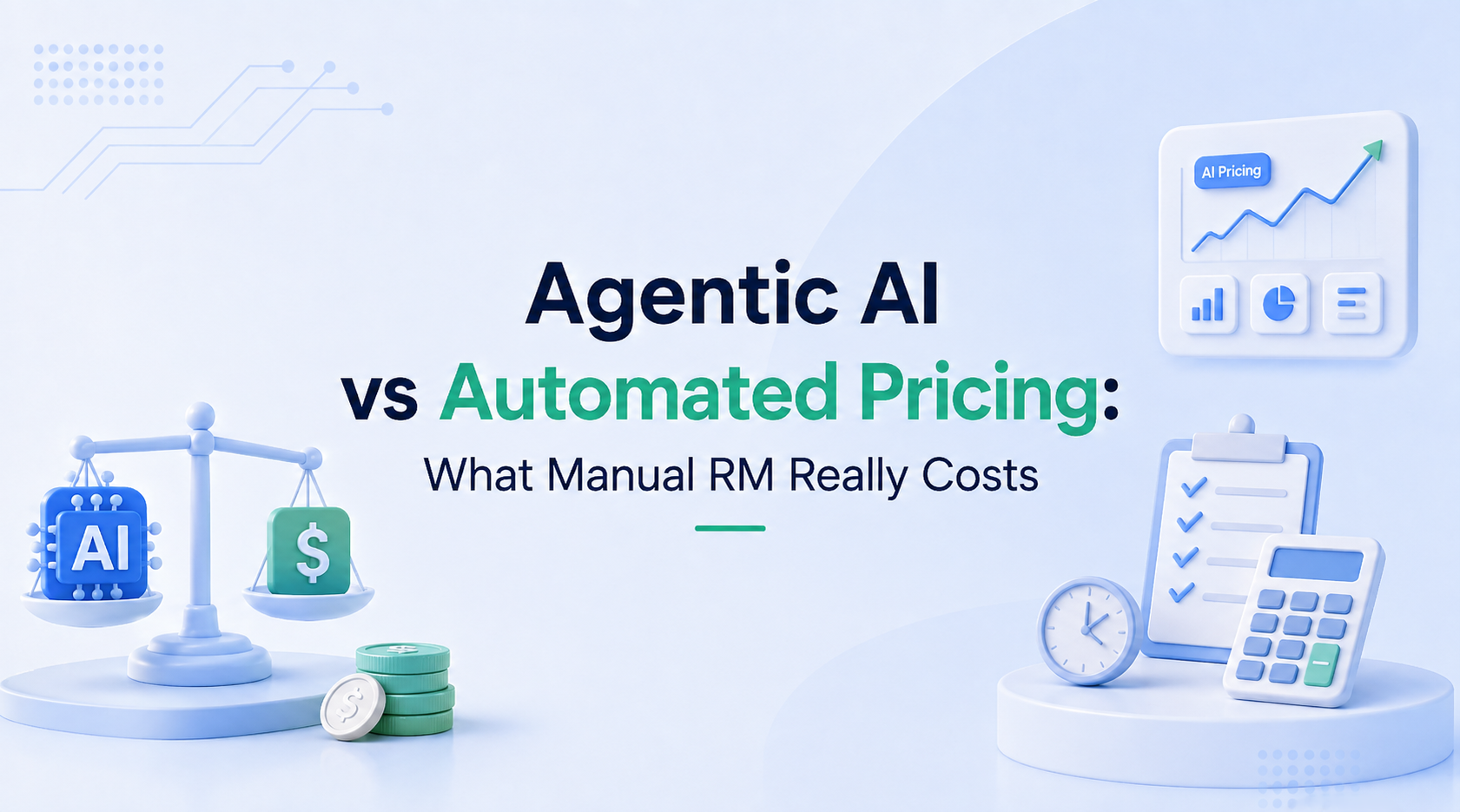
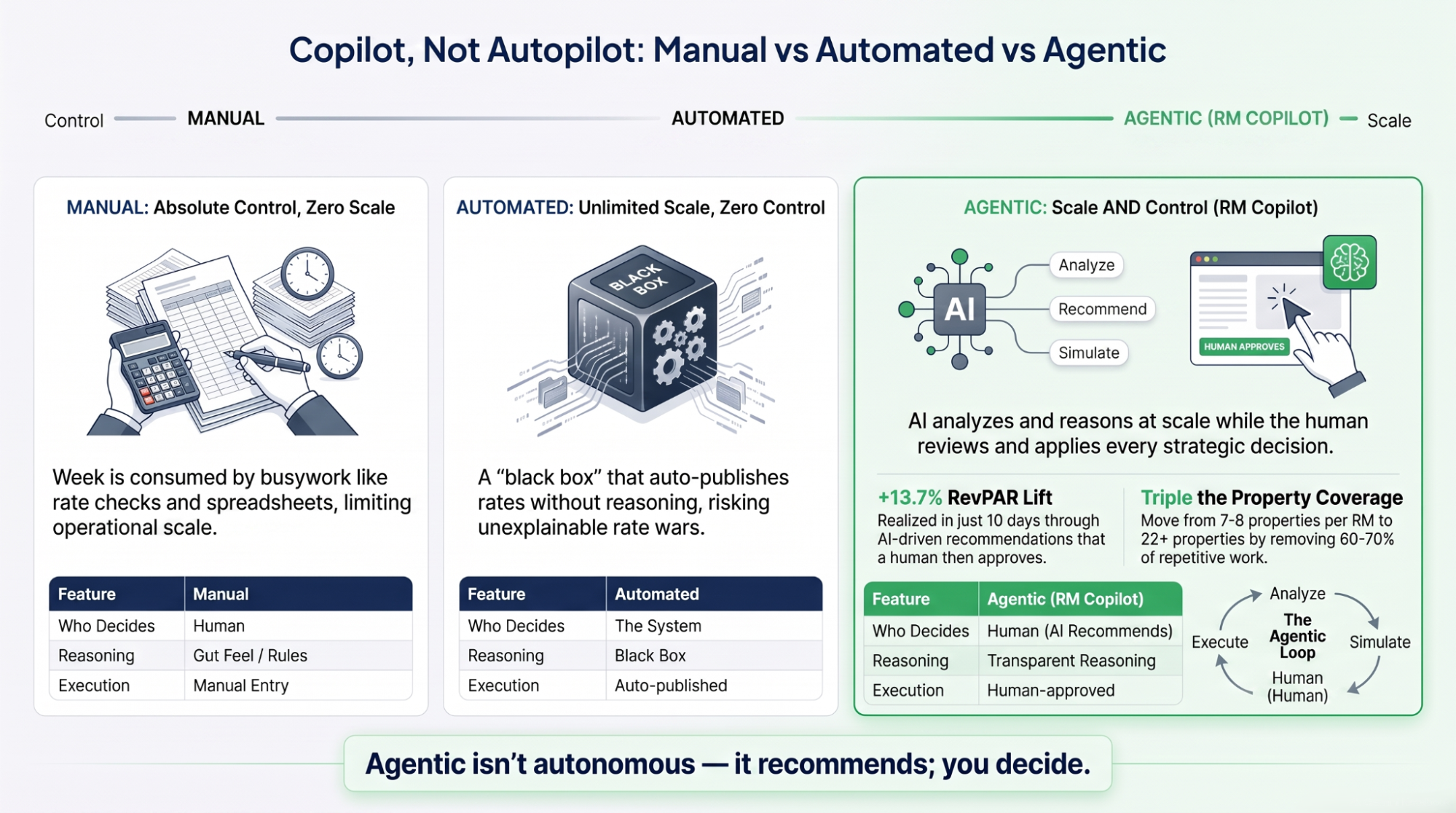
SNIPPET DEFINITION — Automated hotel pricing is software that adjusts room rates on its own from rules or algorithms — fast and scalable, but it acts without a human deciding each move. Agentic AI takes a different path: it reasons through the data like an analyst, recommends the move with the reasoning attached, and simulates the outcome — then a human reviews and applies it. The difference isn’t intelligence; it’s who stays in control.
Every revenue manager has felt both sides of this. Do it all by hand — the spreadsheets, the morning rate checks, the gut calls — and you spend your week on busywork while revenue slips through the gaps you didn’t have time to watch. Hand it to an automated tool, and you get your time back, but you also get a black box that cut rates overnight and no way to explain it to ownership.
That looks like a choice between control and scale. It isn’t — or it doesn’t have to be. There’s a third option that keeps the human deciding while an AI does the heavy analysis: agentic AI.
We let an automated tool set rates and it dropped us into a rate war overnight. I couldn’t even explain to ownership why the algorithm did it. Never again without a human in the loop.
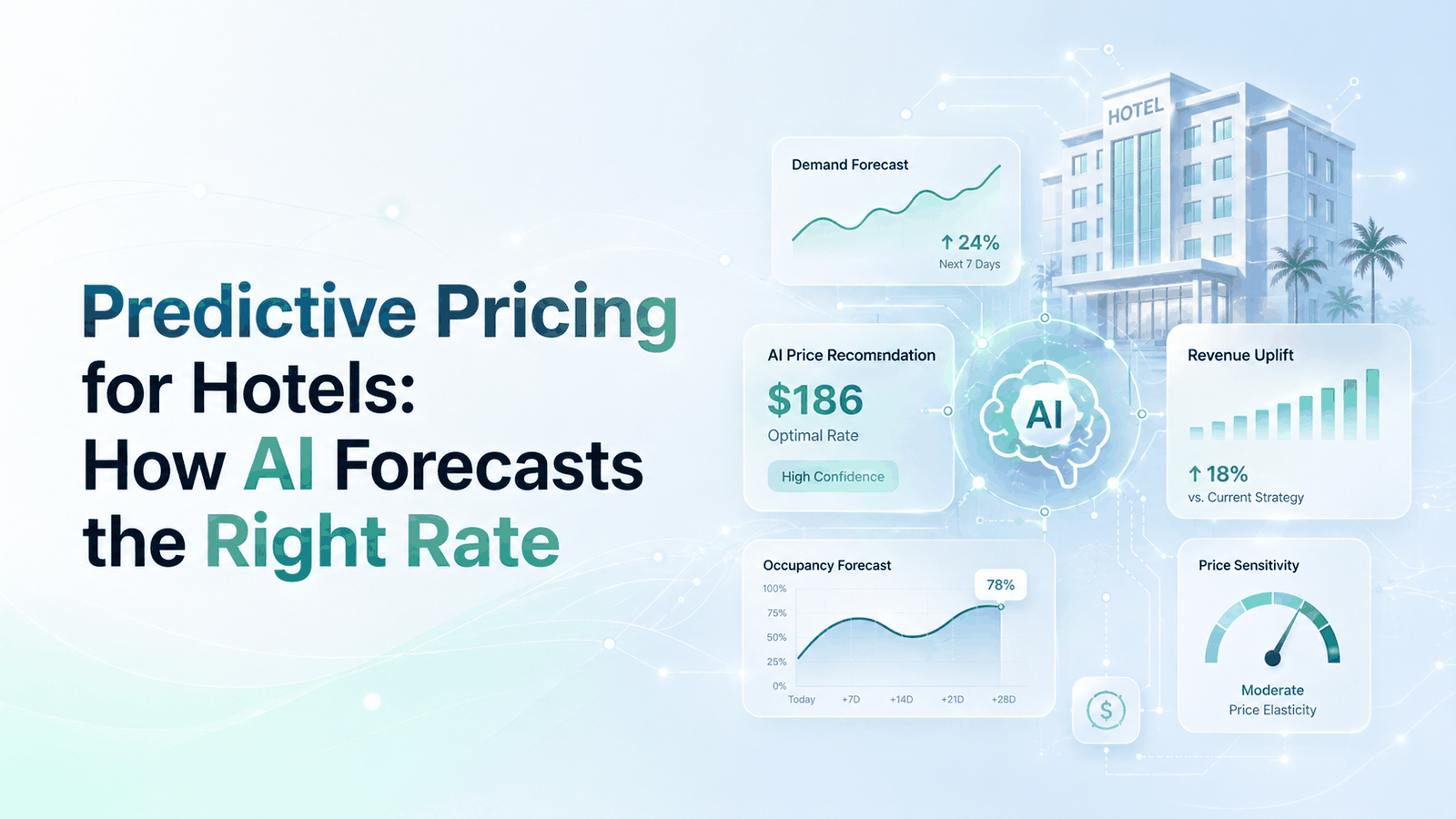
Quick scope note: this is the control debate — manual, automated, or agentic — not a full hotel pricing strategy overview or a deep-dive on any one technique like predictive pricing. Those are the how; this is the who-decides.
Key takeaways
- Manual RM is expensive in hours, missed revenue, and coverage that doesn’t scale.
- Automated pricing scales, but trades away control and explainability.
- Agentic AI reasons and recommends — the human still applies every decision.
- ‘Human in the loop’ is the difference between a copilot and an autopilot.
- You don’t have to choose between scale and control — that’s the false trade-off.
What manual revenue management really costs
The cost of manual RM isn’t a line item, which is exactly why it hides. It shows up in three places: the hours, the misses, and the ceiling.
The hours are the obvious part. A manual revenue manager spends most of the week on repetitive work — rate checks, comp-set monitoring, spreadsheet updates, and reports — leaving only a slice for the analysis and decisions that actually move revenue.
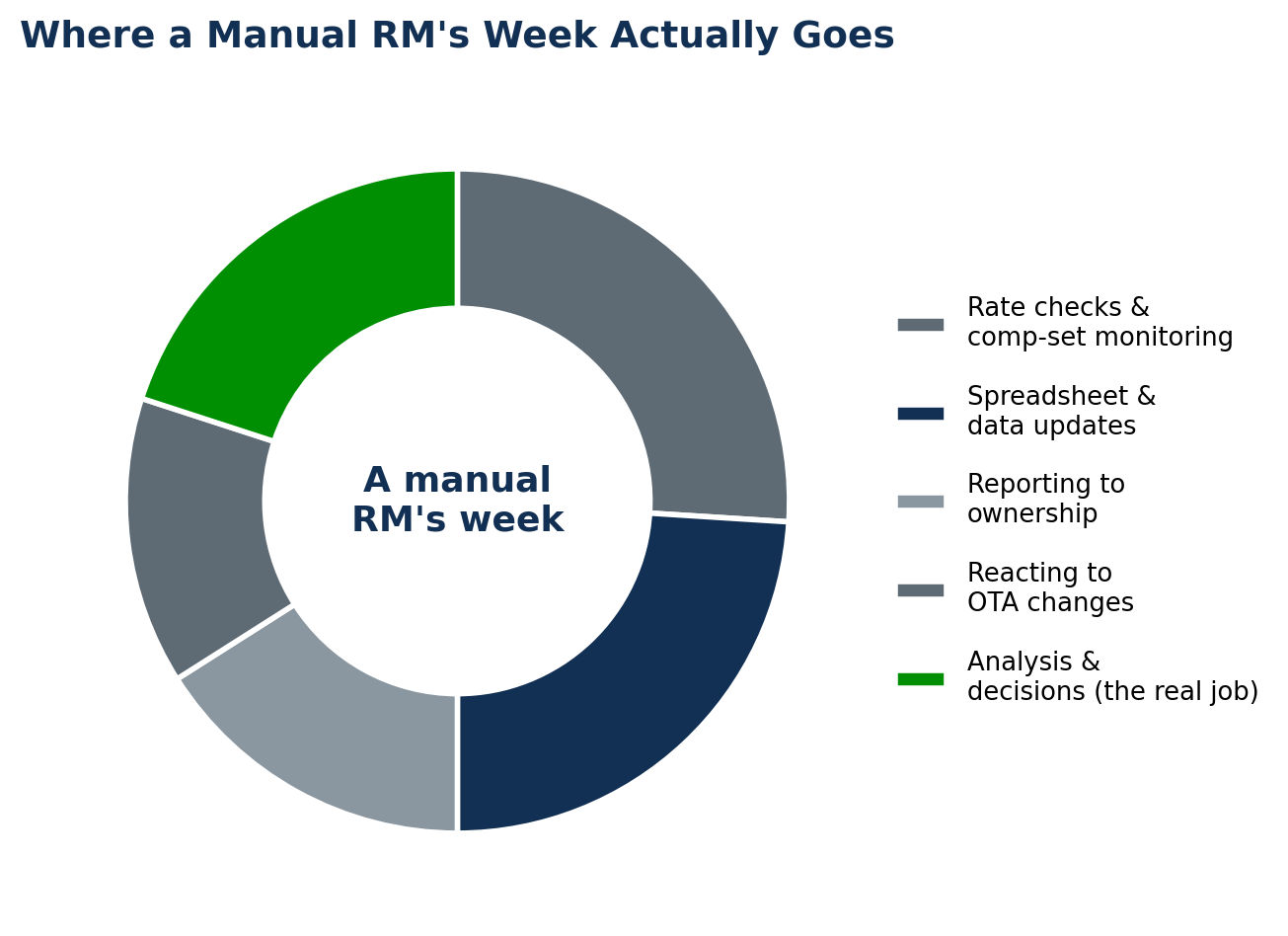
The misses are quieter. A rate left stale over a demand spike, a soft night nobody had time to fence, a competitor move caught two days late — each is small, and together they add up to real revenue that never shows on any report because it never happened.
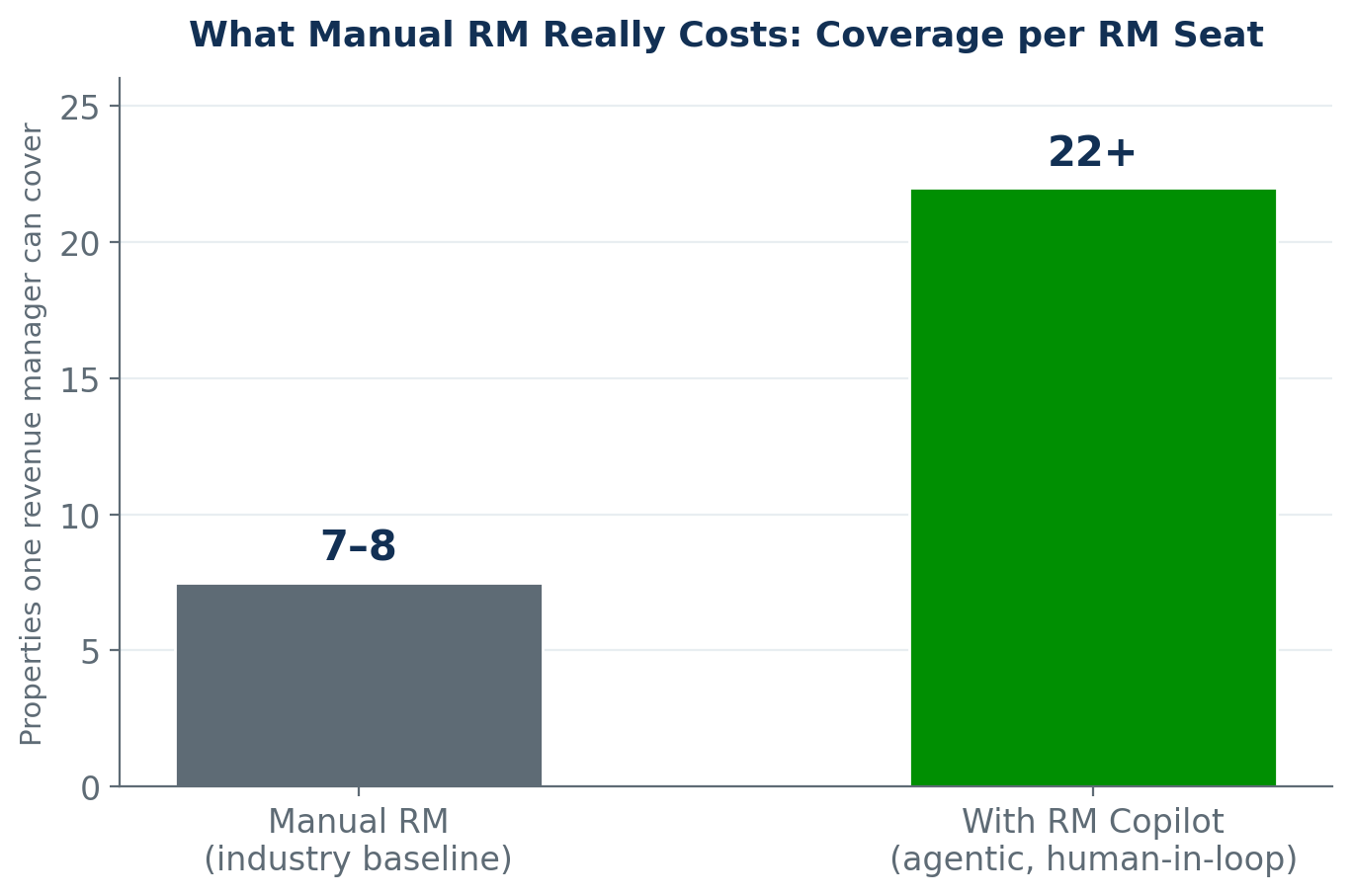
The ceiling is the one owners feel. A manual RM can only watch so many properties by hand — the industry baseline is roughly seven to eight per person. Grow past that and you either add headcount or let quality slip.
What is automated hotel pricing?
Automation is a real step up from spreadsheets. It reacts faster than any human and never sleeps. The question isn’t whether it’s powerful — it’s what you give up when the system acts without you.
The hidden cost of full automation
1 · The black box
When an algorithm cuts your rate, can you explain why? If ownership asks and the honest answer is “the system decided,” you’ve lost the thread. Automated systems optimize; they rarely explain.
2 · Over-corrections and rate wars
An automated system reacting to a competitor’s drop can chase it down, the competitor follows, and both hotels bleed rate — a race to the bottom no human would have chosen. Speed without judgment is a liability on the wrong day.
3 · Loss of control on the decisions that matter
Some rate moves are routine; some are strategic and reputational. Full automation treats them the same. That’s the core trade automation asks you to make — and it’s the one many revenue leaders won’t.
What is agentic AI in revenue management?
That last point is the whole design. The AI does the analysis a human can’t do at scale — across every property, every day — and hands back a recommendation you can read, question, and apply. You get the scale of automation and keep the control of doing it yourself.
Automated vs agentic: the key difference
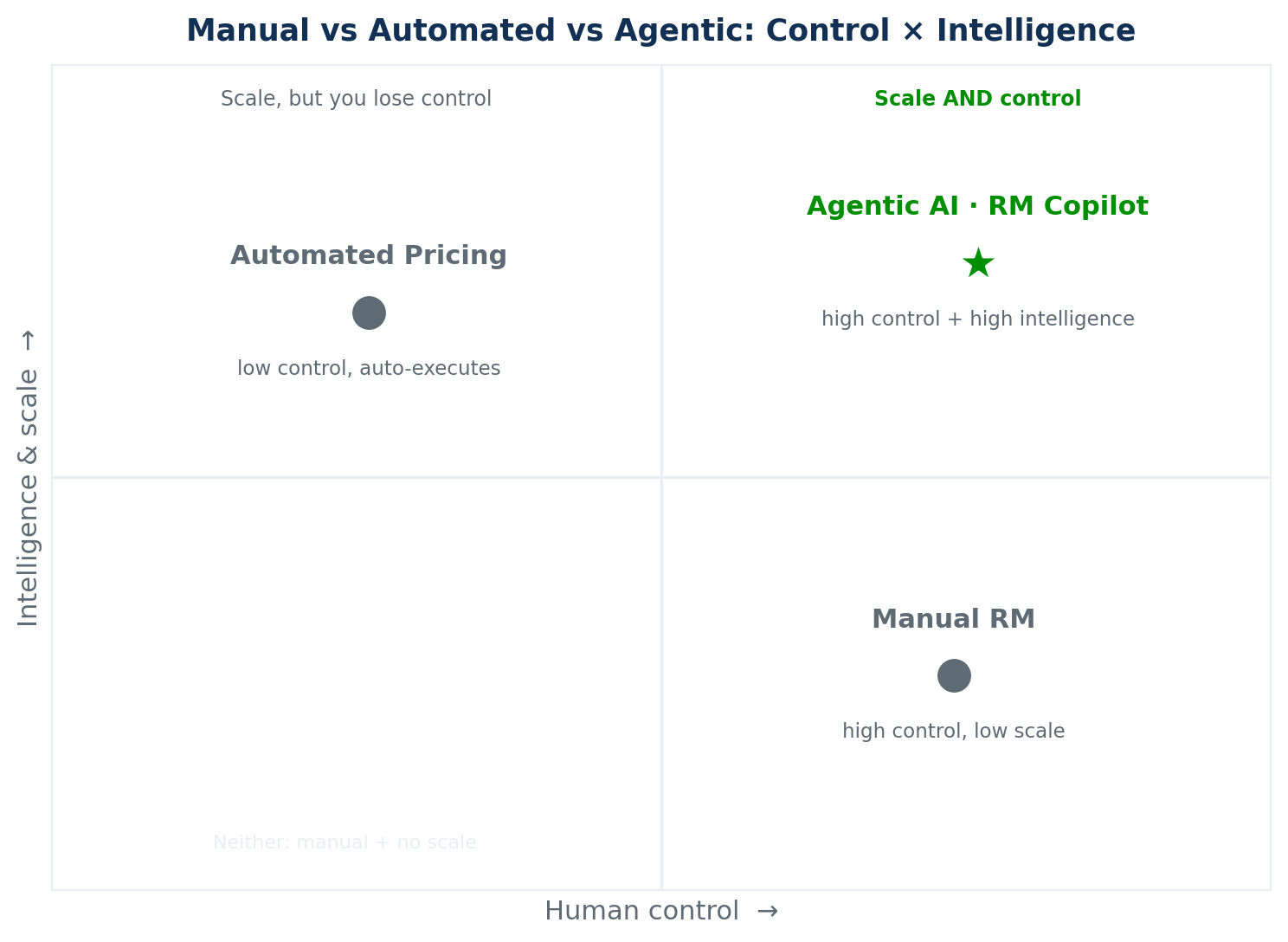
Both use AI. Both scale past what a human can do by hand. The difference is one word: who executes.
| Automated Pricing | Agentic AI (copilot) | |
|---|---|---|
| Who decides the rate | The system | The human (AI recommends) |
| Explains its reasoning | Rarely (black box) | Yes — reasoning attached |
| Publishes rates | Automatically | Only when you apply them |
| Control | Traded for scale | Kept — with scale |
| If it’s wrong | You find out after | You catch it before applying |
Why ‘human in the loop’ matters
It matters for three reasons owners and revenue leaders care about. Control: the strategic and reputational calls stay with a person. Explainability: every move has a reason you can give ownership. Accountability: when a human applies the decision, there’s a clear owner for it — not “the algorithm.”
How agentic AI works: analyze, recommend, simulate, learn
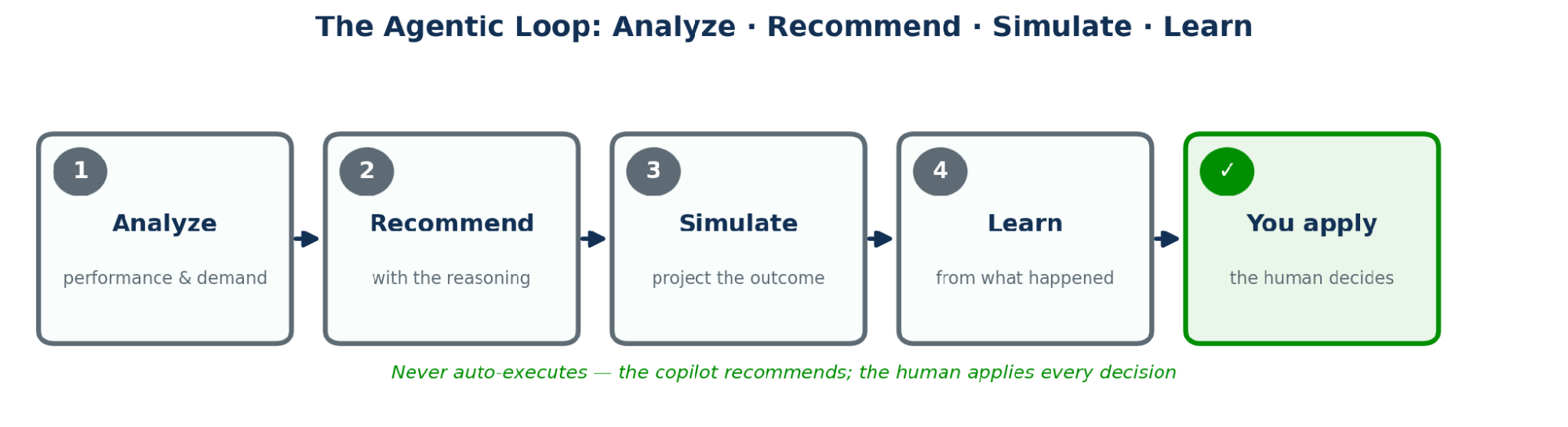
An agentic revenue copilot runs a loop — four steps that mirror what a great revenue manager does, at a scale a human can’t match.
- Analyze — read performance, demand, and market signals across every property.
- Recommend — propose the pricing move, with the reasoning attached so you can judge it.
- Simulate — project the likely outcome before anything is decided.
- Learn — take in what actually happened to sharpen the next recommendation.
Notice what’s not on that list: execute. The loop ends with a recommendation, and you apply it. The AI never publishes a rate on its own.
Case study: agentic vs manual, measured
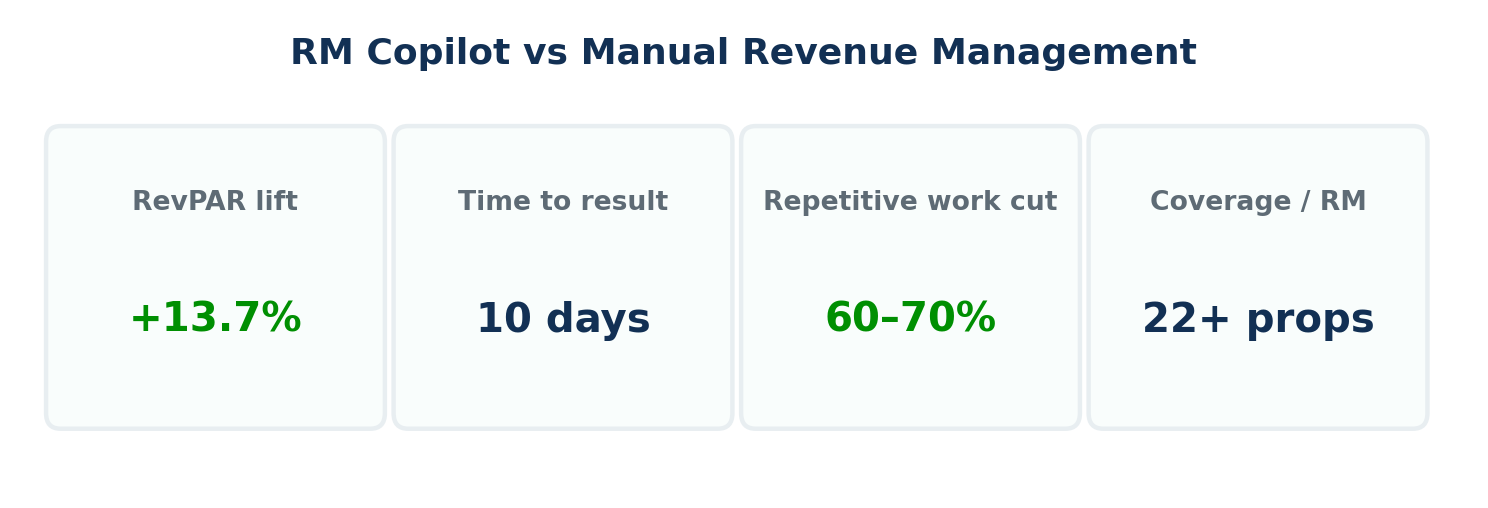
Set against manual revenue management, an agentic copilot delivered a 13.7% RevPAR lift in 10 days across 47 properties, let each revenue manager cover 22+ properties instead of seven or eight, and removed 60–70% of the repetitive work. The revenue managers didn’t lose their jobs or their judgment — they got the busywork taken off their plate and made better calls, faster, across far more properties.
How RevEvolve does it
RM Copilot is an operator-facing AI revenue copilot built on exactly this principle. It analyzes performance, surfaces opportunities, simulates outcomes, and recommends dynamic pricing moves with the reasoning attached — then your team reviews and applies them.
It works in two modes: Advisor Mode, where it surfaces recommendations for you to act on, and Co-Pilot Mode, where it recommends with scenario analysis and your team reviews and manually applies each move. There is no autonomous mode. It does not auto-publish rates or push to your PMS, CRS, or OTAs, and every recommendation is logged with its reasoning so you can always explain a move to ownership.
Which approach fits your hotel?
None of these is universally right — the fit depends on your portfolio and how much a wrong rate move costs you.
- Manual: fine for a single small property with simple, stable demand — until the hours or a growth plan catch up with you.
- Automated pricing systems: a fit where volume is high, margins on any single decision are low, and hands-off speed matters more than explaining each move.
- Agentic AI (copilot): the fit when you have multiple properties or complex demand and you need scale without giving up control, explainability, or accountability — which describes most growing operators.
Agentic AI vs automation: three objections
Copilot, not autopilot
Manual RM costs you hours, misses, and a ceiling on growth. Full automation buys those back — but bills you in control, explainability, and the occasional rate war you didn’t choose. The instinct to see it as scale versus control is understandable, and it’s wrong.
Agentic AI is the resolution: the analysis and reach of automation, with a human still making the call. The AI reasons, recommends, and simulates; you review, decide, and apply. That’s not slower automation — it’s a smarter way to run revenue.
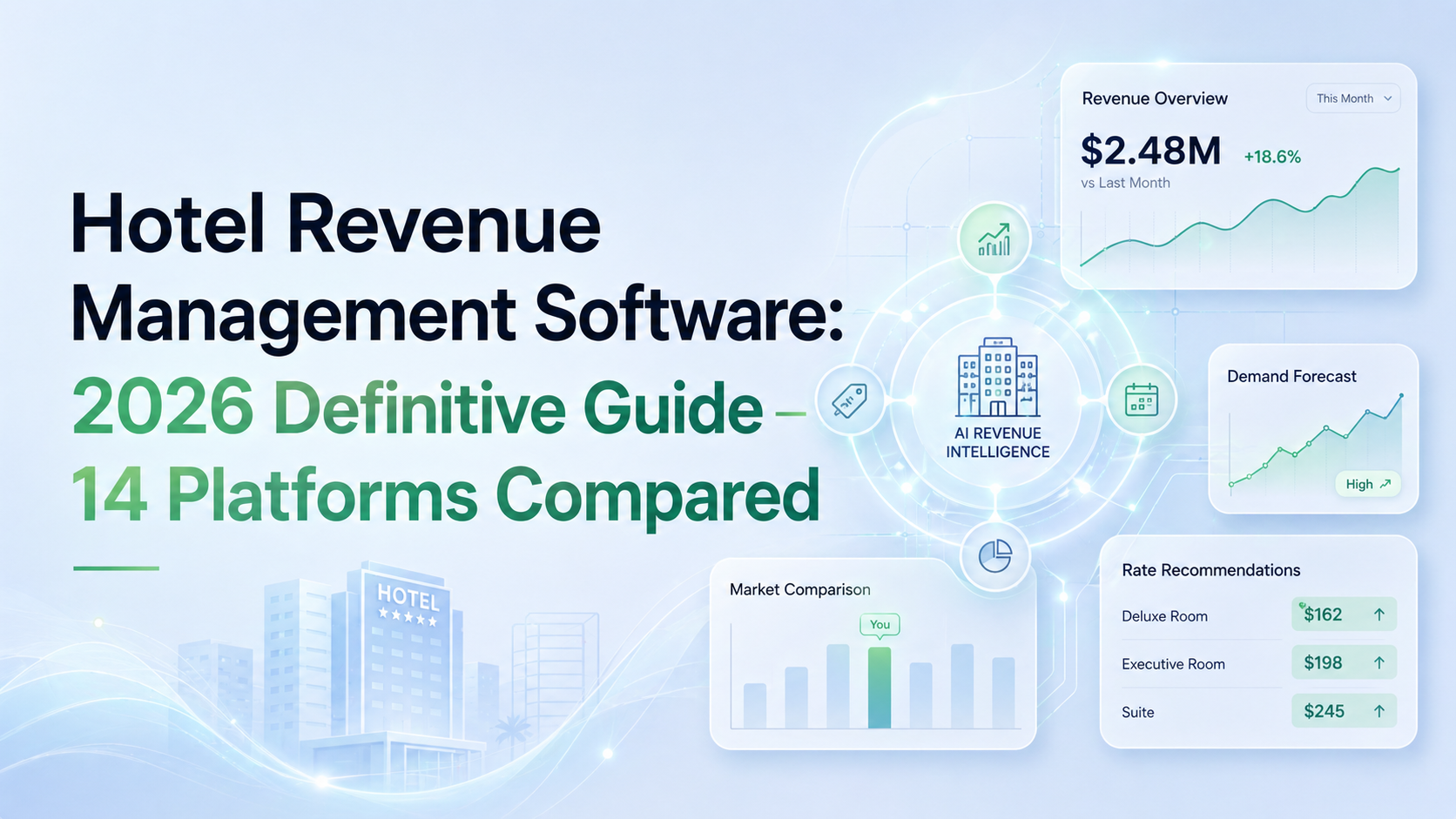
Keep going: Predictive pricing · Hotel pricing strategy · 14 platforms compared · What RM Copilot does.