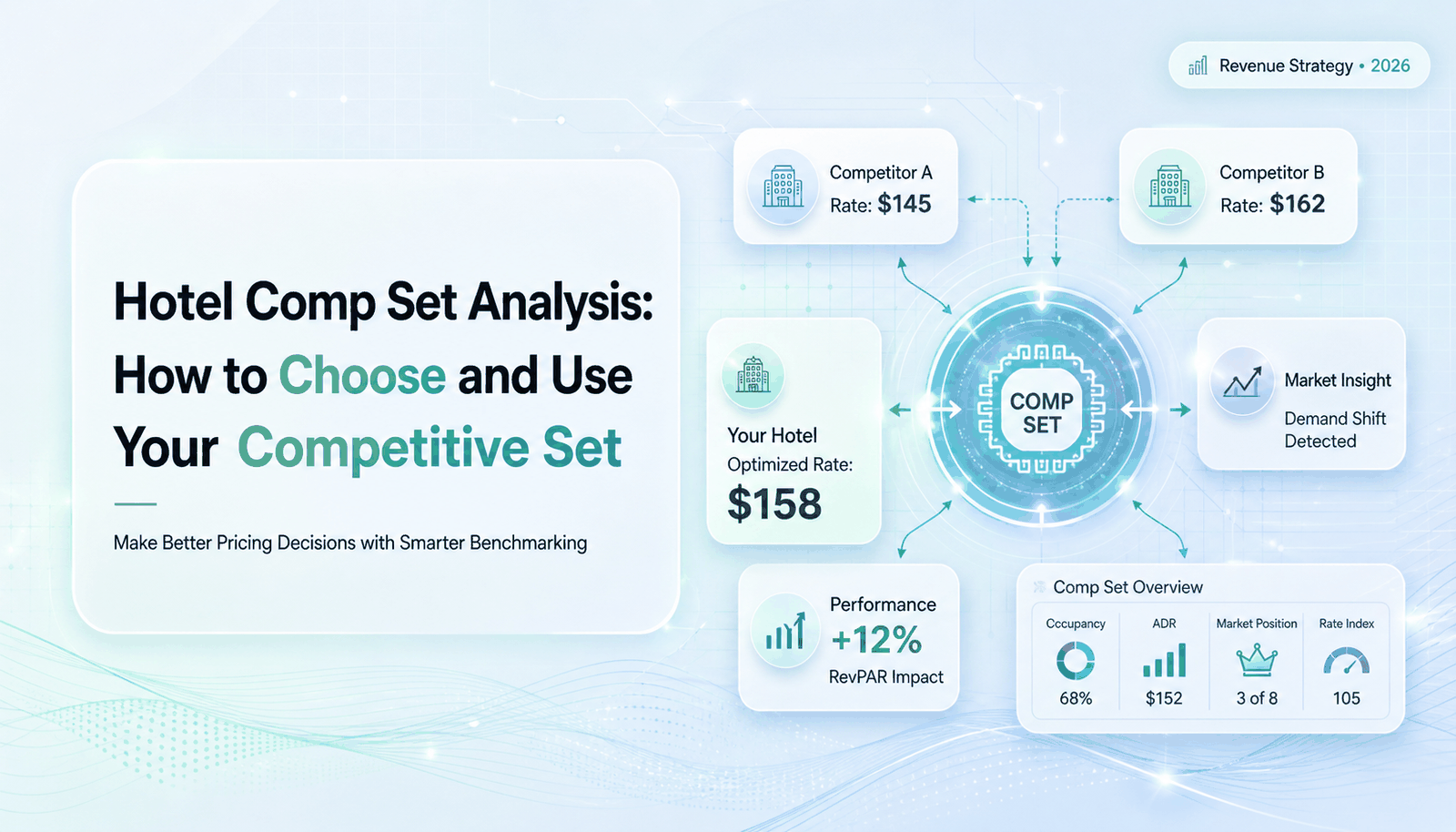
SNIPPET DEFINITION — A hotel comp set (competitive set) is the curated group of 5–12 hotels that a property uses as its benchmark for pricing, performance, and strategic decisions. The right comp set is built from properties guests actually substitute with — same guest segment, similar rate band (ADR within ±25%), similar booking pace, comparable seasonality — not the hotels you compete with on brochure aesthetics. Most hotels build their comp set wrong, review it once a year (or never), and end up benchmarking themselves into the wrong market position. Modern comp set analysis is a continuous calibration loop with quarterly drift checks, not a one-time exercise.
Key takeaways
- A comp set should reflect actual guest substitution behavior, not the hotels your GM thinks are peers. Ego picks are the #1 cause of mispriced inventory.
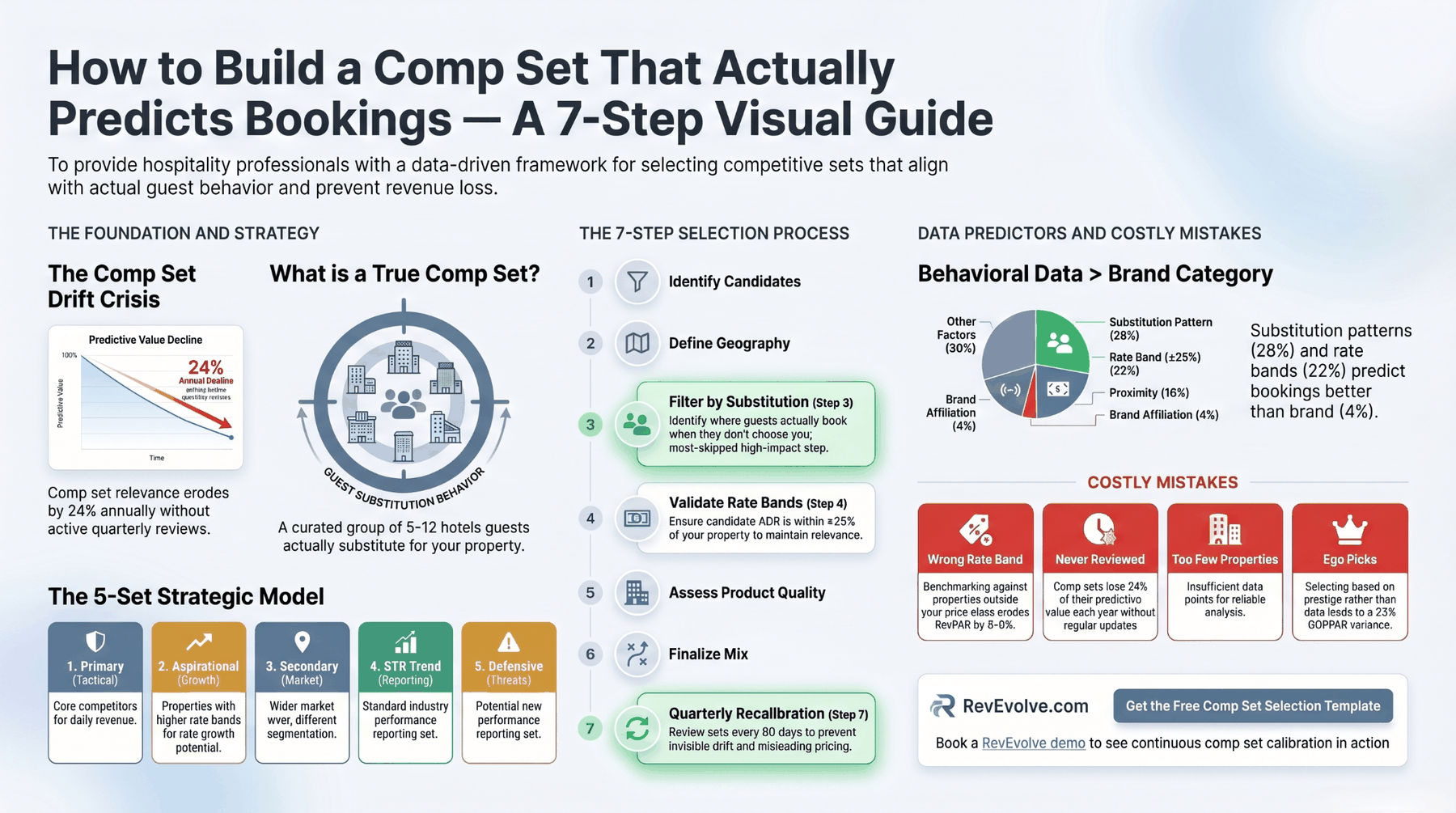
- The 7-step selection process: define your property, list candidates, filter by substitution, validate by rate band, verify booking pace, stress-test seasonality, and lock with a quarterly review cadence.
- There are 5 distinct comp set types every property should run: aspirational, primary tactical, secondary market, STR trend, and aspirational defensive. Most operators run only one.
- Comp set relevance drifts ~24% per year without active review. By month 12, most untouched comp sets are in the "drift zone." By month 18, pricing recommendations from them are actively misleading.
- Booking-substitution data is the single highest-weight selection criterion (28%), followed by rate band (22%) and geographic proximity (16%). Brand affiliation matters far less than most operators think (4%).
- Modern competitive rate intelligence platforms can detect comp set drift automatically and flag the moment a comp set is no longer predictive. Manual quarterly reviews are the floor; agentic AI continuous calibration is the ceiling.
→ Download the Comp Set Selection Template — a printable scoring template that walks you through the 7-step process for any property. Free at revevolve.ai/resources/comp-set-selection-template/.
What Is a Hotel Comp Set?
A hotel comp set — short for competitive set — is the curated group of hotels that your property uses as its benchmark for pricing, performance reporting, and strategic decisions. Your comp set defines who you compare yourself against — and that comparison is the foundation for almost every pricing and positioning decision your revenue management team makes.
The comp set is the answer to the question: "What do other hotels charge for this date, and how does my hotel compare?" If your comp set is wrong, the answer to that question is wrong, and every downstream decision — BAR setting, OTA placement strategy, owner reporting, asset-manager forecasts — is wrong with it.
In a 2026 environment where U.S. RevPAR is forecast to grow only 0.6% (CoStar/STR), the gap between the best-priced hotel in a market and the worst-priced hotel is not 10 percentage points of RevPAR — it’s 25–40 percentage points of GOPPAR. That gap is decided largely by comp set discipline.
The real-world definition that matters: A comp set is not a list of properties you respect. It is a list of properties whose rate movement predicts your booking pace. The two are very different things — and the second one is what matters operationally.
The 5 Types of Hotel Comp Sets
Most hotel operators run a single comp set and call it done. The 2026 best practice is to run five. Each serves a different decision and answers a different strategic question.
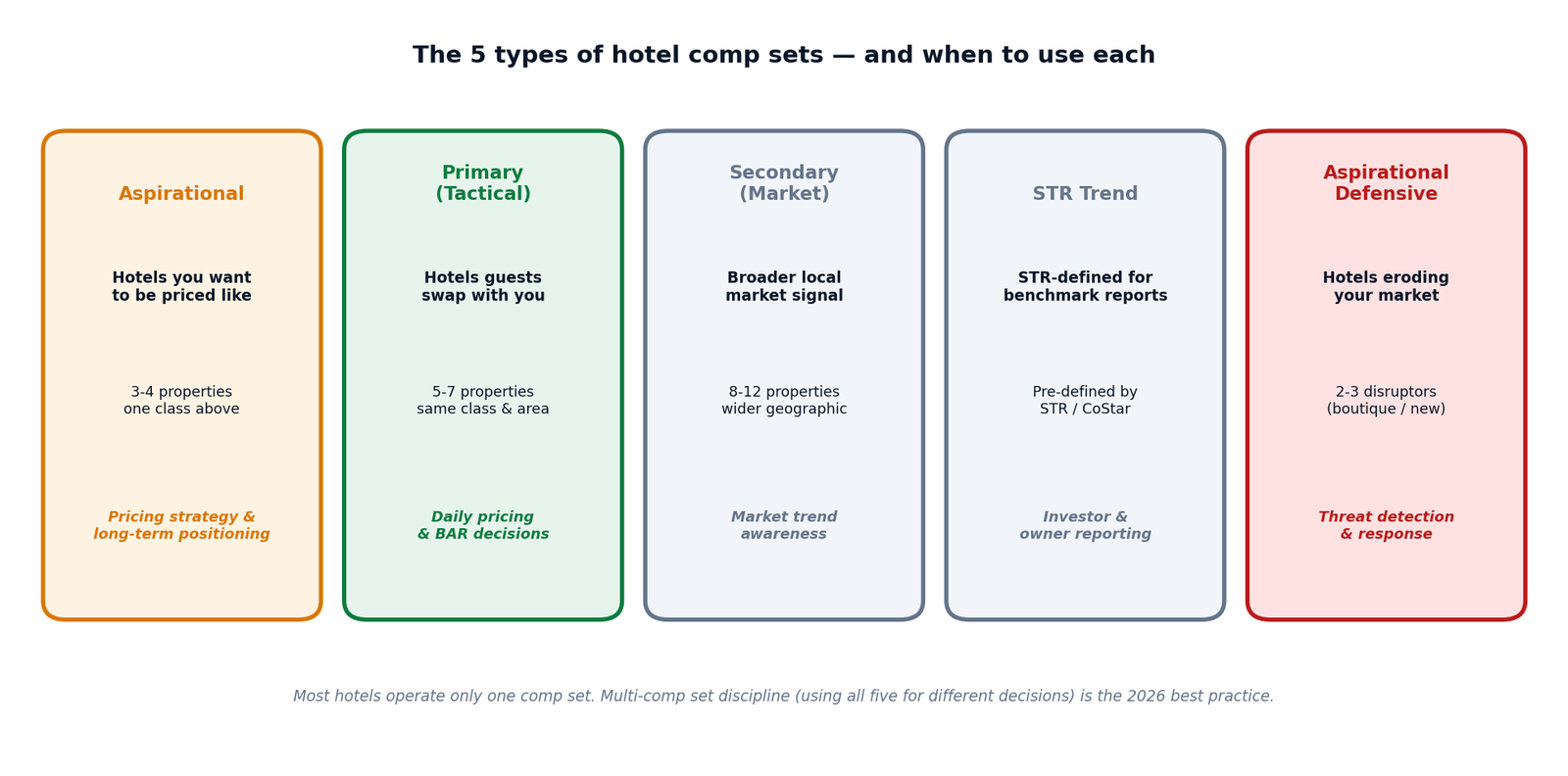
1. Primary (Tactical) Comp Set — for daily pricing decisions
Your primary comp set is the 5–7 properties whose rate movement most closely correlates with your own booking pace. These are the hotels guests actually swap with you when they shop. This is the comp set you watch every morning, the one your RMS pulls into BAR decisions, and the one your revenue manager defends in pricing meetings.
- Scope: 5–7 properties, same class, same micro-market, similar rate band
- Decision use case: Daily BAR setting, OTA rate decisions, weekend pricing strategy
- Refresh cadence: Quarterly review (mandatory)
2. Aspirational Comp Set — for long-term positioning
Your aspirational set is 3–4 properties one class above where you currently sit. You don’t price to them — you price toward them. Over 12–24 months, the gap between your ADR and the aspirational set’s ADR is the metric you’re trying to close.
- Scope: 3–4 properties, one class above, same market
- Decision use case: Pricing strategy, long-term positioning, capex investment justification
- Refresh cadence: Annual review
3. Secondary (Market) Comp Set — for trend awareness
Your secondary set is a wider 8–12 properties that captures broader market signal — including hotels in adjacent micro-markets and slightly different segments. Use this set to detect macro market shifts (a new convention attracting demand, a major employer leaving the area) before they show up in your primary set.
- Scope: 8–12 properties, wider geographic and segment scope
- Decision use case: Market trend awareness, macro signal detection
- Refresh cadence: Semi-annual review
4. STR Trend Comp Set — for owner and investor reporting
Your STR (or CoStar) trend comp set is the pre-defined comp set used in the STR/CoStar benchmarking reports your owner and asset manager receive. You don’t choose this set yourself — STR’s algorithm assigns it based on geographic, class, and amenity criteria. Your job is to know it, monitor your performance against it, and explain RGI variance when it appears.
- Scope: Pre-defined by STR/CoStar (typically 5–8 properties)
- Decision use case: Investor and owner reporting, Smith Travel benchmarking
- Refresh cadence: As STR updates (usually annual)
5. Aspirational Defensive Comp Set — for threat detection
Your defensive set is 2–3 disruptors that are eroding your market — typically newly opened boutique hotels, brand-flag conversions, or properties post-renovation. These are the hotels whose strategy will challenge yours next year, even if they’re not yet in your primary set. Watch them quarterly; respond before they show up in your tactical comp set.
- Scope: 2–3 disruptors (boutique, new, repositioned)
- Decision use case: Threat detection, response strategy, competitive intelligence
- Refresh cadence: Quarterly review (more frequent if active disruption)
The operator implication: If you’re running only a primary comp set, you’re operating without aspirational anchor, market trend awareness, owner reporting context, or threat detection. Each of the other four sets exists for a reason — and skipping them costs decision quality.
The 7-Step Comp Set Selection Process
This is the process every hotel should follow — once, formally, with documentation — to build their primary comp set. It applies to all property types, room counts, and markets.
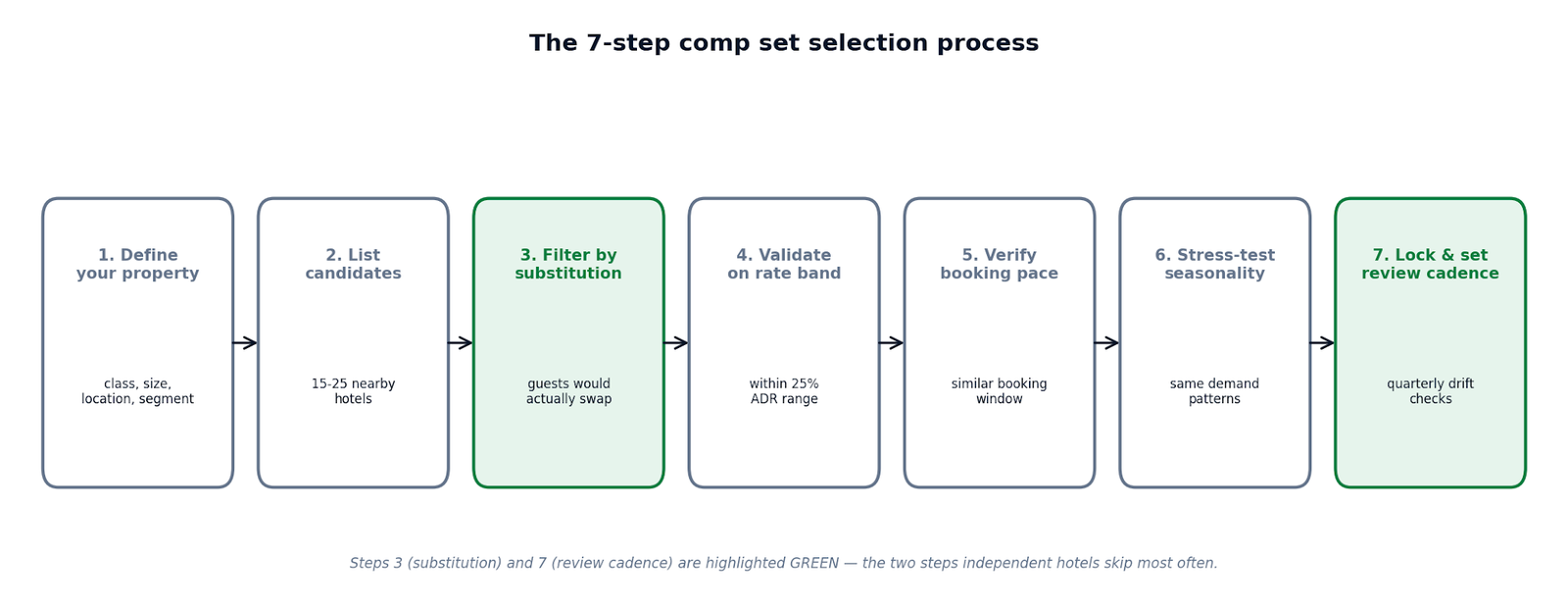
Step 1 — Define your property profile precisely
Before you can pick comparables, you need a precise, written description of your own property. Pull these data points:
- Star rating / class (limited-service, mid-scale, upscale, upper-upscale, luxury)
- Total rooms and physical configuration (king, queen, suite mix)
- Year of last major renovation
- Brand affiliation (independent / soft brand / branded / luxury collection)
- Primary segment mix (corporate %, leisure %, group %, government %)
- Booking window distribution (% bookings 0–7 days, 8–30 days, 31+ days)
- Geographic micro-location (CBD, airport, suburban, resort)
- Rate band (last 12 months ADR range)
This profile is the input that drives everything else. Skip this step and you end up comparing yourself to hotels that look similar on the surface but operate in completely different demand environments.
Step 2 — List 15–25 candidate hotels
Cast a wide net first. List every hotel within a reasonable substitution radius of yours — typically 3–5 miles in urban markets, 10–15 miles in suburban, 25+ miles in resort or rural. Include:
- All hotels in your class within the geographic radius
- Hotels one class above (potential aspirational picks)
- Hotels one class below (defensive watch list)
- Any newly-opened or recently-renovated property in the radius
- Any property your front-desk team mentions guests "considered before booking with us"
You’ll cut this list aggressively in subsequent steps. The goal here is breadth — make sure you don’t miss a strong substitute by prematurely narrowing.
Step 3 — Filter by booking substitution pattern
This is the most important filter and the most commonly skipped one. For each candidate, ask: does a guest who would book my property realistically also book this one? You can answer this empirically using:
- Front-desk lost-business reports: When a quote-and-no-book happens, where did the guest go instead?
- Booking engine bounce data: What sites do guests visit before/after your direct site?
- Cancellation reason analysis: When a guest cancels, where do they re-book?
- Survey data: Direct guest questions ("which other hotels did you consider?")
- Rate-shopping correlation: Across 90 days, which hotels’ rate movements correlate most strongly with your own booking pace?
Hotels that pass this filter are real substitutes. Hotels that fail this filter are not, no matter how similar they look on paper.
Step 4 — Validate on rate band (ADR within ±25%)
Cut any property whose 12-month average ADR is more than ±25% from yours. A property with $260 ADR is not a substitute for a $140 ADR property, even if they’re across the street from each other. Different guests, different price expectations, different booking behavior.
For aspirational comp sets, you can stretch to +35–40% ADR. For primary tactical comp sets, hold the ±25% line strictly.
Step 5 — Verify booking pace and window similarity
Two properties with identical ADR can have completely different booking-window distributions. A corporate-heavy hotel that books 70% within 14 days behaves differently in pricing decisions than a leisure-heavy hotel that books 60% at 45+ days out. Verify that candidate hotels have a similar booking-window profile to yours:
- Segment mix (corporate vs leisure vs group)
- Length of stay distribution
- Day-of-week occupancy patterns
If you don’t have direct booking-pace data on competitors (you usually won’t), proxy via the items above.
Step 6 — Stress-test on seasonality
Run the candidate comp set against three high-stress periods: peak season (your highest-occupancy month), low season, and a known event (convention week, school holiday, major sports event). Does the comp set move with you in all three?
If a candidate property prices independently of your market during peak season — for example, holds high rates while everyone else discounts — it’s not a true substitute. Cut it.
Step 7 — Lock the comp set and set a quarterly review cadence
Document your comp set with property-by-property selection rationale. Lock it in your RMS, your rate-shopping tool, and your reporting templates. Then put a quarterly review on the calendar.
Quarterly review is the single most under-implemented step in the comp set lifecycle. New hotels open. Existing hotels renovate. Competitors close. Demand shifts. Comp sets degrade — and the degradation is invisible until pricing recommendations start producing surprising bookings.
How to Weight Your Comp Set Selection Criteria
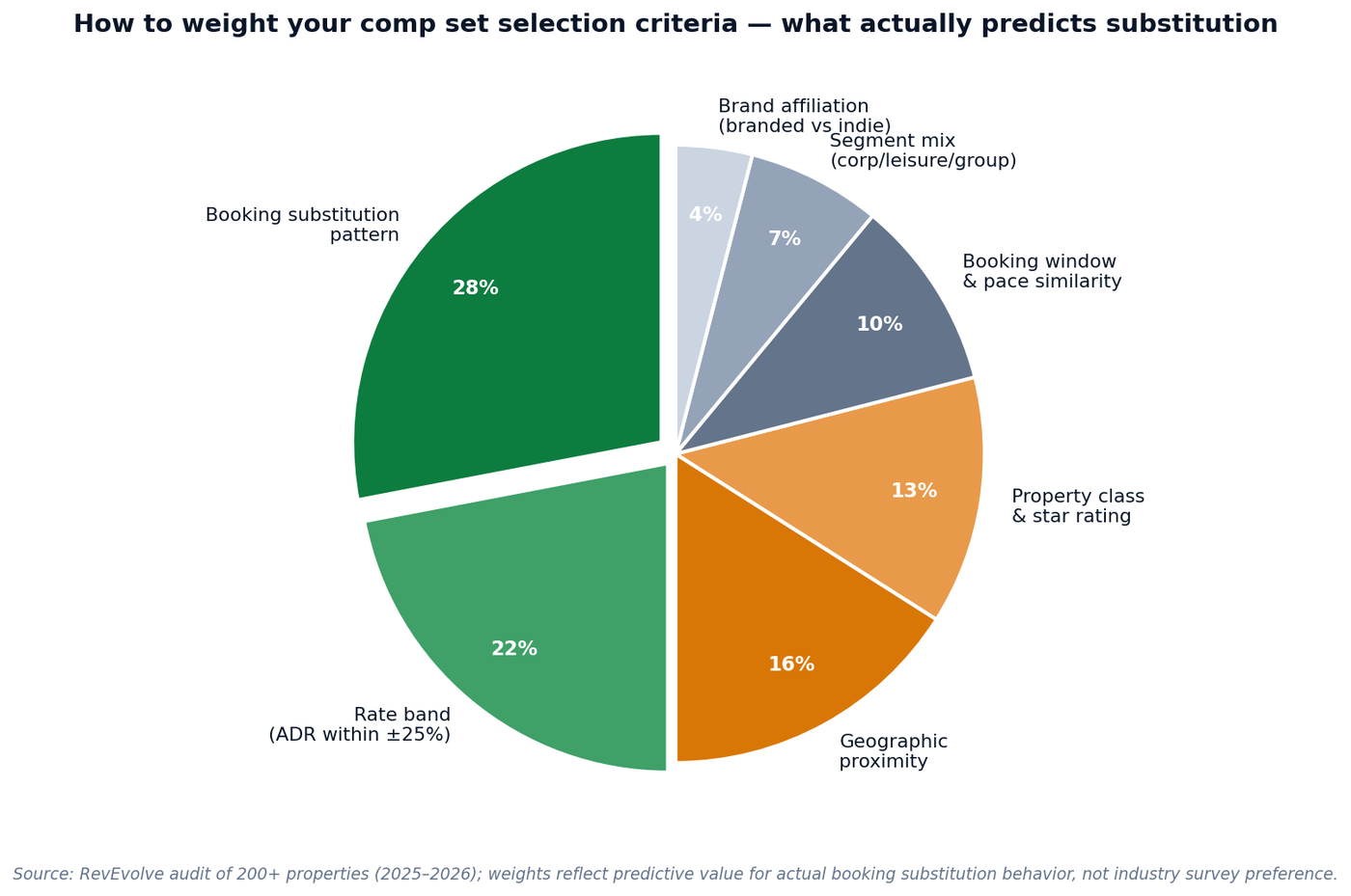
The pie chart above is the most counterintuitive part of this guide. Most hotel operators think they weight comp set selection criteria in roughly this order:
- Geographic proximity (closest = most relevant)
- Brand affiliation (same flag = most relevant)
- Star rating / class
What actually predicts booking substitution behavior — across 200+ properties RevEvolve has audited — is closer to:
| Criterion | Predictive weight | Why it matters |
|---|---|---|
| Booking substitution pattern | 28% | Direct evidence of substitute behavior; the highest-signal data point |
| Rate band (ADR within ±25%) | 22% | Guests at $140 don’t shop $260 properties (and vice versa) |
| Geographic proximity | 16% | Important but overweighted; not the top criterion |
| Property class & star rating | 13% | Useful proxy when no other data; weaker than people think |
| Booking window & pace similarity | 10% | Correlates with segment mix; differentiates corporate vs leisure |
| Segment mix (corp/leisure/group) | 7% | Important but partially captured by booking window |
| Brand affiliation (branded vs indie) | 4% | Surprisingly low; guests substitute across brands more than expected |
The headline finding: brand affiliation matters far less than most operators assume (4%). Independent hotels regularly substitute with branded peers and vice versa. The strongest signals are behavioral (substitution pattern, rate band) — not categorical (class, brand).
Hotels that select their comp set primarily on geographic proximity and brand affiliation end up with a benchmark group that looks right and acts wrong. Pricing recommendations from a wrong-feeling-right comp set are the most dangerous kind — because no one questions them.
Comp Set Drift — Why Your Set Goes Stale
The most overlooked truth about comp sets: they have a half-life.
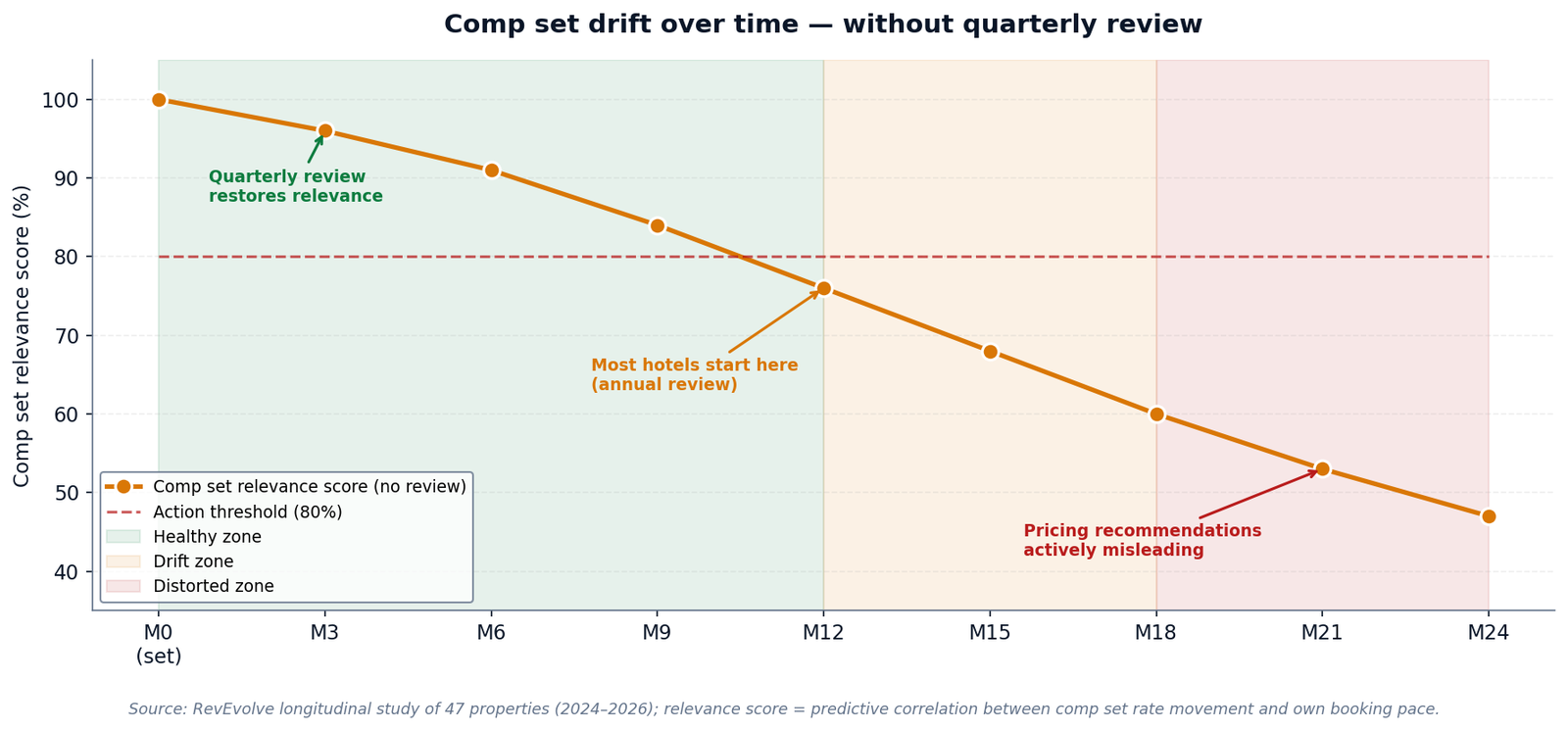
The drivers of this drift:
- New hotels open in your market (typically 1–3% room supply growth annually)
- Existing hotels renovate and reposition up- or down-class
- Brand conversions change the segment of an established competitor
- Major employers move in or out of your market, shifting corporate demand patterns
- OTA market share shifts within the comp set (some properties move to direct-heavy strategies)
- Your own property changes (renovation, brand change, segment shift)
The three zones of comp set health
Healthy zone (M0–M12, ~80%+ relevance): The comp set is doing its job. Pricing recommendations derived from comp set rate movement are predictive. Forecast accuracy is high.
Drift zone (M12–M18, 60–80% relevance): The comp set is degrading. Pricing recommendations are becoming noisier; forecast accuracy is declining. Quarterly review would catch and correct this.
Distorted zone (M18+, <60% relevance): The comp set is now actively misleading. Rate movements in the comp set are producing pricing recommendations that don’t match real demand. Hotels in this zone are pricing themselves wrong without knowing it — which is the worst possible position to be in.
How comp set drift hides
The reason drift goes uncaught is structural: comp set rate data still looks clean. The comp set is still 5–7 hotels, still produces a daily competitor rate report, still gets fed into the RMS. What’s broken is not the data feed — it’s the relevance. And relevance is invisible without continuous calibration against your own booking outcomes.
This is exactly what modern competitive rate intelligence platforms now do automatically: they continuously compute the predictive correlation between each comp set member’s rate movement and the property’s booking pace, and flag the moment a member drops below threshold. Manual quarterly reviews are the floor; agentic AI continuous calibration is the ceiling.
The 4 Most Expensive Comp Set Mistakes
These are the patterns RevEvolve audit teams see most consistently — and the ones that hurt revenue most directly.
Mistake 1 — Wrong rate band (comp set above your class)
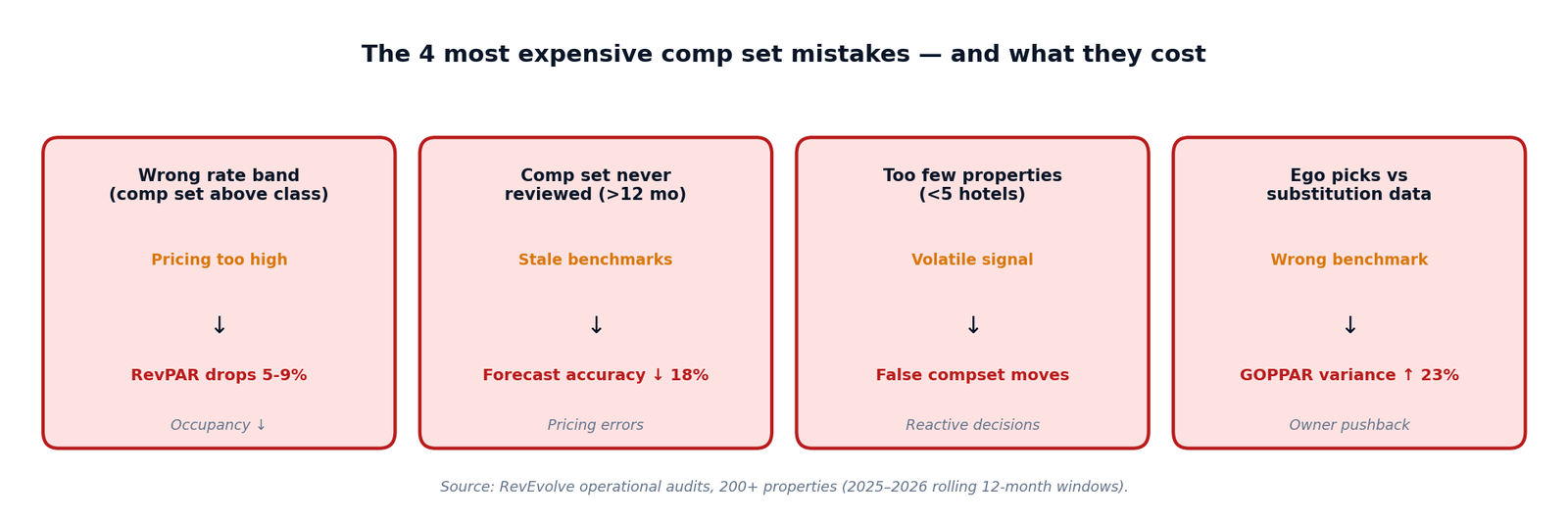
The most common pricing-strategy mistake. Hotels build a comp set of properties whose ADR is 30–50% above their own — out of aspiration or front-of-the-mind familiarity — and start pricing to match. The result: occupancy collapses while ADR climbs, RevPAR drops 5–9%, and the property gets compared unfavorably against its actual peers in owner reporting.
Mistake 2 — Comp set never reviewed (>12 months stale)
Per the drift chart above, an unreviewed comp set is 24% less predictive after 12 months. Forecast accuracy drops by ~18% on average; pricing recommendations become noisier; the RMS gets blamed for outputs that are correct given the (now wrong) inputs.
Mistake 3 — Comp set too small (<5 properties)
A 3-property comp set is dominated by the noise of any single property. If one of those three has a one-off event (renovation, OTA promotion, group block at distressed rates), the comp set signal jumps even though nothing real changed. Pricing recommendations follow the noise.
Mistake 4 — Ego picks instead of substitution data
The hotels your GM wants to be compared against are not necessarily the hotels guests substitute with. Ego picks are aspiration cosplaying as benchmark. Common patterns: "We’re like the W down the street" (different rate band, different segment), "We compete with the boutique on Main Street" (closed last year), "We benchmark to the airport Hilton" (different segment mix entirely). The cost: 23% increase in GOPPAR variance across the portfolio, owner pushback in monthly reporting, and pricing recommendations the revenue manager has to manually override.
How to Use Your Comp Set in Daily Operations
A correctly built comp set is only valuable if you actually operate against it. Here’s the daily, weekly, and monthly rhythm:
Daily — Rate parity and BAR alignment
- Check your BAR vs the comp set median for the next 14 days
- Identify any date where your rate is more than 10% above or below the comp set median
- For each gap, note whether it’s intentional (event, weekend strategy) or drift (channel sync issue, OTA discount funding) — see our guide to hotel rate parity
- Push BAR adjustments to the channel manager before peak booking hours (typically 9–10am local time)
Weekly — Pace and pickup analysis
- Review own pace vs comp set pace for the next 30 / 60 / 90 days
- Identify dates where comp set pickup is materially ahead of yours (you may be priced too high) or behind yours (you may be priced too low)
- Cross-check with own booking-window data; corporate-heavy properties react slower to rate changes than leisure
- Adjust BAR rules and length-of-stay restrictions accordingly
Monthly — Strategy and reporting
- Pull RGI (Revenue Generation Index) vs comp set for the month
- Pull MPI (Market Penetration Index — occupancy) and ARI (Average Rate Index)
- Document any month where MPI > 100 and ARI < 100 (you’re filling rooms but at lower rates; investigate)
- Document any month where MPI < 100 and ARI > 100 (you’re pricing high and losing share; investigate)
- Report all three indices in monthly owner reporting alongside RevPAR and GOPPAR
Quarterly — Comp set health check
- Compute the predictive correlation between each comp set member’s rate movement and your booking pace over the last 90 days
- Any member below 0.7 correlation: candidate for replacement
- Add 1–2 new candidates from the wider candidate pool (Step 2 above)
- Re-validate on rate band and booking pace
- Document changes with rationale (you’ll need this for owner conversations)
Comp Set Tools — From Spreadsheets to Agentic AI
The tools available for comp set management in 2026 sit on a spectrum:
Manual spreadsheets
The starting point for many independent hotels. A revenue manager opens 5–7 OTA listings, logs rates daily, computes simple averages.
- Strength: Free, full operator control
- Weakness: Slow, inconsistent, high error rate, no drift detection
- Verdict: Adequate only for properties under 30 rooms with stable comp sets
Rate-shopping tools (Lighthouse Pricing, RateGain, OTA Insight legacy)
Pull comp set rates automatically on a scheduled cadence, surface in a dashboard.
- Strength: Reliable data, automated; standard for boutique through mid-market
- Weakness: Don’t detect comp set drift; you still build and maintain the set manually
- Verdict: Industry standard for properties with active revenue managers
Real-time competitive intelligence platforms
Continuously poll rates, alert on parity breaks, surface pace and pickup signals.
- Strength: Best-in-class monitoring; low-latency alerts
- Weakness: Still recommendation-only; comp set selection and review is still manual
- Verdict: Strong fit for independent luxury, branded, and groups with mature RM teams
Agentic AI competitive intelligence (RevEvolve)
Detects comp set drift automatically, recommends additions/removals, and feeds the validated comp set directly into autonomous pricing decisions via RM Copilot. Continuous calibration loop, not a quarterly check-in.
- Strength: Closes the detect-to-update loop; comp set health is continuous, not periodic
- Weakness: Newer category; requires owner trust threshold for autonomous mode
- Verdict: The 2026 standard for multi-property operators and revenue management companies
For a wider view of the category, see our 2026 guide to hotel revenue management software — 14 platforms compared.
Conclusion — Build the Set, Then Keep It Honest
Most hotels treat comp set construction as a one-time event. They build a list, lock it into the rate-shopping tool, and move on. That posture is the source of more bad pricing decisions than any single other operational gap in revenue management.
In 2026, comp set analysis is an operating discipline. The right comp set is built from booking-substitution data, not ego. It runs as five distinct sets serving five distinct decisions, not one set serving everything. It is reviewed quarterly at the floor, continuously at the ceiling. And its predictive relevance is computed against actual booking outcomes — not assumed from when the set was first built.
The hotels that get this right outperform their comp set peers by 5–9% in RevPAR within 12 months — not because they have better strategy, but because their strategy is benchmarked correctly. The hotels that get this wrong keep wondering why their RMS recommendations don’t match what they see in the market. The answer is rarely the RMS. The answer is the comp set.
Stop benchmarking against the wrong hotels in 2026.
- → See RevEvolve’s Competitive Rate Intelligence in action — continuous comp set calibration with autonomous response. 15-min walkthrough.
- → Download the Comp Set Selection Template (free) — printable scoring template that walks you through the 7-step process.