SNIPPET DEFINITION — Hotel upselling is offering a guest a higher-value room or add-on for additional revenue — an upgrade from standard to suite, a package, an early check-in. It lifts ADR only when the upgrade is priced to add rate rather than give it away: too cheap and you move guests up for free, too expensive and no one converts. The skill is finding the price gap that both converts and grows your average rate.
Two front desk agents work the same shift. Both “upsell.” One hands out room upgrades for ten dollars to be friendly, fills every suite by noon, and moves the ADR needle exactly zero. The other offers the right guest the right upgrade at the right price, converts fewer of them — and lifts the hotel’s average rate for the night.
That gap is the whole point. Upselling that fills better rooms is easy. Upselling that actually grows revenue is a discipline, and it hinges on something most upsell advice skips: the price.
We ‘upsell’ by giving cheap upgrades at check-in. The rooms fill but our ADR doesn’t move at all. Upselling to a guest who’d have paid the higher rate anyway isn’t upselling — it’s discounting.
Key takeaways
- Upselling offers a higher room or add-on for more revenue.
- Filling upgrades isn’t the goal — lifting ADR is.
- A too-cheap upgrade gives rate away; a too-expensive one won’t convert.
- Pre-arrival and check-in are the highest-converting moments.
- Measure upsell in ADR lift, not the number of upgrades.
What is hotel upselling?
Both grow revenue per guest. But upselling has a special relationship with rate: because it moves a guest into a higher-priced room, done right it directly lifts your ADR — and done wrong, it quietly doesn’t.
Why most upselling doesn’t lift ADR
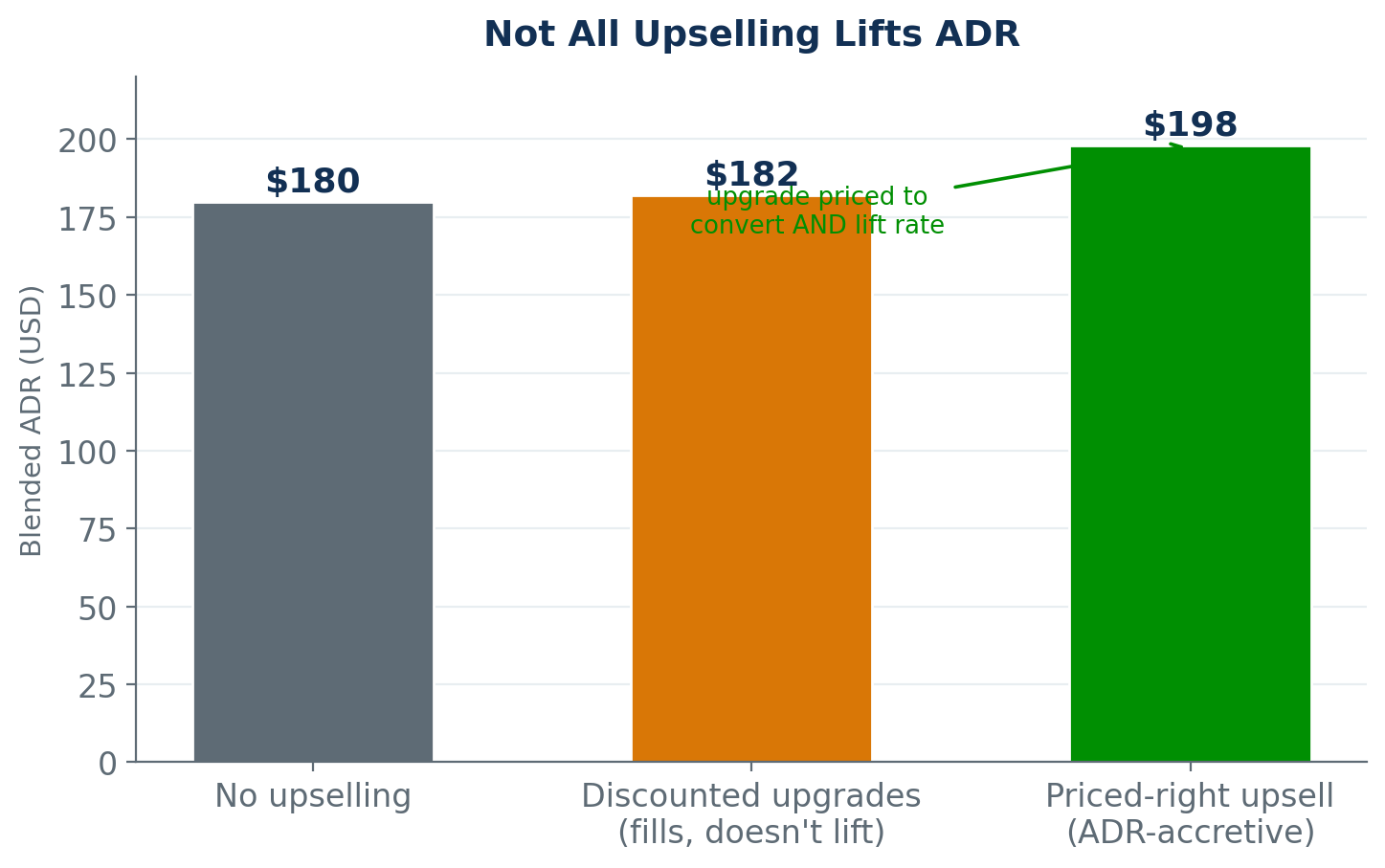
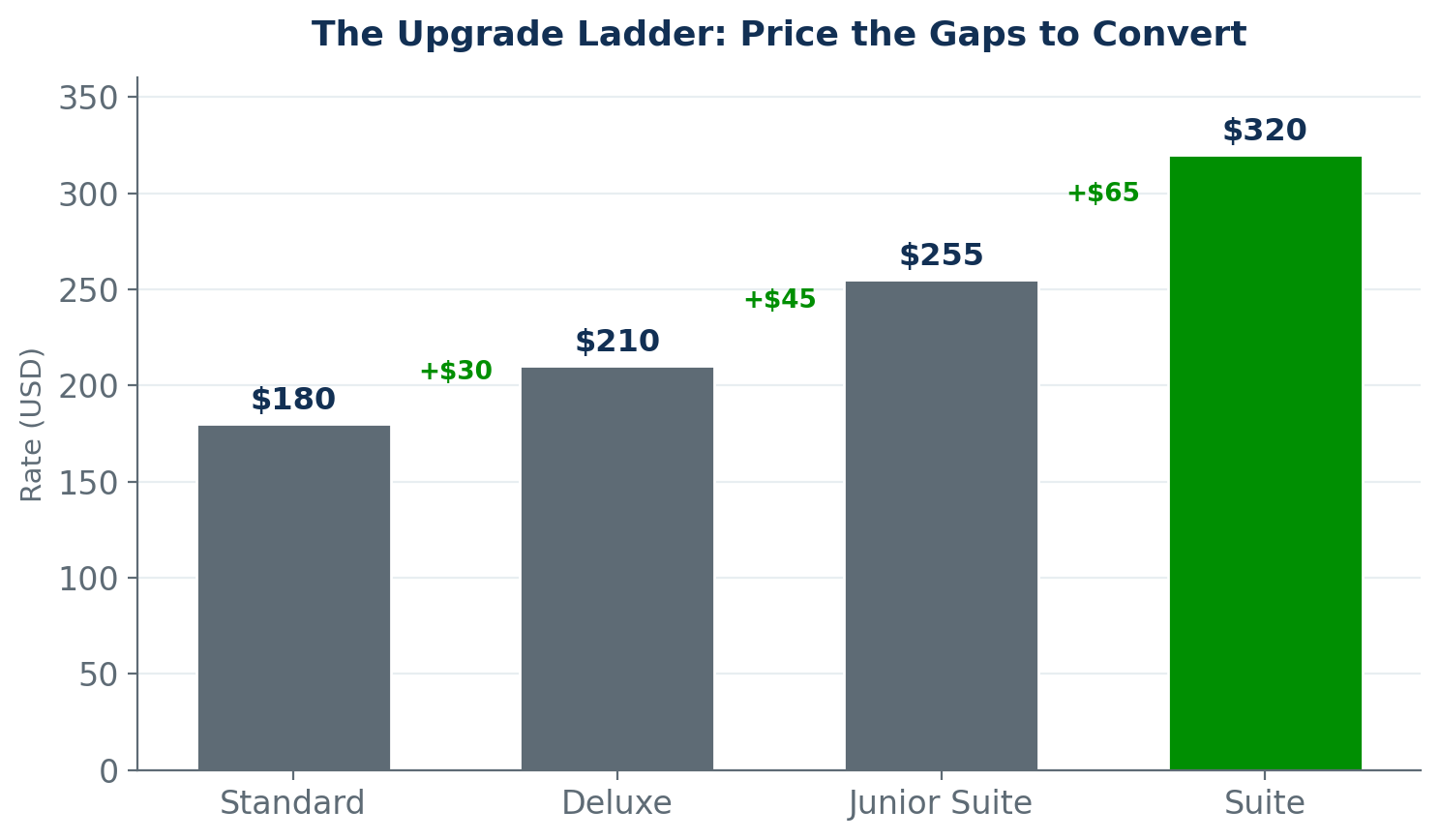
Here’s the trap. A guest booked a standard at $180. You offer the deluxe for $10 more, they take it, and you feel like you upsold. But the deluxe normally sells for $210 — you just moved a guest into a $210 room for $190 and your ADR barely moved. You filled a better room; you didn’t grow rate. Multiply that across a shift and your ‘upselling’ is really a discount program.
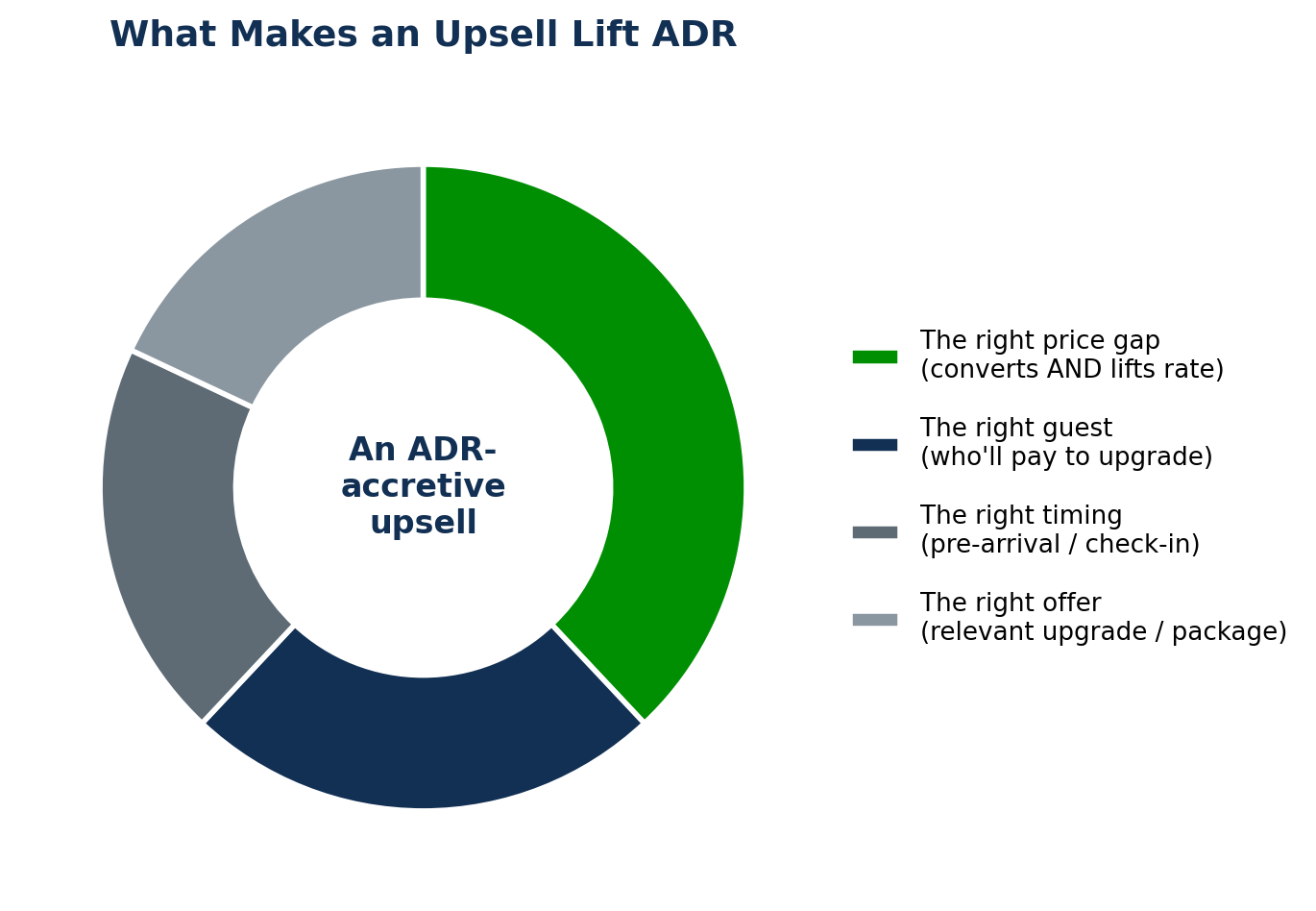
There are three ways upselling fails to lift ADR: pricing the upgrade too low (giving it away), upselling a guest who’d have booked the higher room anyway (cannibalizing your own rate), and upselling just to fill premium rooms rather than to grow revenue. All three feel productive and none of them move the number that matters.
The three upsell moments
Upselling happens at three points in the guest journey, and each has a different rhythm.
| Moment | How it works | Why it converts |
|---|---|---|
| Pre-arrival | An email or app offer days before arrival | Guest is excited, planning, low pressure |
| Check-in | The front desk offers at the counter | Personal, real-time, reads the guest |
| In-stay | An offer during the stay (late checkout, upgrade) | Guest already values the experience |
Pre-arrival catches the guest while they’re anticipating the trip; check-in catches them in person, where a good agent can read whether an upgrade will land. In-stay offers work but convert less — the decision moment has largely passed.
Front desk upselling that works
The front desk is where upselling is most personal and most often fumbled. A few principles separate the agent who lifts ADR from the one who hands out free upgrades.
- Read the guest — a couple on an anniversary is an upsell; a road-warrior on a per-diem usually isn’t.
- Offer, don’t discount — present the upgrade at a real price, not a token “just $10.”
- Sell the benefit, not the room — “a quieter floor with a city view” beats “a deluxe.”
- Give the team a reason — an incentive tied to upsell revenue turns a nicety into a habit.
The last one matters most. A front desk with no stake in upsell revenue defaults to being generous — free upgrades feel like good service. Tie a small incentive to upsell rate captured, and the same agents start pricing the offer instead of giving it away.
How to price upgrades so they lift ADR
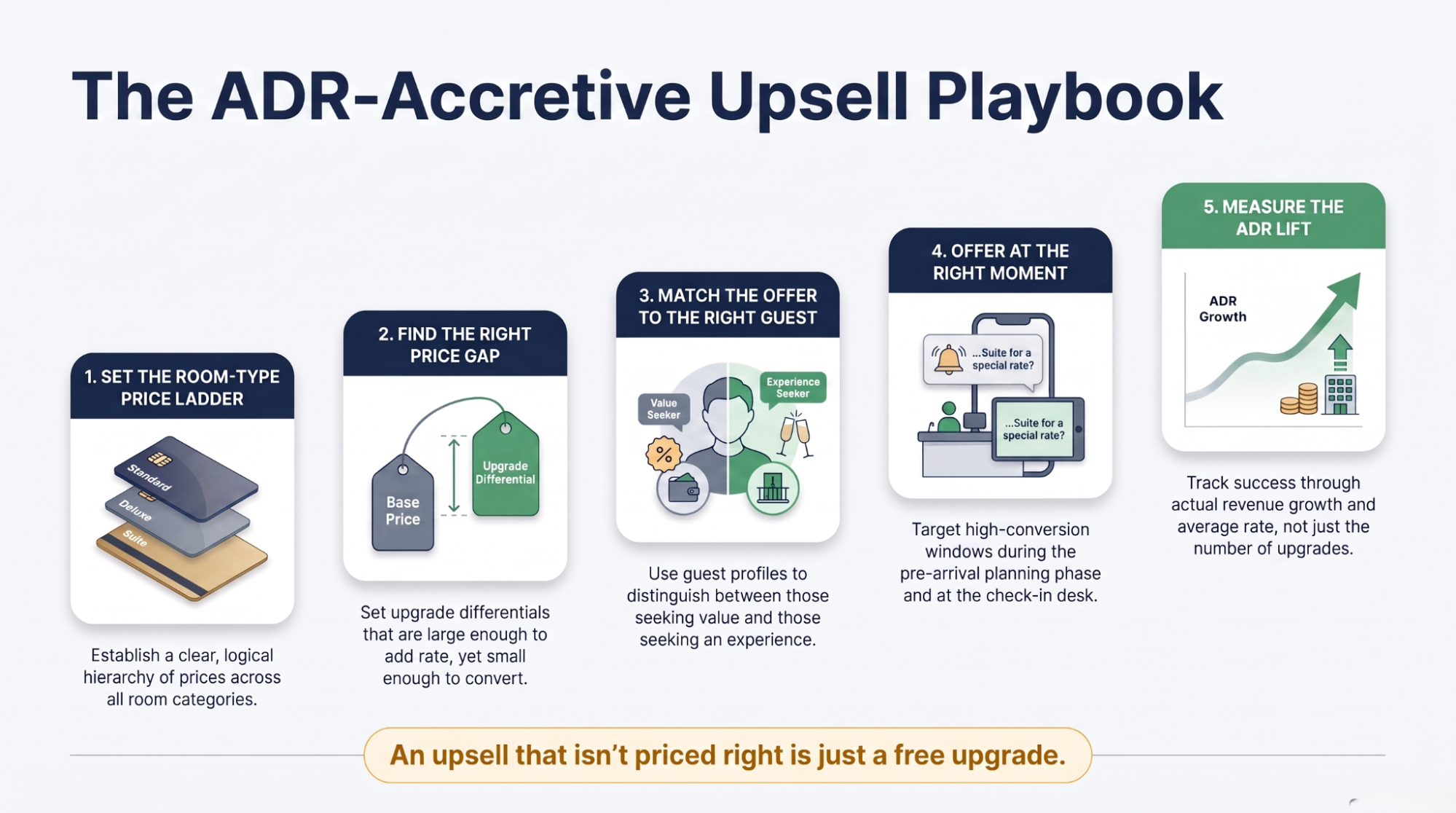
This is the revenue manager’s part of upselling, and it’s the part that makes the rest work. Every upgrade offer is a price gap — the difference between the room the guest booked and the one you’re offering. Set that gap wrong and no amount of front-desk charm saves it. The gap lives inside your rate architecture, the ladder of room-type prices that everything else derives from.
The gap has a sweet spot. Too small, and you convert everyone but add almost no rate — the $10 upgrade problem. Too large, and no one bites. The right gap converts a healthy share of guests at a price that meaningfully lifts your blended rate. And because demand moves, the ideal gap moves too: on a high-demand night the upgrade should cost more, because the premium room is genuinely scarcer.
Upsell strategies that actually grow rate
- Package the upgrade — bundle the better room with an add-on so the value is obvious and the rate comparison less direct.
- Price the ladder to demand — widen upgrade gaps on high-demand nights, narrow them on soft ones.
- Personalize the offer — use booking data (occasion, loyalty tier, past stays) to offer the upgrade most likely to land.
- Offer scarcity honestly — “we have two suites left” converts when it’s true; overuse kills trust.
- Automate the easy wins — a well-timed pre-arrival email captures the guests who’d upgrade without any prompting.
Where upselling goes wrong
1 · Discounting the upgrade
The token “$10 more” upgrade is the most common mistake. It converts because it’s barely a decision — and it adds almost nothing to ADR. Price the gap to matter.
2 · Upselling to fill, not to grow
Filling premium rooms is an operations goal, not a revenue one. If the aim is a full suite floor rather than a higher rate, you’ll happily discount your way there and call it success.
3 · Cannibalizing your own rate
Offering an upgrade to a guest who would have booked the higher room anyway just moves them down in price. Target upsells at guests who booked the lower category on purpose.
4 · Not measuring it
If you count upgrades instead of measuring ADR lift, you’ll optimize for the wrong thing — more upgrades, not more revenue.
How to measure upsell ADR lift
Measure the outcome, not the activity. Track upsell revenue as its own line, watch ADR on nights with and without an upsell push, and look at the conversion rate against the rate added — not just how many upgrades sold. For the full picture, read upsell revenue against your RevPAR and ADR, and net of any cost, against net revenue. A program that sells lots of upgrades but doesn’t move ADR is a discount program wearing an upsell badge.
How RevEvolve helps (and where it doesn’t)
RM Copilot is an operator-facing AI revenue copilot. It analyzes demand and recommends pricing across your room types — including the differentials between categories — so the upgrade gaps are set to convert and to add rate, and it moves those gaps with demand. It surfaces where an upgrade is priced to give rate away and recommends a correction. Then your team applies it, and your guest-facing upsell does the selling on top of a rate structure built to lift ADR.
Hotel upselling: three objections
Price the gap, or you’re just discounting
Upselling gets treated as a front-desk skill, and the technique does matter. But the reason most upsell programs don’t show up in ADR isn’t that agents lack charm — it’s that the upgrade was priced to be taken, not priced to add rate.
Set the ladder so each step converts and contributes, move the gaps with demand, target the guests who genuinely booked down, and measure the ADR lift rather than the upgrade count. Do that and upselling stops being a nicety and starts being a rate strategy.
Keep going: Average Daily Rate (ADR) · BAR & rate fences · NRevPAR explained · The 20 hotel KPIs.