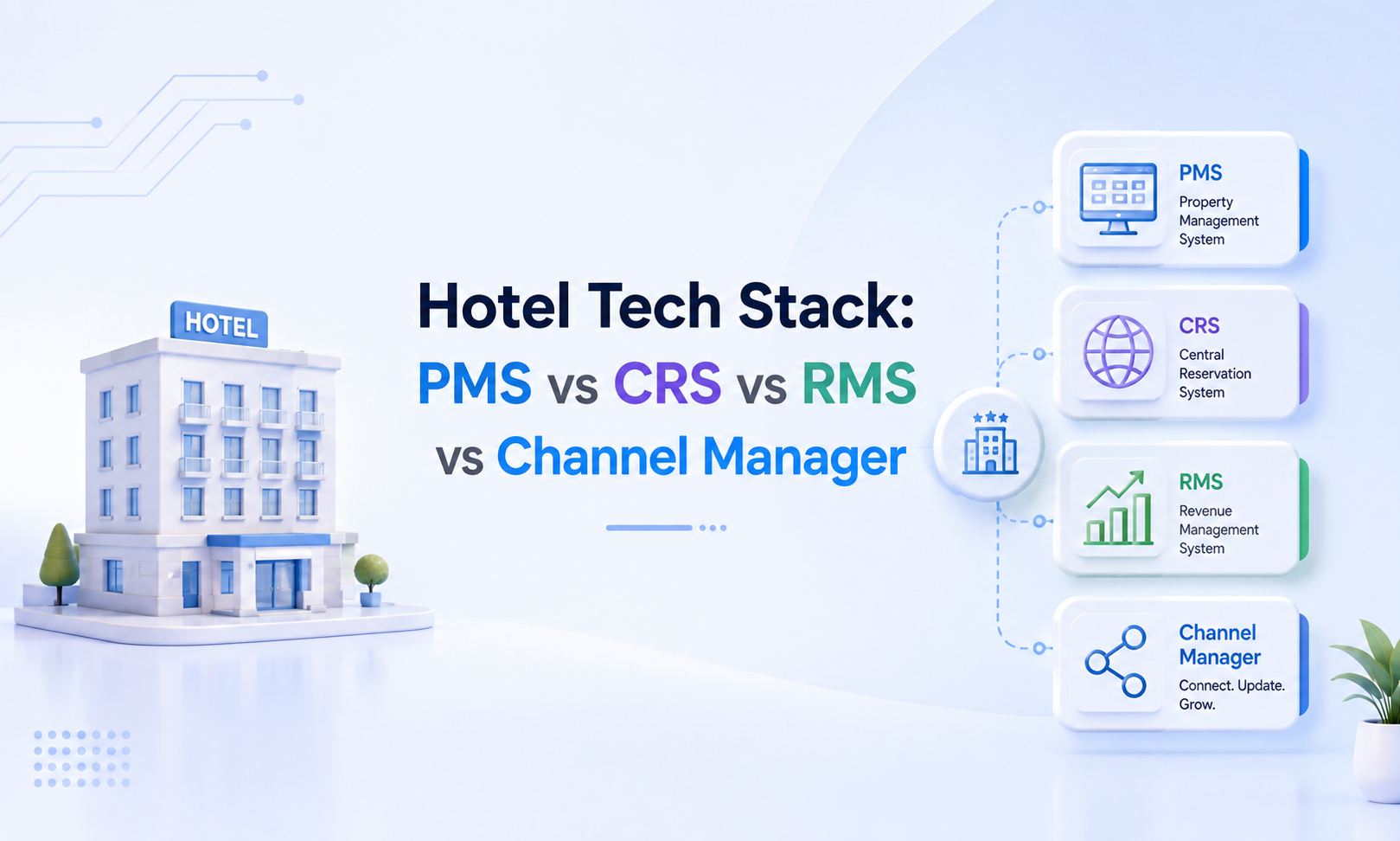
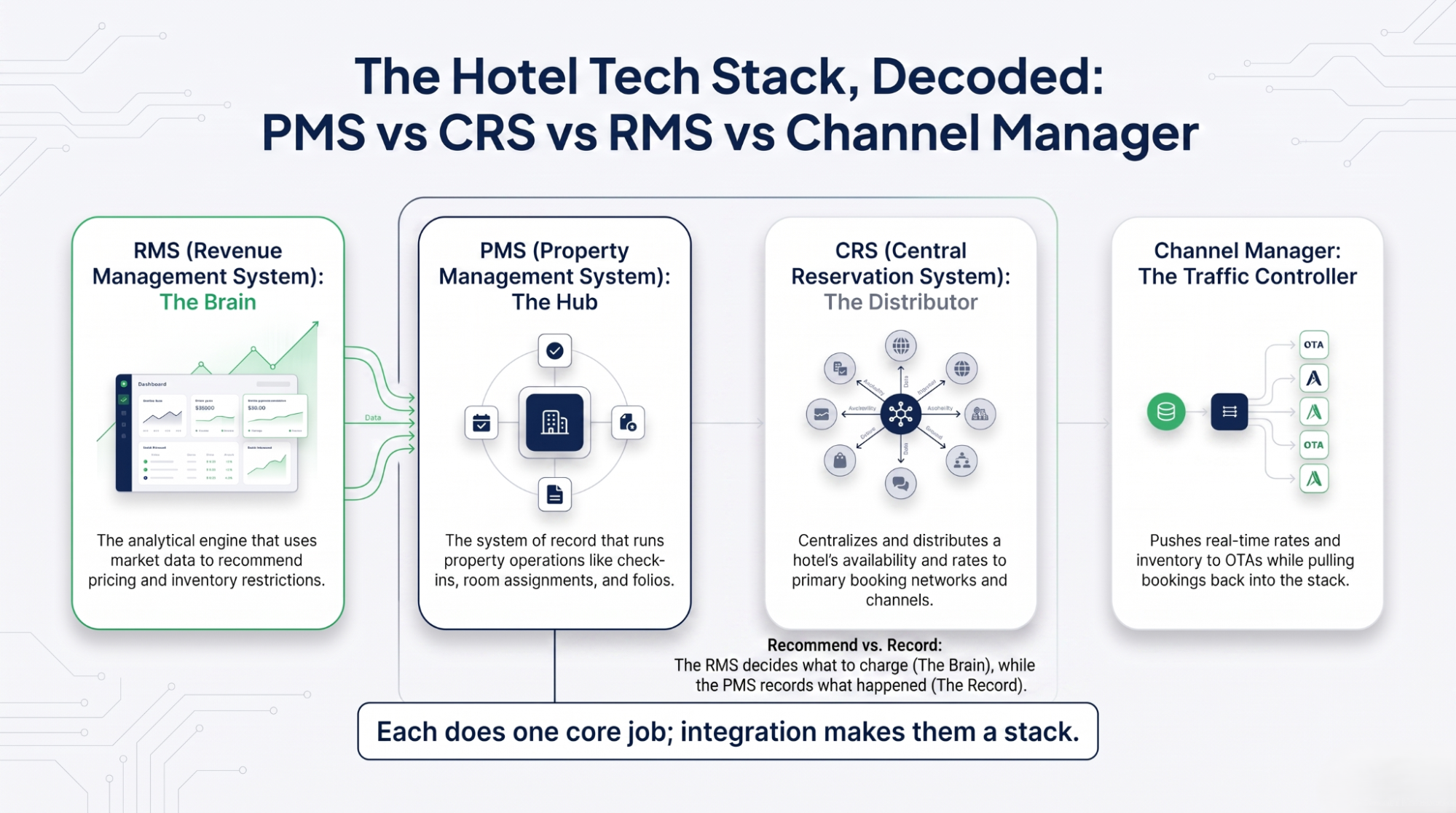
SNIPPET DEFINITION — A hotel tech stack is the set of connected systems that run a property. The PMS (property management system) is the operational hub and system of record. The CRS (central reservation system) distributes availability and rates. The RMS (revenue management system) recommends pricing. The channel manager pushes rates and inventory to OTAs and other channels. Each does one core job; the value is in how they connect.
Four acronyms, a dozen vendors, and every one of them claims to do everything. Somewhere between the sales decks, the difference between a PMS, a CRS, an RMS, and a channel manager gets lost — and hotels end up paying for overlap they don’t need or missing a system they do.
Here’s the clean version. Each system has one core job. Once you can name that job, the overlap stops being confusing and the stack starts making sense. This guide draws the map — what each system does, how they connect, and which ones you actually need.
Every vendor says their product does everything, so I still can’t tell where the PMS ends and the RMS begins. Ownership asks me the difference and I fumble it every time.
Key takeaways
- PMS = the operational hub and system of record.
- CRS = distributes availability and rates centrally.
- RMS = recommends what to charge (pricing & forecasting).
- Channel manager = pushes rates/inventory to OTAs and channels.
- The systems overlap at the edges; integration is what makes them a stack.
Why the hotel tech stack confuses everyone
The confusion is real, and it isn’t your fault. Three things drive it. First, vendors bundle — a PMS that includes a channel manager, an RMS built into a CRS — so the lines blur. Second, the systems genuinely overlap at the edges: both a CRS and a channel manager touch distribution, for instance. Third, the acronyms sound interchangeable when you’re new to them.
The fix is to anchor on each system’s core job — the one thing it exists to do — and treat everything else as a feature bolted on. That’s how the rest of this guide is organized.
What is a PMS (property management system)?
If you removed one system and the front desk stopped functioning, it’s the PMS. It doesn’t decide prices or distribute rates on its own — it runs the property and records what happens.
What is a CRS (central reservation system)?
For a single independent hotel, the PMS and booking engine may cover much of this. For brands and groups, the CRS is what keeps reservations consistent across every property and channel from one place.
What is an RMS (revenue management system)?
This is the system most often confused with the PMS, which is why it gets its own comparison below. Short version: the RMS recommends prices; the PMS records what actually happened.
What is a channel manager?
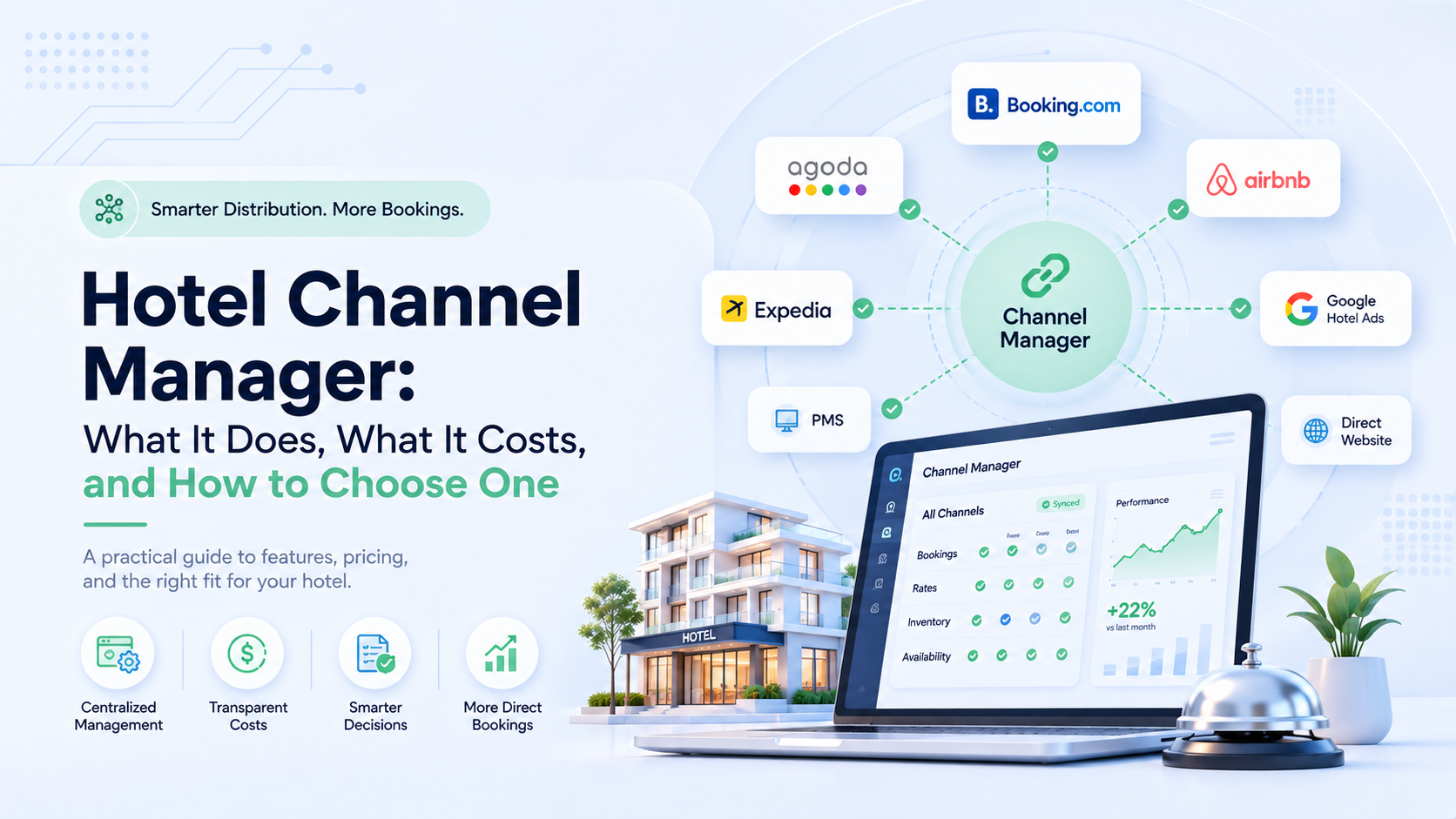
A channel manager pushes your rates and available inventory out to OTAs, the GDS, and other booking channels — and pulls bookings back in — so you don’t update each channel by hand or oversell a room sold on two sites at once. It’s the distribution traffic controller. We cover it in depth in the channel manager guide; for the stack picture, that one-line job is all you need. It sits between your rates and the distribution channels that sell your rooms.
PMS vs CRS vs RMS vs channel manager: the comparison
Here are the four systems side by side. Read down the “core job” row first — that’s the fastest way to tell them apart.
| PMS | CRS | RMS | Channel Mgr | |
|---|---|---|---|---|
| Core job | Run the property | Distribute reservations | Recommend pricing | Push to channels |
| Think of it as | The hub / record | The distributor | The brain | The traffic controller |
| Owns | Guest data, folios | Availability & rates | Price recommendations | Channel connections |
| Decides price? | No | No | Recommends it | No |
| Talks to | Everything | PMS, channels | PMS, market data | PMS/CRS, OTAs |
| Primary user | Front desk / ops | Reservations | Revenue manager | Distribution |
How the four systems connect
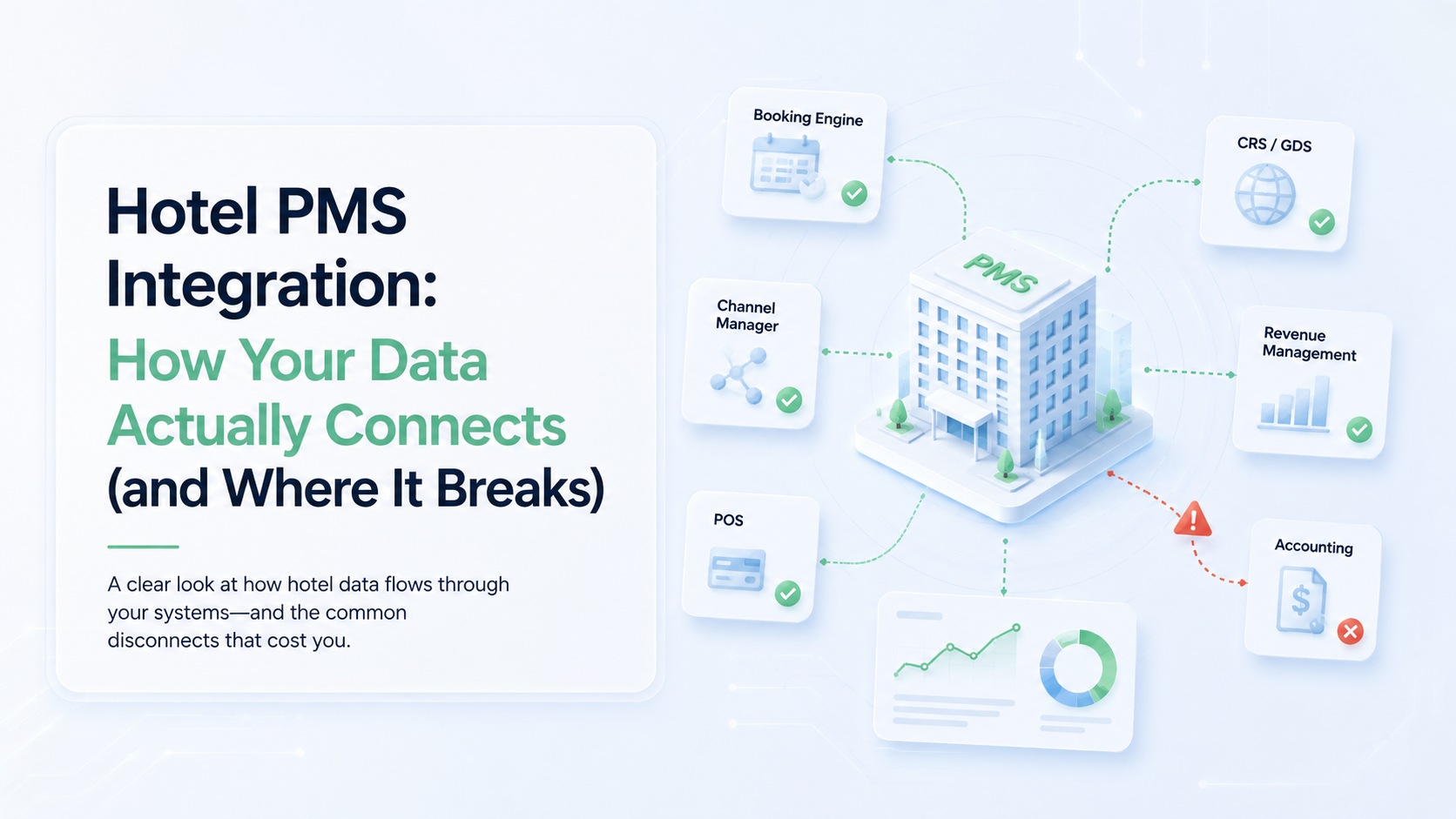
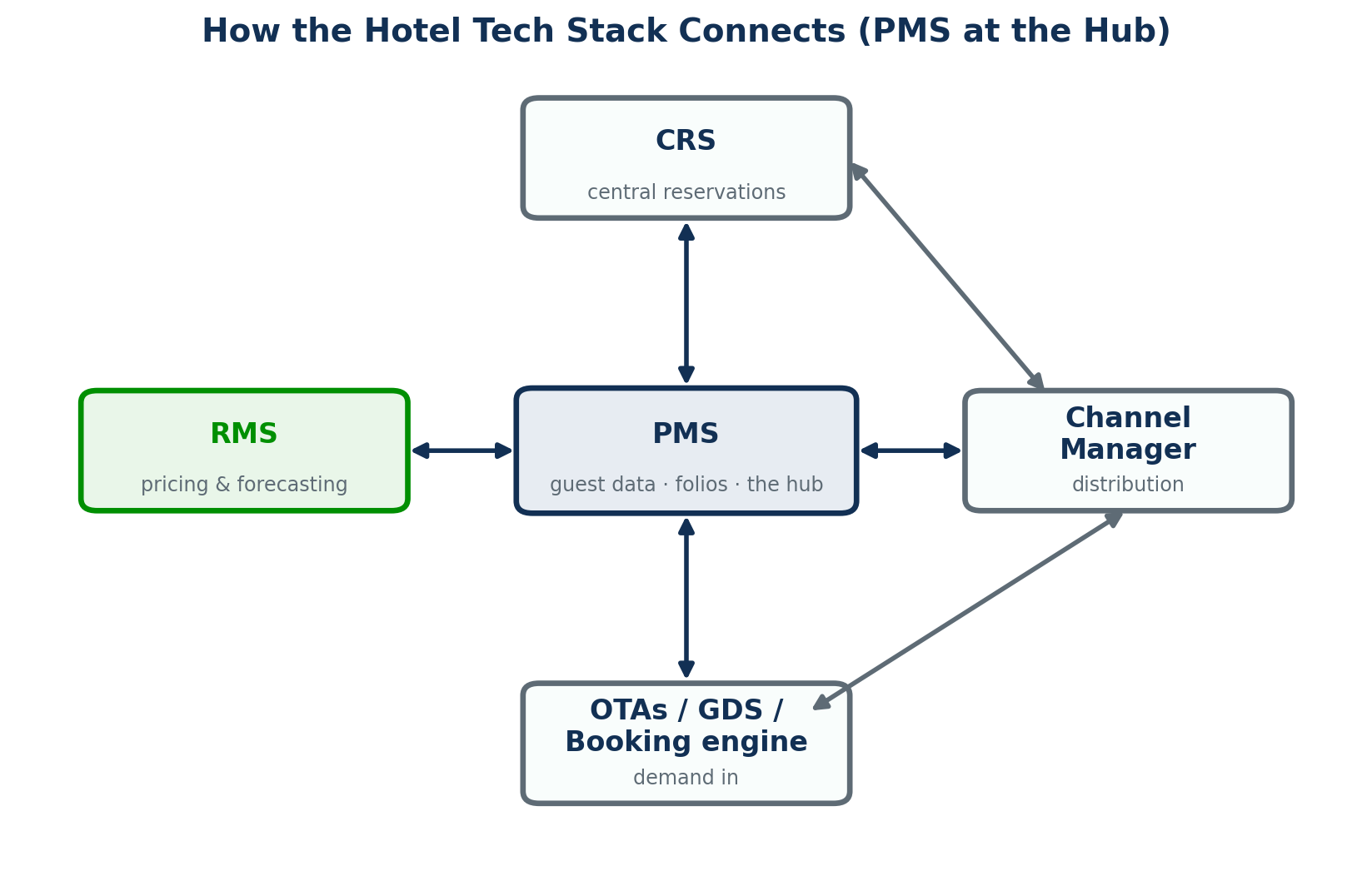
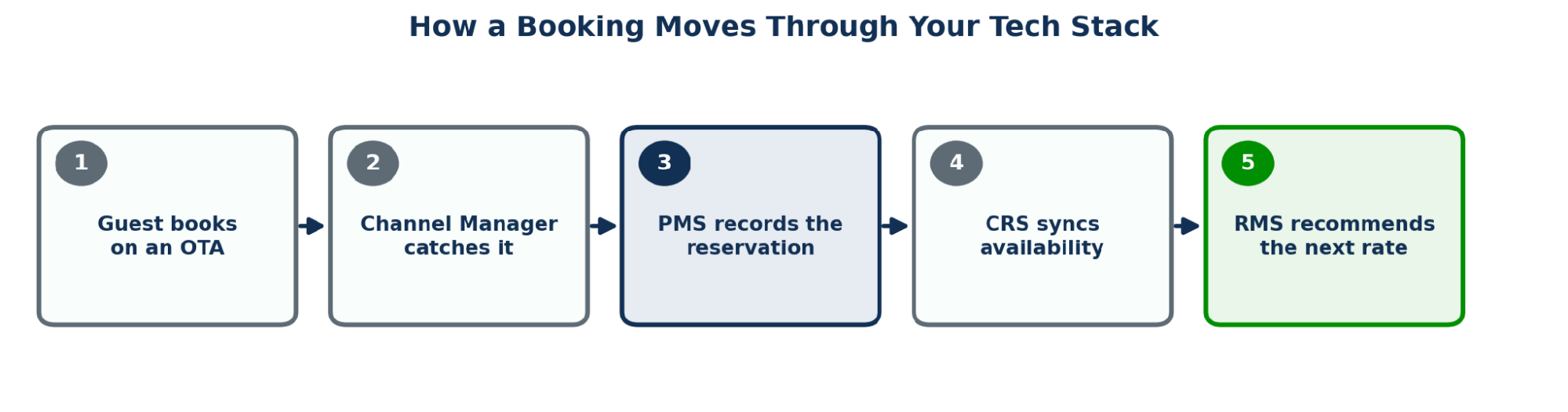
The systems only deliver value when they talk to each other, and the PMS sits at the center of that conversation. A booking comes in through a channel, the channel manager catches it, the PMS records it, the CRS keeps availability consistent, and the RMS reads the new demand and recommends the next rate. When those handoffs are clean, the stack runs itself; when they aren’t, you get double-entry and stale rates. That’s why PMS integration quality matters more than any single system’s feature list.
RMS vs PMS: the difference people keep asking about
| Dimension | RMS | PMS |
|---|---|---|
| Core job | Recommend pricing & restrictions | Run the property, keep the record |
| Output | Rate recommendations, forecasts | Reservations, folios, room status |
| Answers | “What should we charge?” | “What is actually happening?” |
| Without it | You price by gut | The front desk stops |
They’re complementary, not interchangeable. A hotel can run without an RMS (badly, by intuition); it cannot run without a PMS. Most stacks have both, and the RMS reads the PMS’s data to make its recommendations.
CRS vs PMS: what’s the difference?
Do you need all four systems?
Not every hotel needs every system as a separate product. What you need scales with size, channel mix, and portfolio complexity.
| Property type | Usually needs | Often optional / bundled |
|---|---|---|
| Small independent | PMS + channel manager | CRS (booking engine may suffice); RMS as you grow |
| Growing independent / boutique | PMS + channel manager + RMS | CRS (depends on channels) |
| Branded / franchised | PMS + CRS + channel manager | RMS (brand may provide or require) |
| Group / multi-property | All four, tightly integrated | — |
The through-line: as properties, channels, and rate complexity grow, the case for a dedicated system for each job gets stronger — and so does the case for pricing help. A small hotel can price by hand; a portfolio can’t. That’s where an operator-facing revenue copilot earns its place on the stack.
Where the tech stack goes wrong
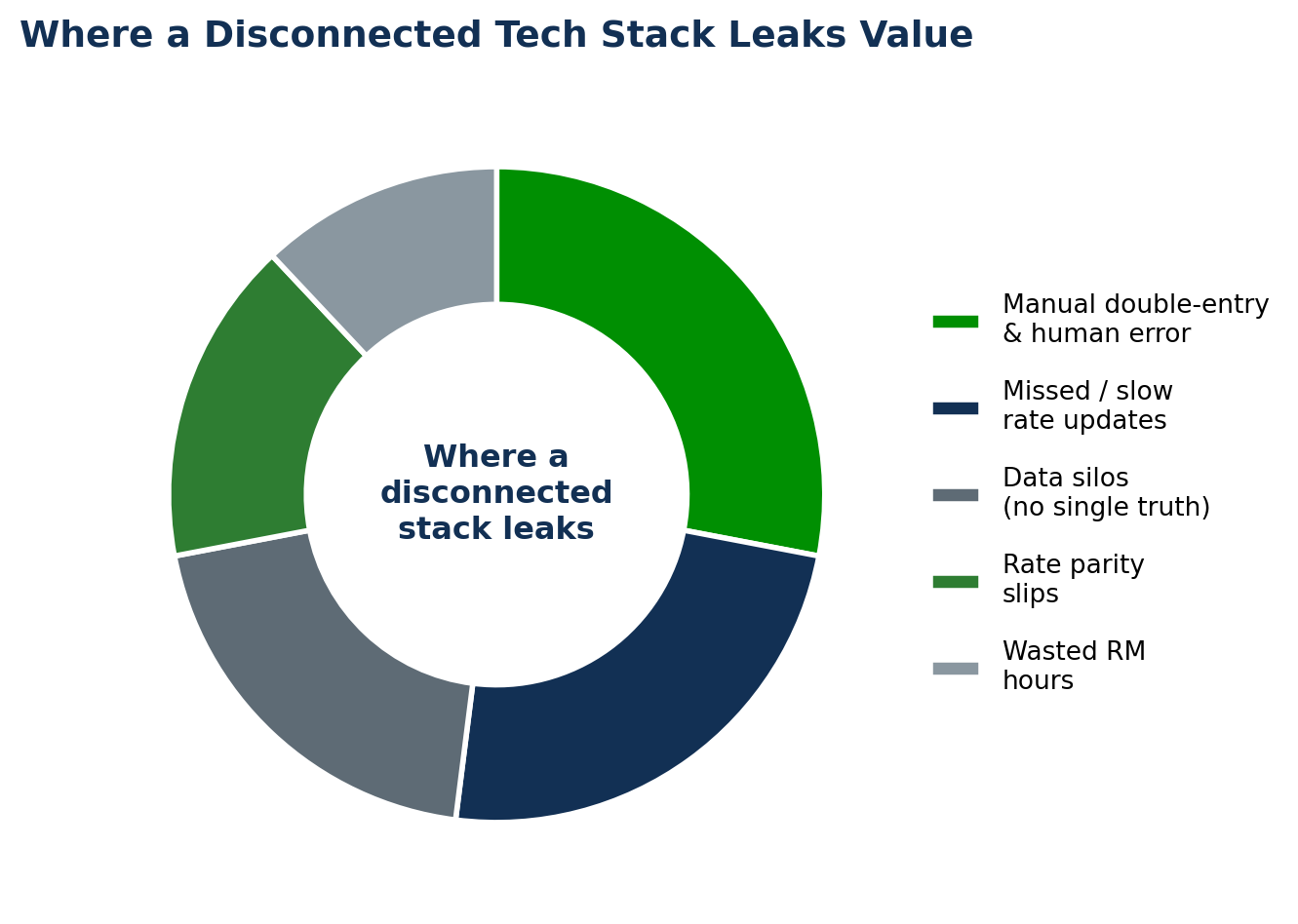
Most stack problems aren’t about the systems themselves — they’re about the seams between them.
1 · Double-entry between disconnected systems
If two systems don’t sync, someone re-keys data by hand — slow, and a reliable source of errors. “Integrated” is a spectrum; confirm what actually syncs before you buy.
2 · Data silos and no single source of truth
When each system holds a slightly different version of availability or rate, nobody trusts the numbers. The PMS should be the source of truth, with everything reconciling to it.
3 · Stale rates and parity slips
A rate change that doesn’t propagate to every channel breaks rate parity and confuses guests. The channel manager only helps if it’s actually connected to where rates are set.
4 · Buying overlap instead of coverage
Two systems that do the same job, and a gap where a needed one should be. Map jobs to systems before you map vendors to budget.
Where RevEvolve fits on your stack
RM Copilot is an operator-facing AI revenue copilot — the RMS-category layer of your stack, reimagined. It reads your connected PMS and channel data, analyzes performance, simulates outcomes, and recommends pricing and restriction actions with the reasoning attached — then your team reviews and applies them. It does not auto-publish rates or push to your PMS, CRS, or OTAs. You keep control of every decision.
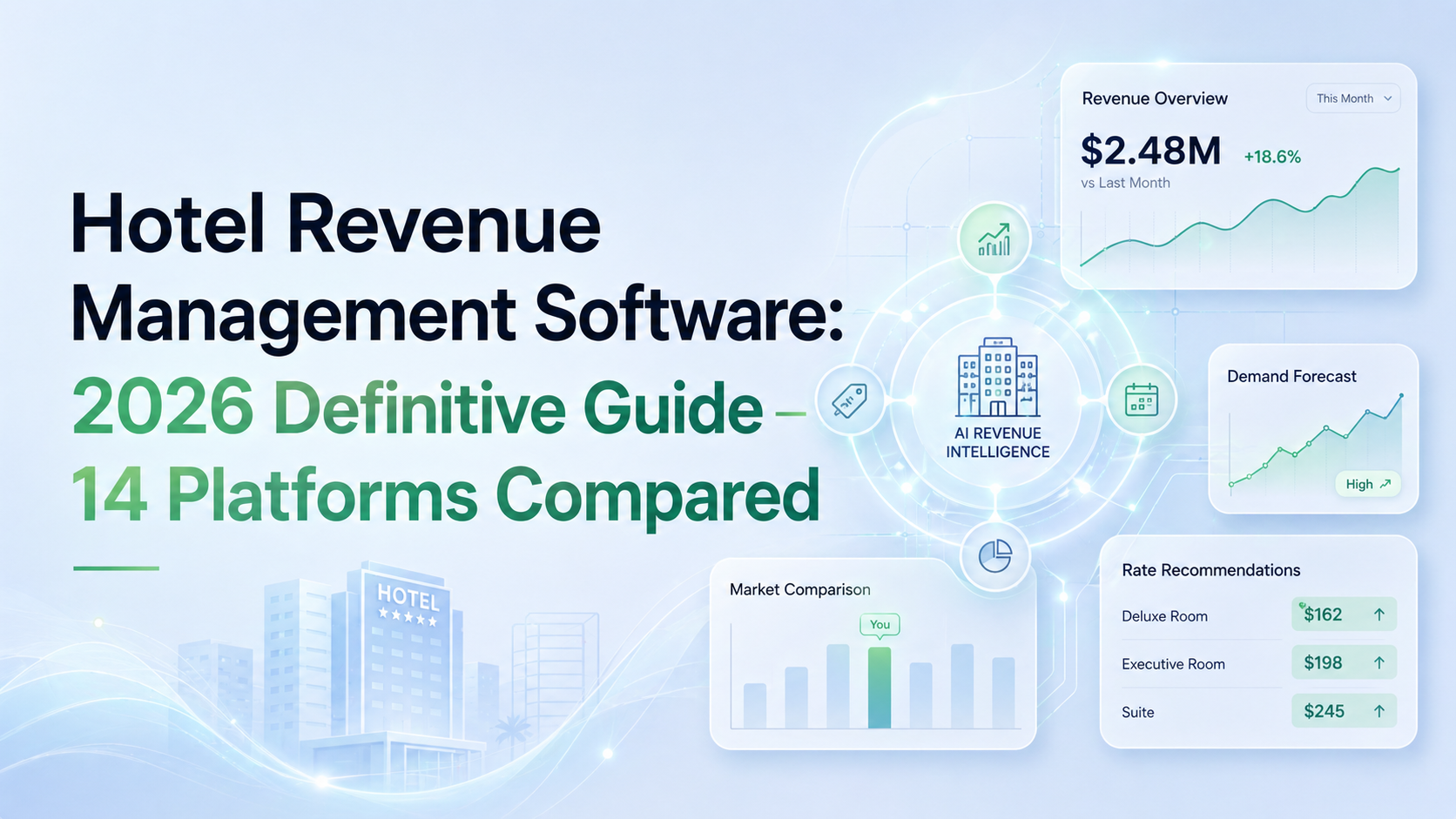
If you’re evaluating the wider platform question rather than the stack itself, our 2026 revenue management software guide compares 14 platforms on one rubric.
Hotel tech stack: three common objections
Name the job, and the stack makes sense
The hotel tech stack only looks complicated because the acronyms blur together and the vendors bundle. Strip that away and each system has one job: the PMS runs the property, the CRS distributes reservations, the RMS recommends pricing, and the channel manager pushes rates to channels. RMS versus PMS — the question everyone asks — comes down to recommend versus record.
Map the jobs first, then the systems, then the vendors. Confirm what actually integrates, not just what claims to. Build the stack your property size and channels call for — no more, no less — and it stops being four confusing acronyms and starts being the machine that runs your hotel.
Keep going: Hotel PMS integration · Hotel channel manager · Hotel distribution channels · 14 platforms compared.