QUICK ANSWER — Hotel PMS integration is the automated exchange of data between your property management system and other hotel software — channel manager, booking engine, POS, CRM, payments, revenue system — using APIs, so every system works from the same information without manual re-entry. The quality of an integration comes down to three things: whether it is two-way, how fast it syncs, and whether the fields map correctly. All three fail silently.
The integration was signed off eleven months ago and it has been quietly wrong for six of them. Nobody noticed because the dashboard still loads, the numbers still populate, and no error message was ever generated. What actually happened was that a rate code got renamed during a seasonal setup, the mapping did not follow, and every booking on that code has been landing in the wrong segment ever since.
This guide is the technical version, written for the person who has to live with the consequences rather than the person selling the connector. What PMS integration is, how the data actually moves, the difference between polling and webhooks, the five places it breaks, and what to ask a vendor before you sign. For the wider question of adopting technology into a revenue process, we covered that separately here.
Spent two days reconciling a variance before we found it. Rate code mapping broke in March. Nothing alerted. The reports were confidently wrong the whole time.
Key takeaways
- The PMS is the system of record. Integration keeps every other system aligned to it — it does not replace it.
- Two-way beats one-way. A one-way connection pushes data out but cannot receive bookings back fast enough to prevent double-selling.
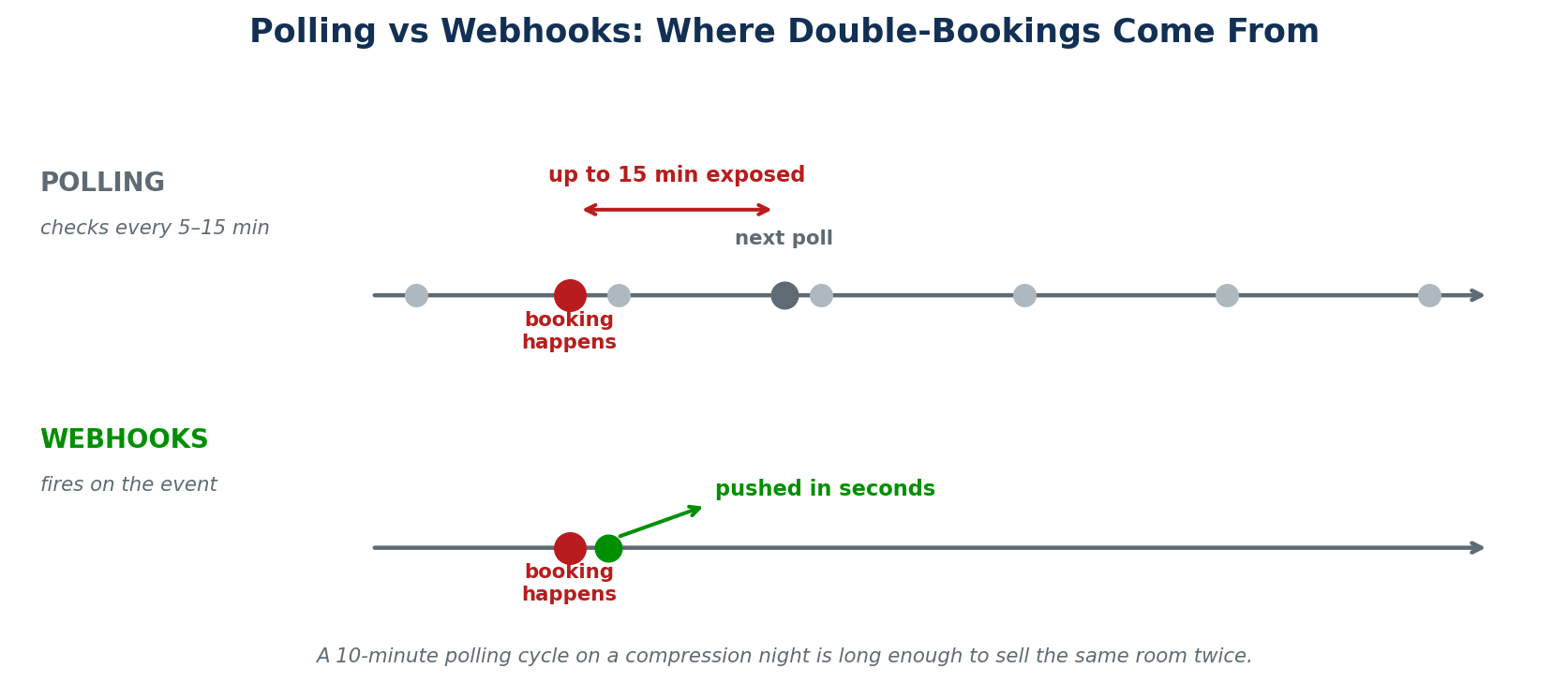
- Polling vs webhooks is the detail that matters. A 10-minute polling cycle on a compression night is long enough to sell the same room twice.
- Field mapping is the silent killer. When schemas differ, rate codes and segment labels do not always survive the round trip — and nothing errors.
- Live sync is not enough for revenue management. Forecasting needs 24–36 months of history backfilled, not just today’s data going forward.
What Is Hotel PMS Integration?
Start with what a PMS is, because the term gets used loosely. The property management system is the operational hub of the hotel — reservations, room assignments, check-in and check-out, folios, billing, and housekeeping status. It is the system of record: when two systems disagree about whether room 412 is occupied, the PMS is right by definition.
Integration is what keeps everything else agreeing with it. Without it, a booking taken on an OTA sits in the extranet until someone types it into the PMS, and in the gap between those two events you can sell the room again. Multiply that across five channels and a busy weekend and you have the operational chaos that integration exists to prevent.
How the Data Actually Moves
Every integration is an API connection — a defined contract that lets two systems exchange structured data without a human in between. The useful mental model is a messenger that knows exactly which fields to carry and where to put them.
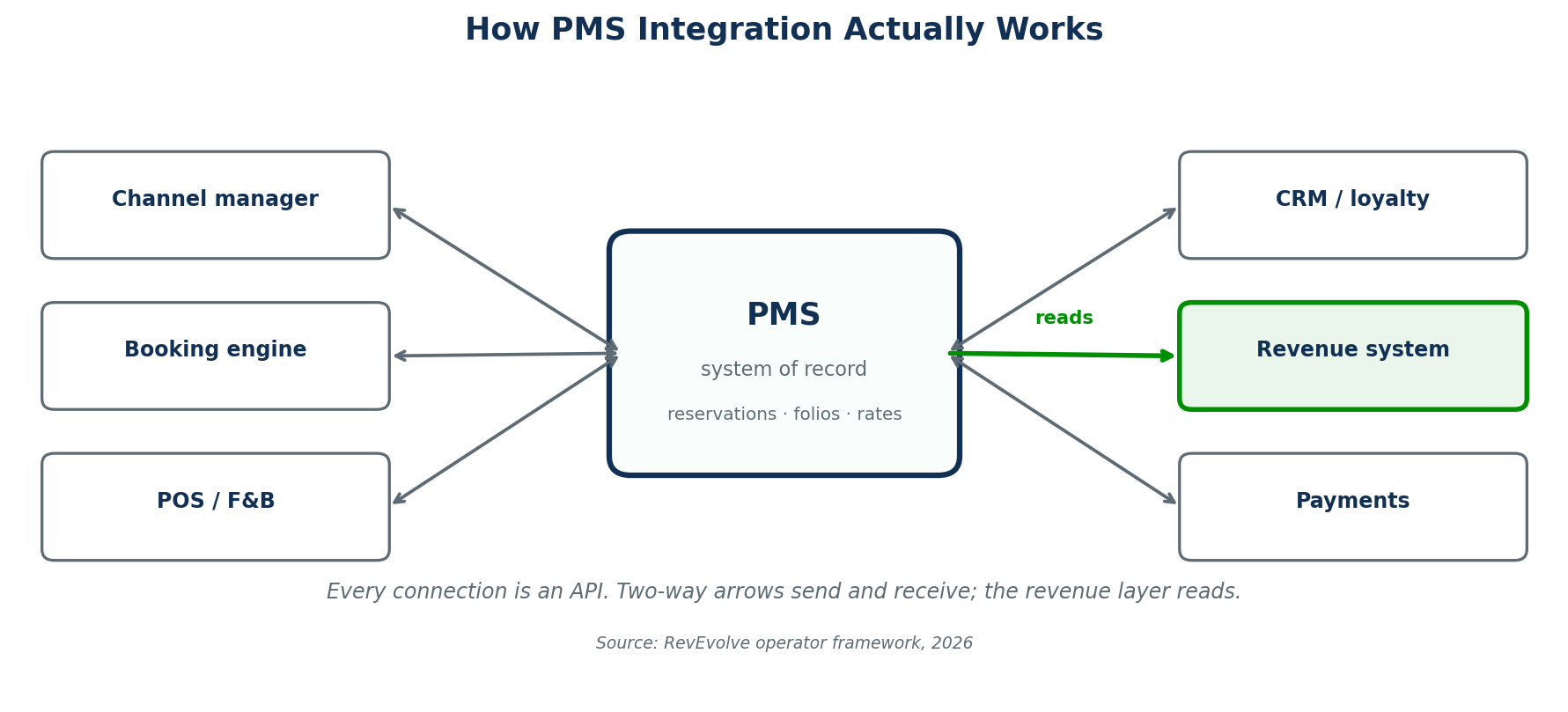
Walk one booking through it. A guest books on an OTA. The channel manager receives the reservation and passes it to the PMS via API. The PMS records it and decrements availability. The API then carries that new availability back out to every other channel, closing the room everywhere within seconds. Meanwhile the CRM receives the guest profile, the payment gateway handles the deposit, and your revenue system reads the updated on-the-books position for tomorrow’s pricing decisions.
One-way versus two-way
A one-way integration sends data in a single direction — typically pushing rates and availability out from the PMS — without receiving anything back. It is cheaper and it is a false economy. The direction that prevents double-bookings is the return leg: the booking coming back in and closing inventory everywhere else.
Two-way (bidirectional) integration carries data both ways. A booking created anywhere propagates to everywhere. A folio charge posted at the POS lands on the guest’s bill in the PMS. A rate change made in the revenue workflow reaches the channels. This is the standard to insist on, and it is worth confirming per connection rather than as a blanket vendor claim — a platform can be two-way with its flagship partners and one-way with the connector you actually need.
Polling vs Webhooks: The Detail That Decides Your Sync Speed
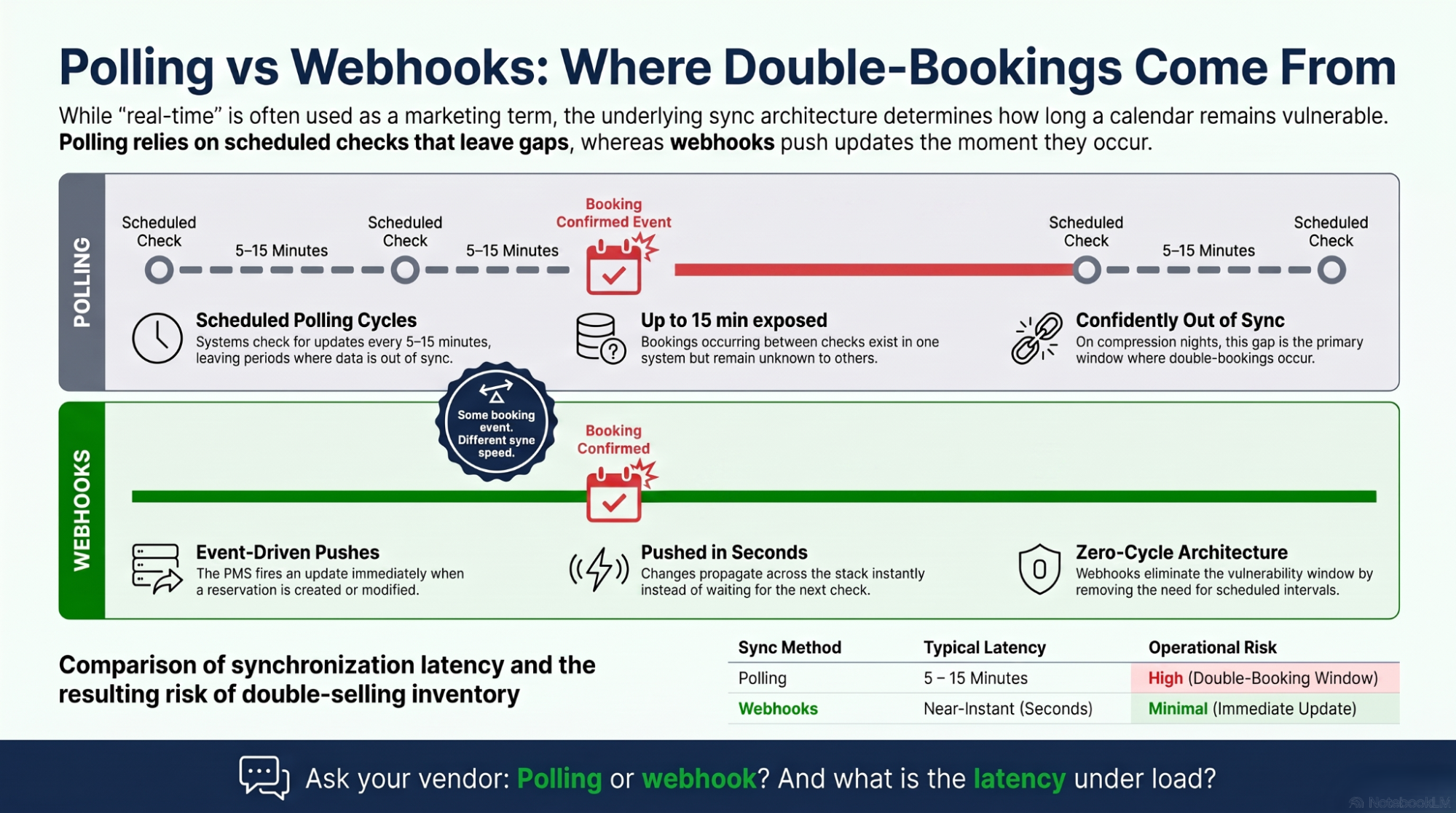
“Real-time” is a marketing word. The architecture underneath it varies enormously, and the difference is measured in double-bookings.
Polling
Older integrations poll: the connected system asks the PMS every few minutes whether anything has changed. Typical cycles run five to fifteen minutes. Between polls, the two systems are out of sync and neither knows it. On a low-demand Tuesday that gap is harmless. On a sold-out compression night it is exactly the window in which the same room gets sold twice.
Webhooks
Modern integrations are event-driven. When a reservation is created, modified, or cancelled, the PMS fires a webhook immediately and the change propagates in seconds rather than minutes. Nothing waits for the next cycle because there is no cycle.
What Actually Gets Connected
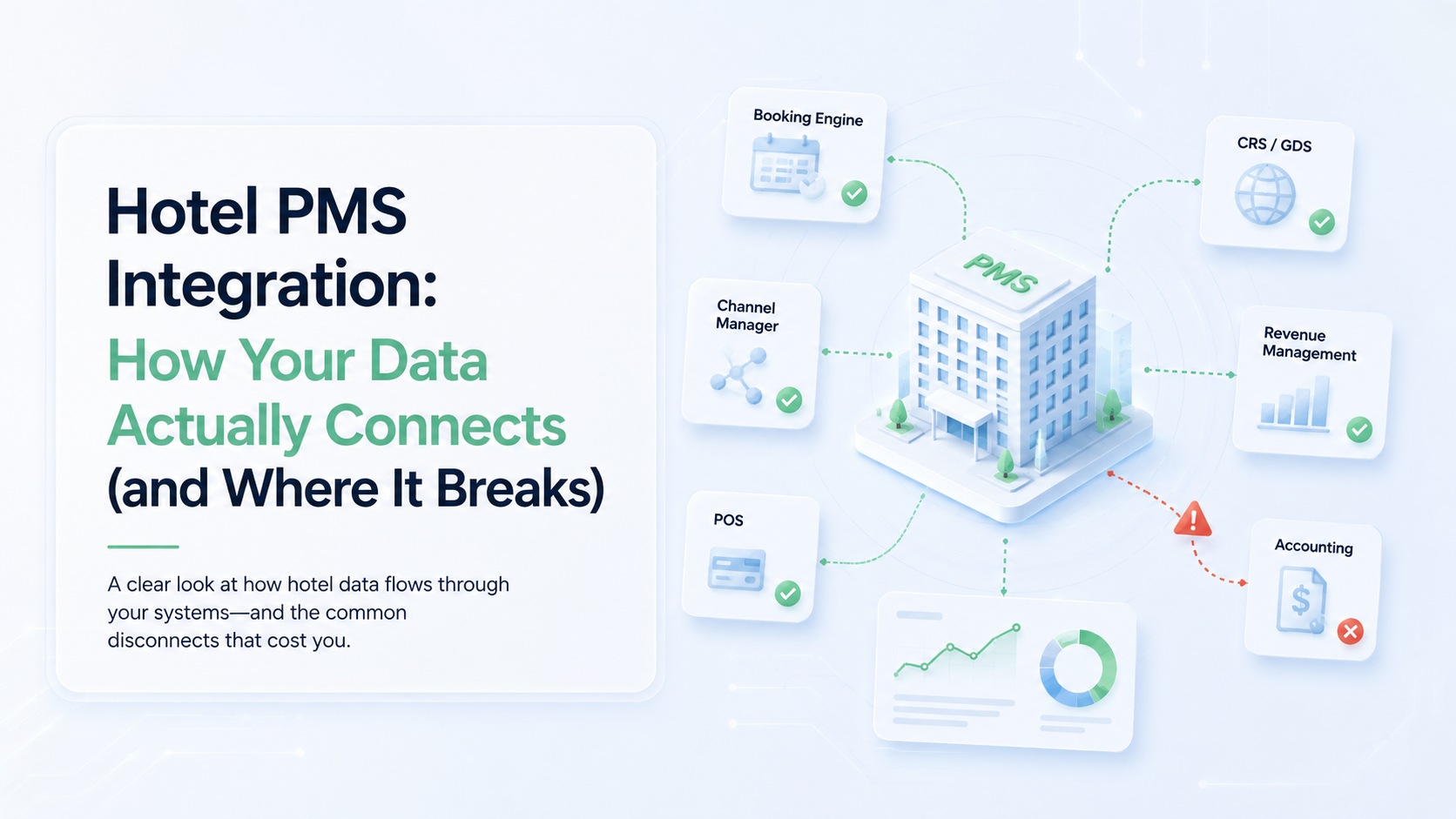
The stack varies by property, but the common connections and what each one carries:
| Integration | Carries | Direction | Breaks look like |
|---|---|---|---|
| Channel manager | Rates, availability, reservations | Two-way, critical | Overbookings, rate parity gaps |
| Booking engine | Direct reservations, inventory | Two-way | Direct bookings missing from the PMS |
| POS / F&B | Charges posted to folio | One-way in, usually fine | Charges missing at check-out |
| CRM / loyalty | Guest profiles, stay history | Two-way | Duplicate guest records |
| Payment gateway | Authorizations, settlements | Two-way | Reconciliation mismatches |
| Revenue system | Performance, pace, segment history | Reads from the PMS | Forecasts built on incomplete data |
That last row is the one this guide cares about most, and it works differently from the others. A revenue system does not need to write into the PMS — it needs to read from it, deeply and reliably. Which introduces a requirement none of the other connections have.
The Requirement Nobody Mentions: Historical Backfill
Most integration content treats the job as connecting live data going forward. For operations that is right. For revenue management it is only half the requirement, and the missing half is the one that determines whether anything works.
Forecasting demand for a date means knowing what happened on comparable dates before. Seasonality, day-of-week patterns, event impacts, segment behaviour, booking curves — all of it is learned from history. A system connected only from go-live day has no seasonality until it has lived through a season, and no year-over-year comparison until it has been running a year.
So the question to ask about a revenue integration is not just “does it connect?” but “how much history does it ingest, and how quickly?” The practical requirement is 24 to 36 months of historical data, backfilled at implementation rather than accumulated afterwards. In a RevEvolve deployment that ingest — PMS integration plus 28 months of historical data — happens in the first three days, which is what makes forecast validation possible in the same month rather than the following year.
Five Places PMS Integrations Break
None of these produce an error message. That is what they have in common and why they persist.
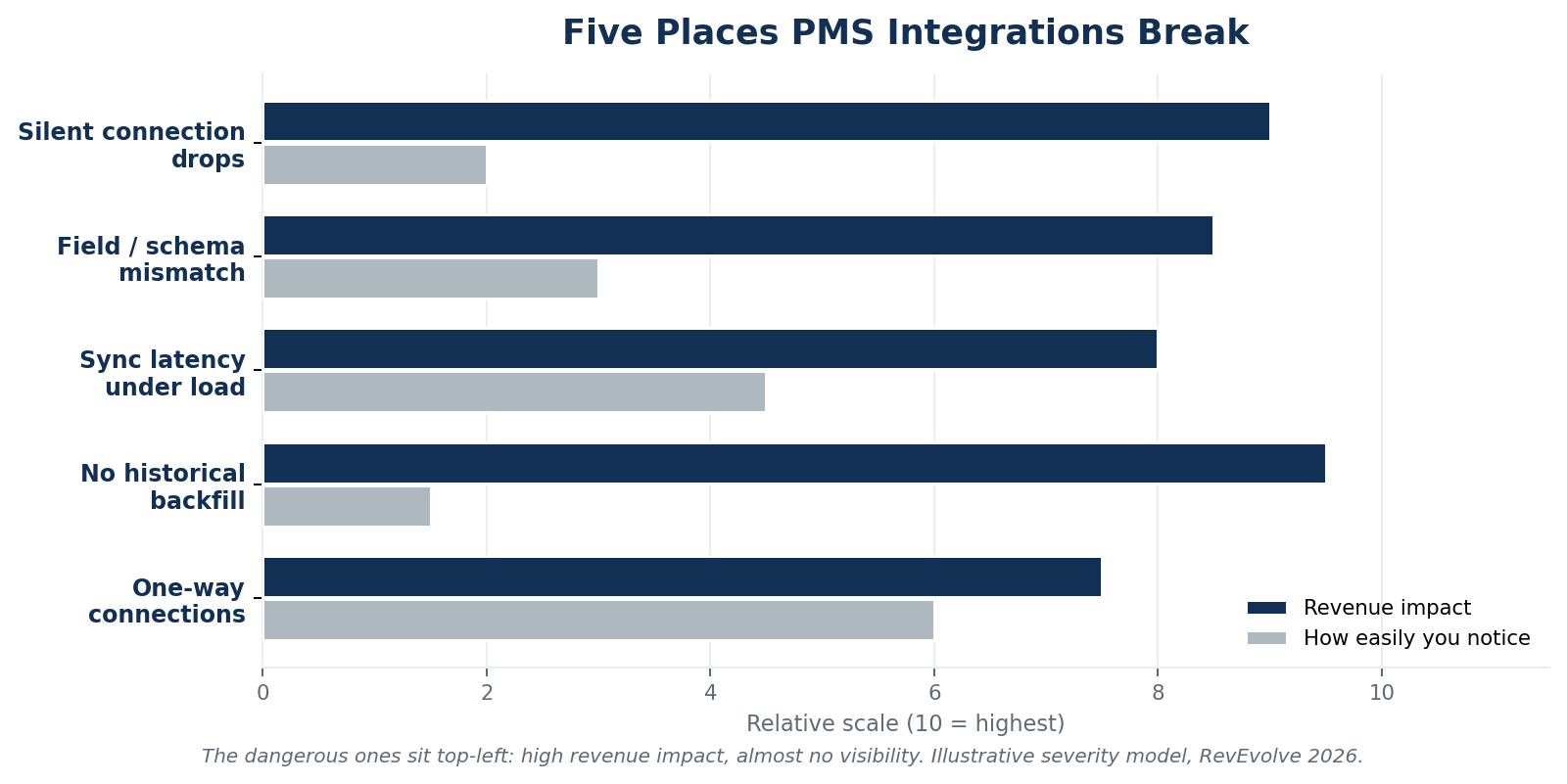
1 · Silent connection drops
A connection fails and nothing tells you. The channel keeps selling on the last data it received — a stale rate, stale availability — until a guest or an OTA flags it. Alerting on dropped connections is not a premium feature; it is the difference between a two-hour problem and a two-week one.
2 · Field and schema mismatch
Two systems describe the same thing differently. Your PMS calls a segment “CORP-NEG”; the receiving system expects “Corporate Negotiated.” Most fields survive the round trip. The ones that do not fail quietly, land in a default bucket, and corrupt every segment report downstream. This is the failure in the opening scenario, and it is remarkably common after any rate-code or seasonal reconfiguration.
3 · Sync latency under load
The integration that performs well in testing behaves differently during a citywide event, when transaction volume spikes and queues build. Latency is a load-dependent property, and it degrades exactly when accuracy matters most.
4 · No historical backfill
Covered above. Highest impact, lowest visibility, and almost never raised during procurement.
5 · One-way connections sold as integration
“Integrated” is doing a lot of work in most vendor copy. Confirm the direction per connection. A published partner ecosystem with documented endpoints is a good sign; a vague “open API” claim with no partner list is a yellow flag.
The Portfolio Problem: When You Run More Than One PMS
Everything above assumes one property with one PMS. Groups rarely have that. Acquisitions arrive with their own systems, brand standards mandate specific platforms, and a portfolio of forty hotels routinely runs four or five different PMS products.
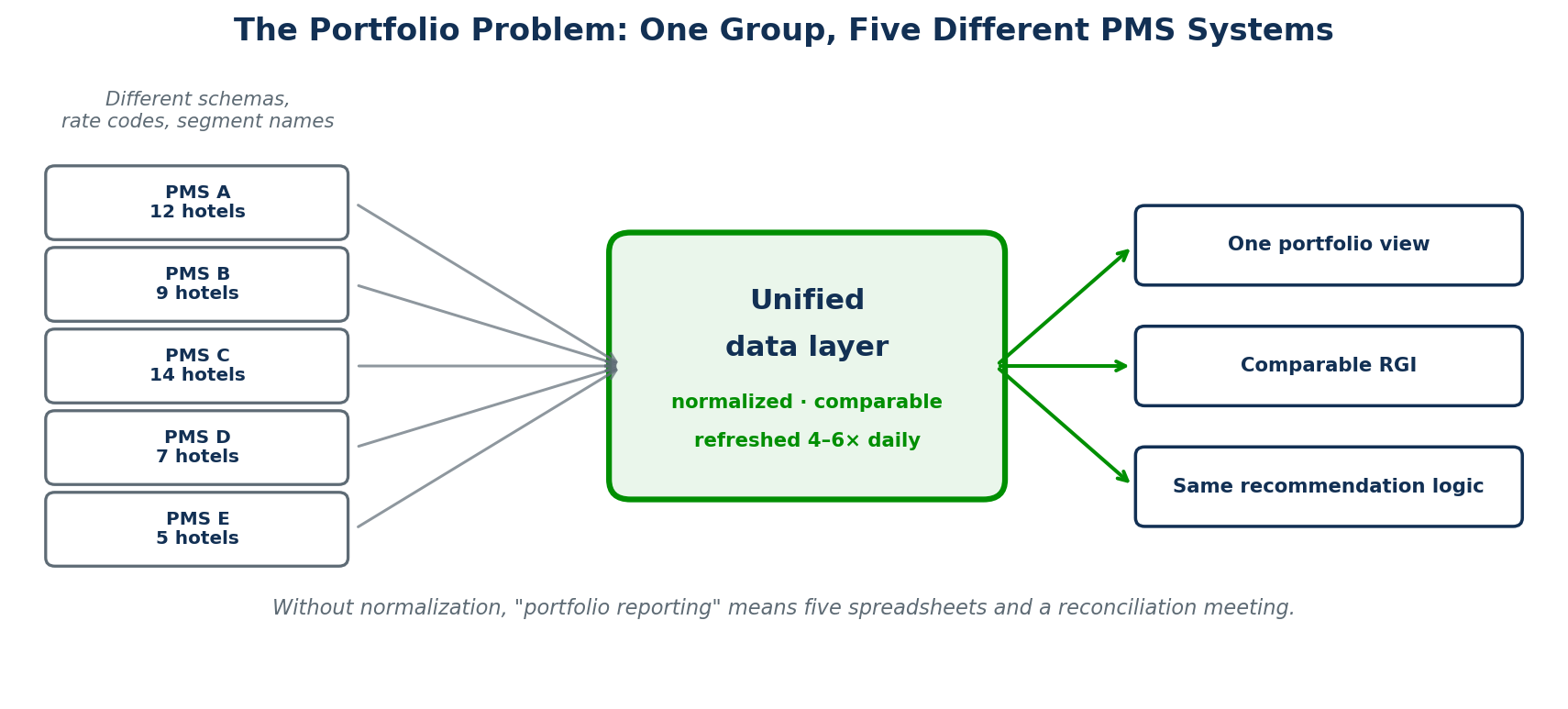
Each of those systems has its own schema, its own rate-code conventions, and its own segment taxonomy. One calls it “Corporate,” another “Business Transient,” a third “BT.” Nothing is wrong with any of them individually. Collectively they make portfolio-level analysis a reconciliation exercise before it is an analysis exercise.
Normalization is the fix: a layer that reads from every PMS and maps everything to one consistent schema, so that a segment means the same thing at property 3 and property 31. RevEvolve is built on Hotel Switchboard’s unified data layer spanning 50+ PMS systems, refreshing 4–6 times a day — which is what makes a genuine portfolio view possible rather than a monthly consolidation ritual.
The practical test of whether your portfolio data is normalized: can you compare RGI across every property in one view, today, without anyone exporting anything? If that takes a week to assemble, the data layer is the problem before the pricing is.
What to Ask Before You Sign
Nine questions that separate a working integration from a demo that worked.
- Is this connection two-way, specifically for the systems I use — not as a general platform claim?
- Polling or webhook, and what is the typical sync latency under load?
- What happens when a connection drops? Is there alerting, and who receives it?
- How are fields mapped, and what happens to a value that has no match on the other side?
- How much historical data is ingested at implementation, and how long does the backfill take?
- Is there a published partner ecosystem with documented endpoints, or just an “open API” claim?
- Who owns the integration when it breaks — the PMS vendor, the connecting vendor, or a middleware provider?
- What happens at PMS version upgrades? Integrations that break on the vendor’s upgrade cycle are a recurring cost, not a one-off.
- If we run multiple PMS platforms, how is data normalized across them into one comparable view?
What a Revenue System Needs From Your PMS
Different integrations have different requirements, and it is worth being specific about this one, because it is not the same as a channel manager connection.
A revenue system reads rather than writes. RM Copilot needs deep read access to performance, pace, pickup, and segment history across your PMS data — refreshed several times daily and backfilled with enough history to model seasonality. It analyzes that data, recommends pricing actions with the reasoning attached, and lets your team simulate the projected impact before committing. Your team reviews and applies the decision; the rate reaches your channels through your channel manager, the way it always has.
The reason this distinction matters at procurement is that it changes what “good integration” means. For a channel manager, good means fast and bidirectional. For a revenue system, good means deep, historical, and normalized. A connector that syncs today’s availability flawlessly and carries no history is excellent for one job and useless for the other.
Worth separating two categories people conflate: some hospitality AI is guest-facing — chat and messaging that help you talk to travelers. RM Copilot is operator-facing, working with your revenue team on the pricing decision itself.
If you are evaluating the wider platform question rather than the connection itself, our 2026 revenue management software guide compares 14 platforms on exactly these lines.
Questions That Come Up in Procurement
Keep going: 14 revenue management platforms compared · Integrating technology into your revenue process · Portfolio dashboard.