For two years, a strong market did a lot of the work. Hotels posted RevPAR gains partly on their own effort and partly on a demand tailwind that lifted almost everyone. Your 2026 strategy could lean on that. The 2027 forecast says the tailwind is fading.
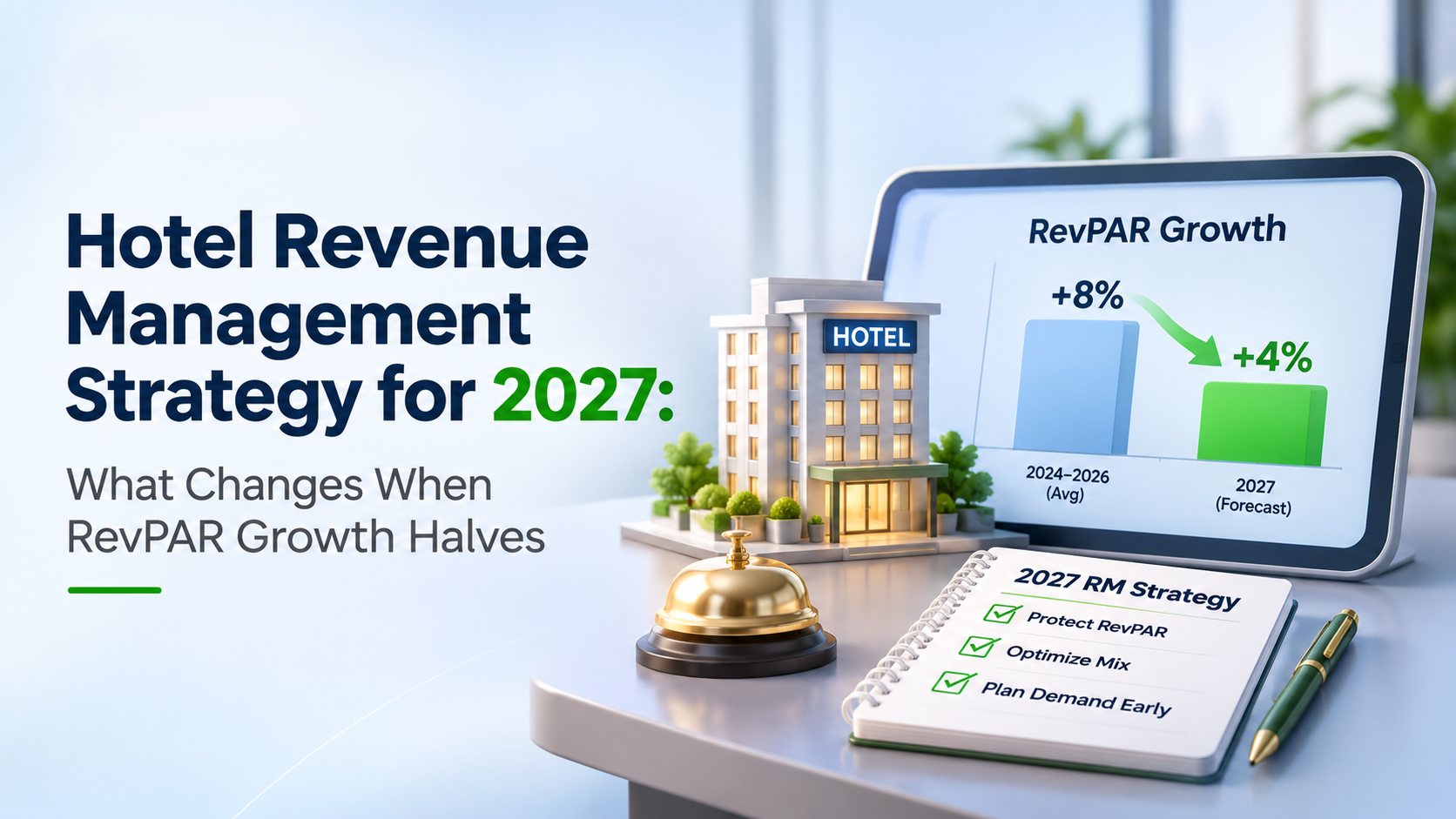
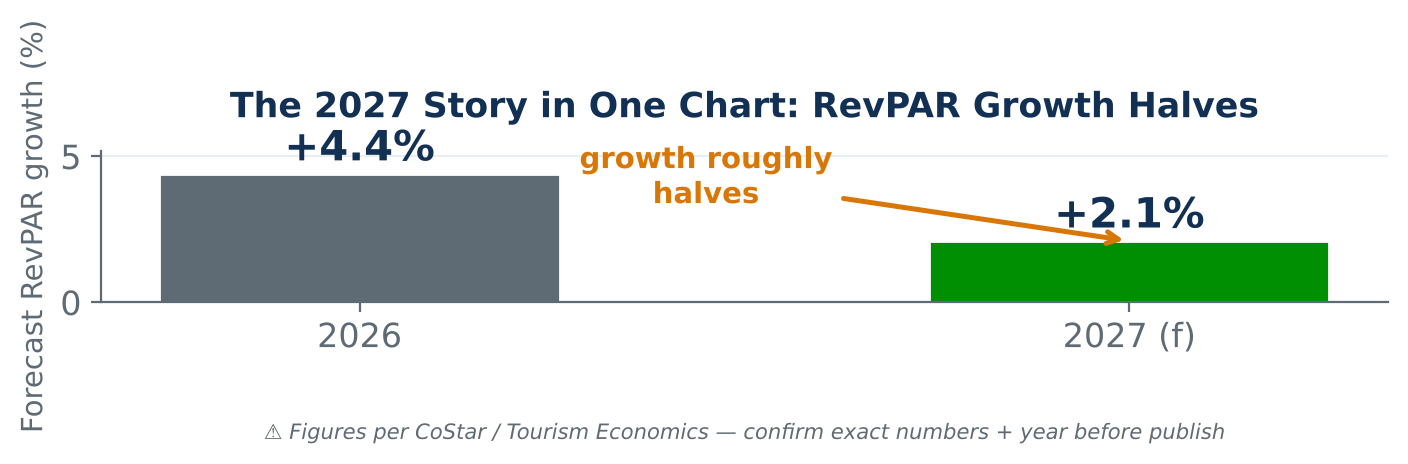
US RevPAR growth is projected to roughly halve in 2027 — from about +4.4% in 2026 to around +2.1% (CoStar / Tourism Economics; confirm the exact figures before you budget on them). That single shift changes the job. When the market gives you half as much, the other half has to come from execution — the thousand small pricing decisions your team makes every week. This is the hub for getting those right, with eight deep-dives linked below.
The last two years the market carried us. The 2027 budget looks flat and ownership still wants growth. Every ‘2027 trends’ article is the same five buzzwords — nobody says what to actually change on Monday.
Scope note: this is the 2027 outlook and playbook. For last year’s plan and data, see the 2026 revenue management strategy post — it still holds for referencing 2026 performance. What follows is what’s different about 2027, and what to do about it.
Key takeaways
- 2027 RevPAR growth is forecast to roughly halve vs 2026 (CoStar/TE — confirm).
- The market tailwind is fading; margin now comes from execution, not demand.
- Win the year in thousands of small pricing decisions, done well and fast.
- Budget for execution, not a repeat of the 2026 compression.
- Decide faster and more consistently than the comp set — that’s the edge.
What’s the 2027 outlook (and what changes)?
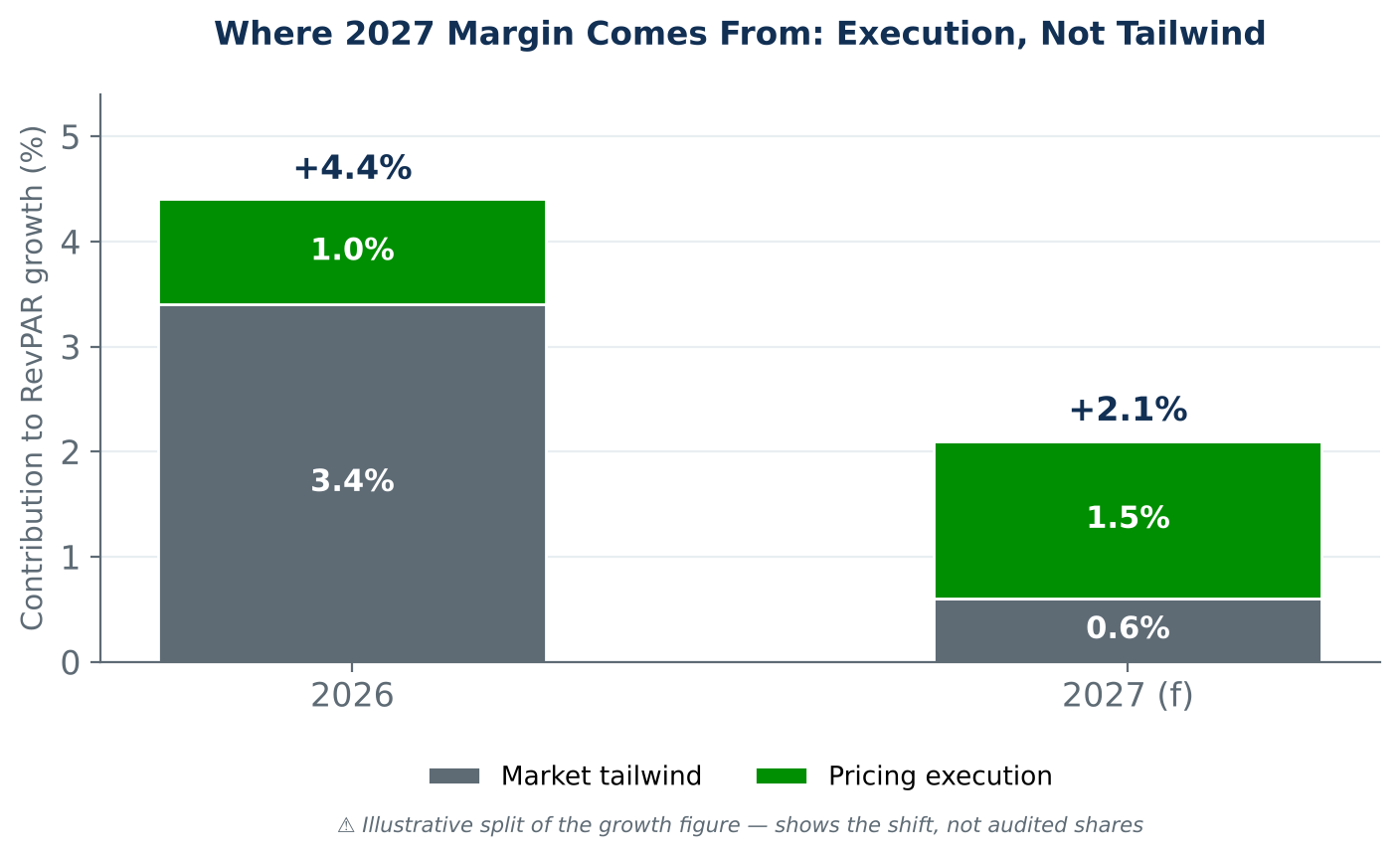
The 2027 outlook is slower growth, not decline: demand keeps rising, but at roughly half the pace of 2026. For revenue management, the change isn’t the direction — it’s who’s responsible for the growth. In a high-tailwind year, the market forgives mistakes; in a low-growth year, it doesn’t. The margin you want has to be earned in your own pricing, because the market isn’t handing it out.
That reframes the whole budget conversation. If ownership still expects the RevPAR gains of the last two years, the honest answer is that those gains now require sharper execution, not a bigger market. This post is built to help you make that case — and then act on it.
Why RevPAR growth halves in 2027
Growth halves for a few compounding reasons. Demand growth is moderating off the post-recovery highs. Some of 2026’s strength was event-driven — the 2026 FIFA World Cup across the US, Canada, and Mexico created compression in host and spillover markets that simply won’t repeat in 2027. And rate growth, which carried RevPAR while occupancy plateaued, is harder to push further without resistance.
The thesis: margin is won in small decisions
Here’s the part the trend lists miss. RevPAR growth in a flat market isn’t one big strategic move — it’s the sum of thousands of small pricing decisions, each made a little better and a little faster than the comp set makes theirs. A few dollars captured on a compression date, a restriction set a day earlier, a shoulder-night rate not dropped too far: none of them is dramatic, and together they are the whole year.
In 2026, a rising market blurred the difference between good and average execution — everyone’s numbers went up. In 2027, that cover is gone. The gap between the hotel that decides well and the one that decides slowly shows up directly in RevPAR, because there’s no tailwind to hide behind.
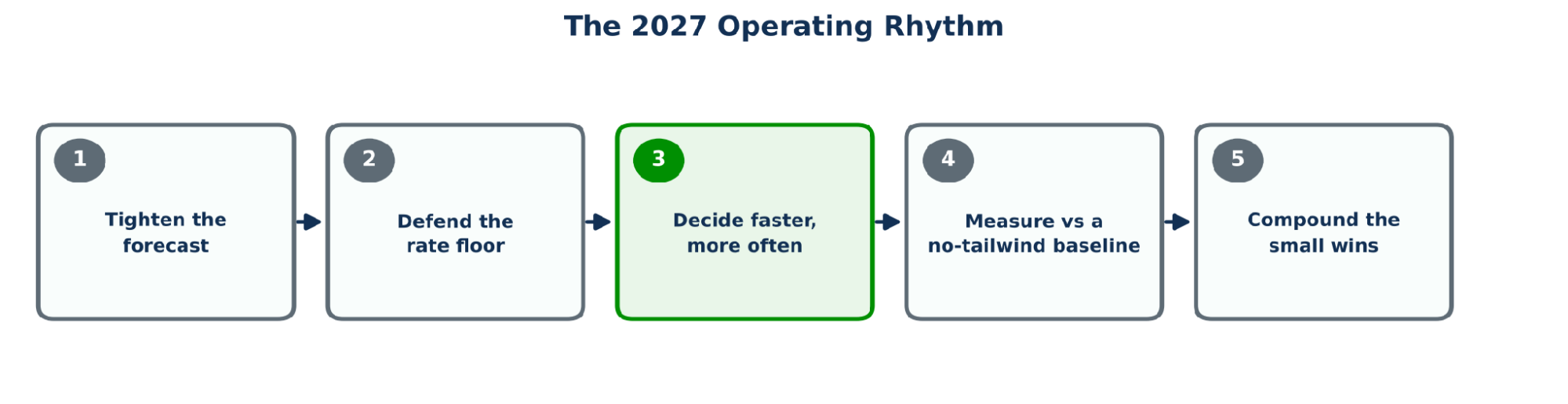
The operational consequence is simple: decision velocity and consistency become the competitive edge. Not working harder — deciding faster, on the dates that matter, without the slow spots and the missed exceptions that a rising market used to forgive.
The 2027 playbook: eight areas to get right
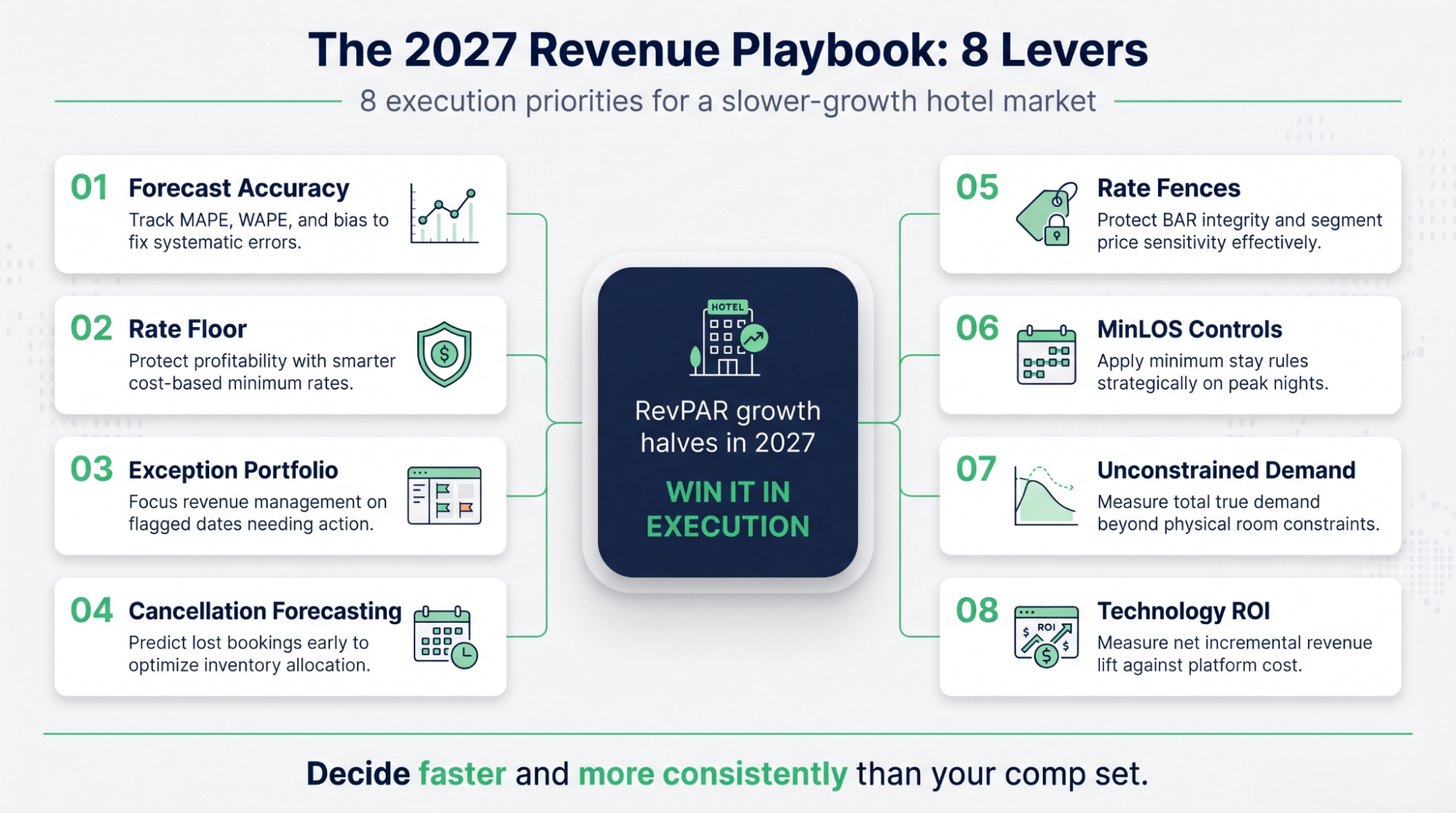
If 2027 is won in execution, these are the eight places to sharpen it. Each is a deep-dive of its own — this is the map; follow the links for the detail. (Confirm each link is live before publish.)
- Tighten forecast accuracy. You can’t out-execute a wrong forecast. Measure it properly — MAPE, WAPE, and bias — and fix the systematic lean first. See the forecast accuracy deep-dive.
- Defend a cost-based rate floor. In a flat market the temptation is to discount for occupancy. Know your break-even and the lowest rate you can defend before you give rate away. See the break-even occupancy guide.
- Run the portfolio exception-based. Cover more hotels without more hands by acting on the dates that changed, not every date. See the multi-property workflow guide.
- Forecast cancellations and no-shows. In a tighter year, overbooking math and attrition assumptions matter more. See the cancellation and no-show forecasting guide.
- Use BAR and rate fences deliberately. Discount without destroying ADR — fence the cheap rates so they don’t leak to guests who’d pay more. See the BAR and rate fences guide.
- Apply length-of-stay controls. Protect high-value dates with MinLOS instead of blunt rate moves. See the minimum length of stay guide.
- Reconstruct unconstrained demand. Price the demand you could have captured, not just what you sold, so you don’t anchor to a constrained past. See the unconstrained demand guide.
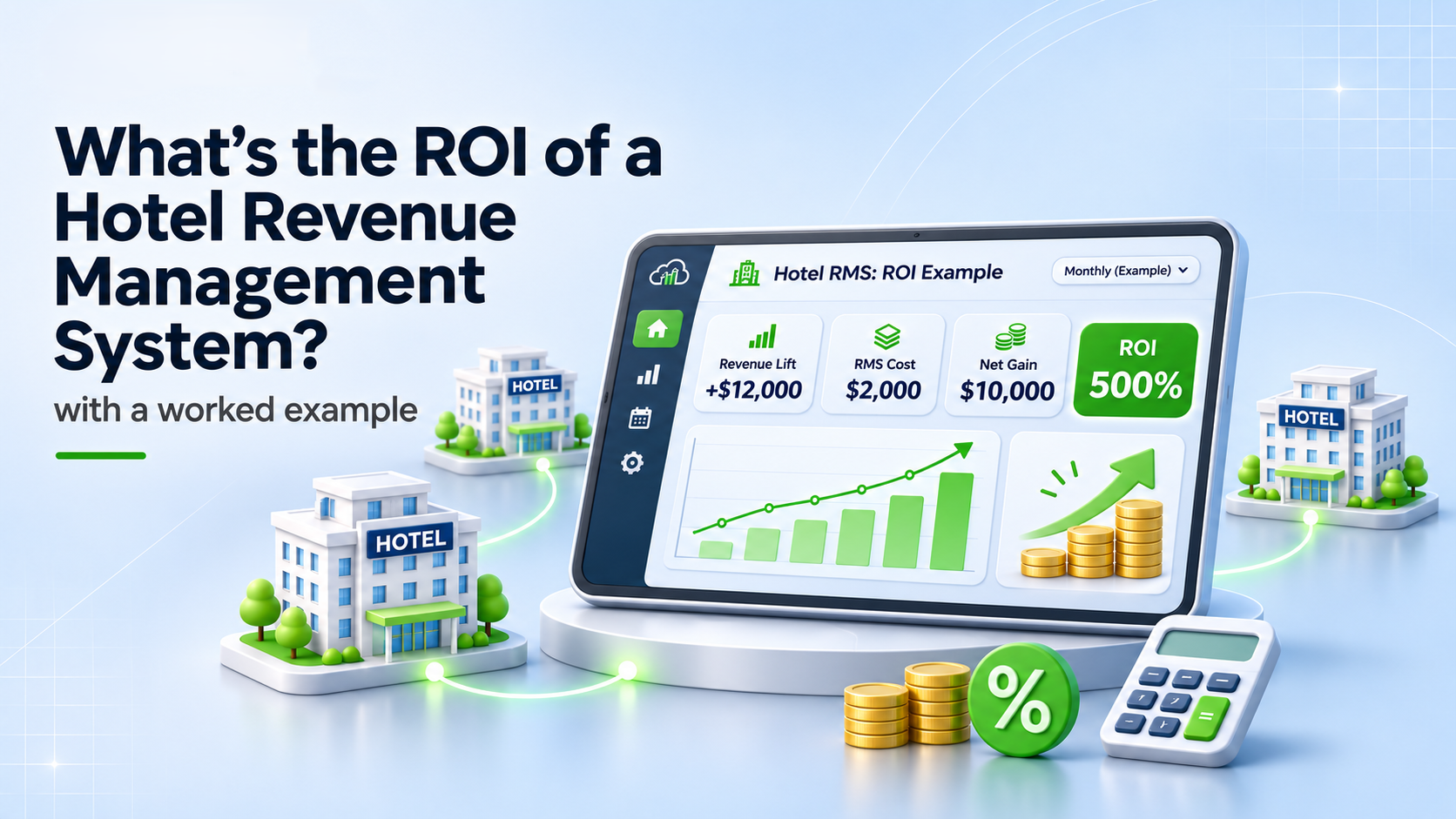
- Make the tech ROI case. If execution is the lever, the tools that speed decisions have to pay back — measure it honestly against a no-RMS baseline. See the RMS ROI guide.
How to budget for a low-growth year
Budget for execution, not for a market gift. The common 2027 mistake is to pencil in another year of 2026-style RevPAR growth and hope the market delivers it. It won’t. Build the budget the other way: start from a realistic, event-adjusted market forecast (strip out the 2026 World Cup compression where it applied), then add the growth you can earn through sharper pricing — and resource that execution.
Practically, that means budgeting for the things that speed and sharpen decisions: forecast quality, the tooling that surfaces the dates needing action, and the RM time to act on them. If growth has to come from execution, under-resourcing execution is how you miss the number. Benchmark against real data before you commit the plan.
Where 2027 strategies go wrong
Three mistakes turn a slow-growth year into a bad one.
Budgeting for a tailwind that isn’t coming
Penciling in 2026’s growth and waiting for the market to deliver it. When it doesn’t, you’re chasing the number by Q2 with discounts that erode ADR. Budget for the market you’ll actually get, then earn the rest.
Chasing occupancy with rate cuts
When demand softens, the reflex is to drop rate to ‘drive occupancy.’ In a flat market that often trades ADR for volume that was coming anyway. Defend the rate floor; occupancy bought below cost isn’t growth.
Deciding too slowly
The quiet killer. In a tailwind year, a day-late rate move still rode the market up. In 2027, the dates that matter are won or lost in hours, and a slow, inconsistent process leaks margin the market no longer refunds.
The edge: deciding faster, consistently
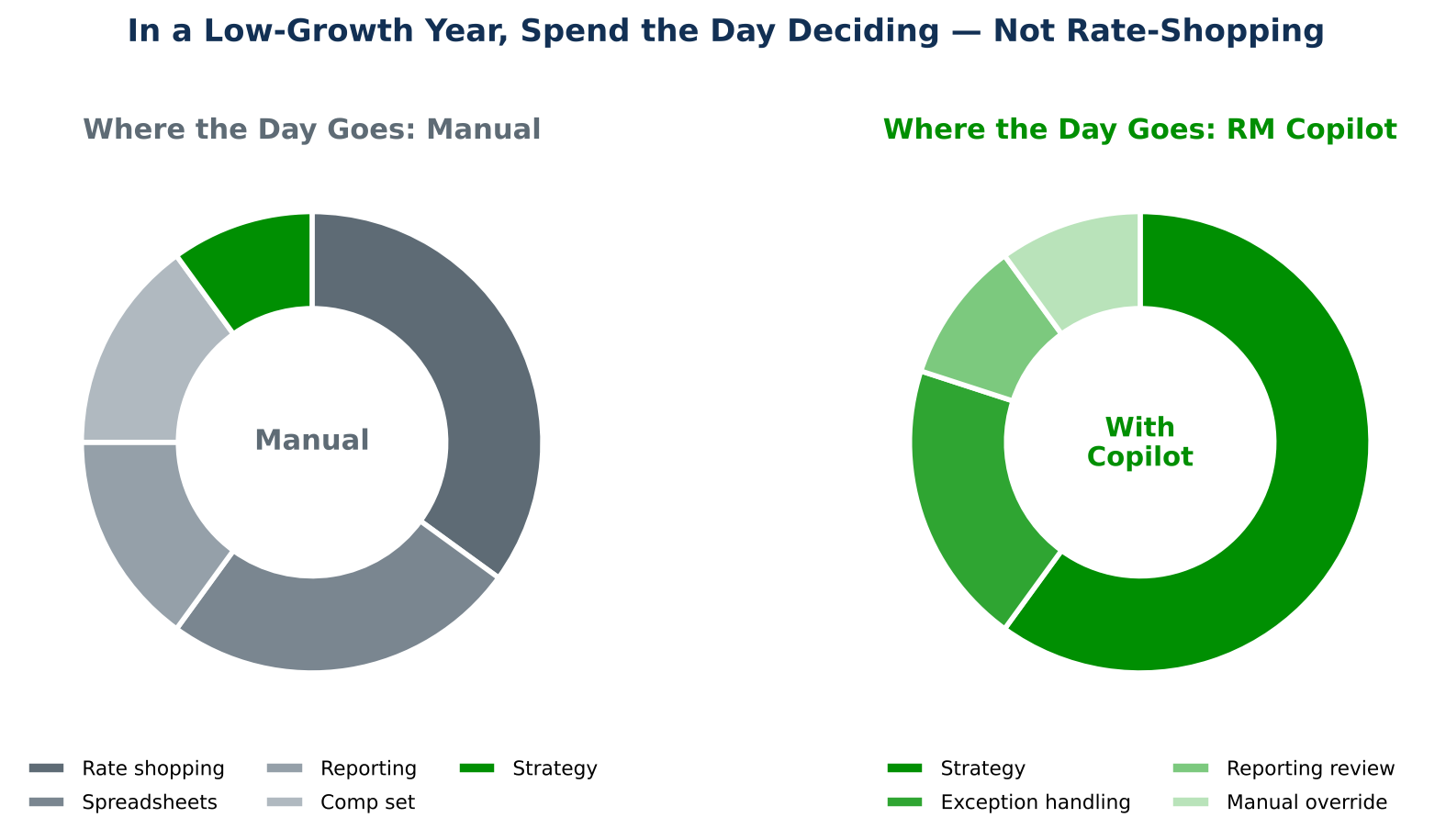
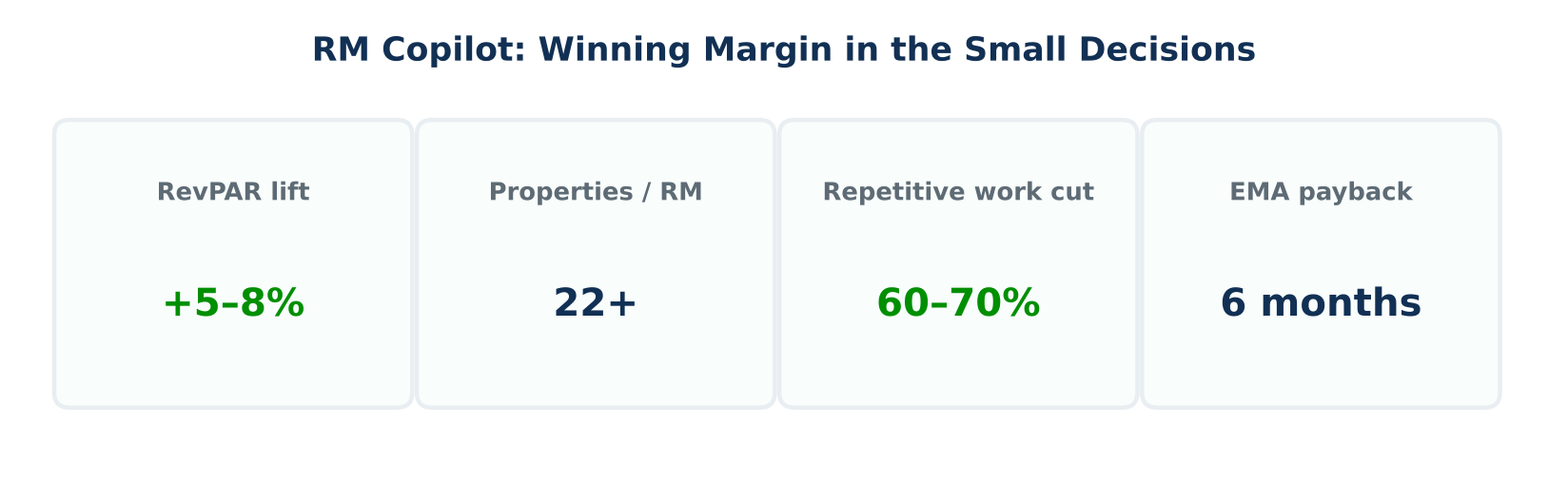
The hotels that win low-growth years aren’t working more hours — they’re deciding faster and more consistently than the comp set. That’s where decision-support tooling earns its place. RevEvolve’s RM Copilot has shown a 5–8% RevPAR lift and frees revenue managers from 60–70% of repetitive rate-checking, and across EMA Hospitality’s 47 hotels it paid back in six months while cutting RGI variance in half. The common thread: more of the day spent deciding, less spent hunting for what to decide.
Verified RevEvolve figures: 5–8% RevPAR lift, 22+ properties per RM, 60–70% repetitive-task elimination; EMA Hospitality — +3.2% RevPAR, 50% RGI variance reduction across 47 hotels, 18 hrs/RM/week, 6-month payback. Recommendations reviewed and applied by the teams — not auto-executed.
How RevEvolve helps you decide faster
If 2027 is an execution year, the question is how to decide faster without cutting corners. RevEvolve’s RM Copilot surfaces the dates and properties that need a pricing decision today — each with the reason — so your team spends its hours deciding, not hunting. Its AI demand forecasting gives you the sharper forecast that good decisions depend on.
The honest boundary: RM Copilot recommends and simulates; it does not auto-publish rates or push changes to your PMS, CRS, or OTAs, and there’s no autonomous mode. Your team reviews each recommendation and applies it — Advisor or Co-Pilot mode. In a year where every decision counts, that’s the point: the system makes your team faster and more consistent, and a human still owns every call. Speed with control, which is exactly what a low-growth year rewards.
| 2027 pressure | RM Copilot capability | Outcome |
|---|---|---|
| Growth must come from execution | Surfaces the decisions that matter | More RevPAR from the same demand |
| No tailwind to hide slow decisions | Exception-based, reason-tagged flags | Decide faster than the comp set |
| Every call counts | Advisor / Co-Pilot — you apply | Speed with human control |
2027 strategy: three objections
Win the year you actually get
2027 isn’t a crisis — it’s a normal year without the extra help. Growth slows, the tailwind fades, and the difference between hotels shows up in execution instead of the market. That’s not bad news for a good revenue team. It’s the year your work is visible, because there’s no rising tide to share the credit.
Budget for the market you’ll get, earn the rest in pricing, and build a process that decides faster than your comp set. Work the eight levers above, and start by benchmarking where you stand — download the 2026 benchmark report before you lock the plan. The market won’t carry you in 2027. Your decisions will.