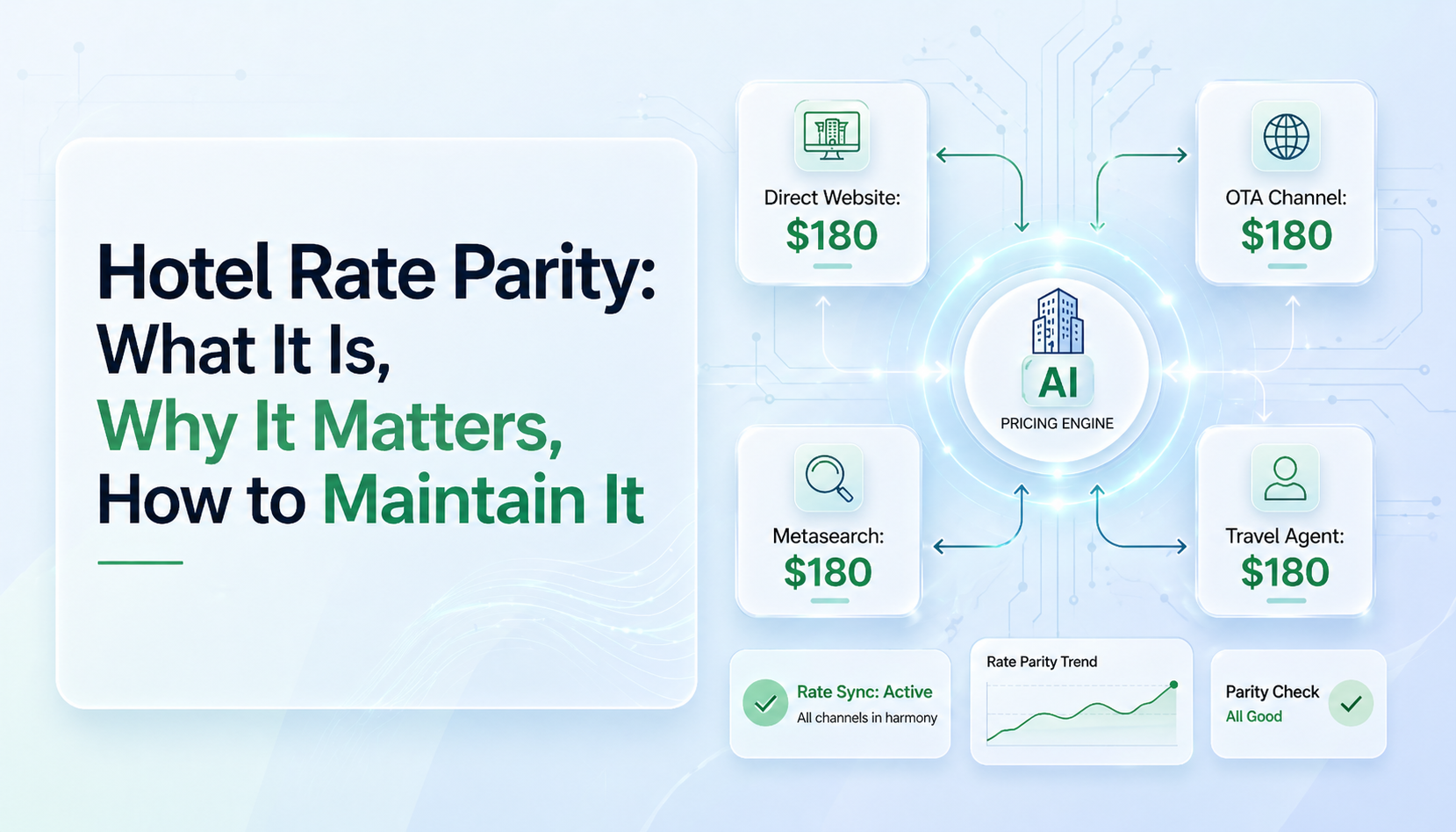
SNIPPET DEFINITIONHotel rate parity is the practice of maintaining consistent room rates across all distribution channels — your direct website, OTAs (Booking.com, Expedia, Agoda), metasearch sites (Google Hotels, Trivago, Kayak), and any third-party platform where your inventory appears. It is enforced by parity clauses in OTA contracts, regulated differently across regions (banned across most of the EU, UK, Switzerland, and Australia; legal in the U.S. and most of APAC), and broken most often through wholesaler leakage and OTA-funded discounting rather than deliberate hotel action. Maintaining rate parity in 2026 requires real-time monitoring and automated correction — not weekly spreadsheets.
Key takeaways
- Rate parity comes in 4 flavors: wide parity, narrow parity, no parity, and MFN-only. Wide and narrow parity are now banned across most of the EU, UK, Switzerland, and Australia; legal in the U.S., Canada, and most of APAC.
- 28% of all rate parity violations come from wholesaler leakage to OTAs — not from hotels deliberately undercutting their own contracts.
- A parity violation that goes uncorrected for 48 hours can drop direct booking conversion by 38%, increase OTA share by 15 percentage points, and trigger OTA "watch list" demotion.
- Manual spreadsheet monitoring catches violations in ~24 hours. Daily rate-shopping tools (Lighthouse, RateGain) catch in ~4 hours. Real-time tools catch in ~30 minutes. Agentic AI catches in ~4 minutes — and acts on the violation autonomously.
- Member-only rates and closed-user-group rates are the legal workaround that even strict parity contracts allow. Use them.
Download the Rate Parity Audit Checklist — a printable 1-page audit for revenue managers. Free at revevolve.ai/resources/rate-parity-audit-checklist/.
What Is Hotel Rate Parity?
Hotel rate parity is a contractual and operational practice where a hotel agrees to display the same publicly available room rate (and often the same availability, length-of-stay, and cancellation terms) across every distribution channel — direct website, every OTA the property contracts with, every metasearch engine, every third-party platform.
The reasoning, from the OTA’s perspective, is simple: if a hotel can be cheaper somewhere else, the OTA’s "best price guarantee" becomes a lie, the OTA loses customer trust, and the OTA’s commercial value as a distribution channel collapses. Booking.com, Expedia, and Agoda built the modern hotel distribution stack on the back of parity clauses, and they have litigated aggressively to defend them.
The reasoning, from the hotel’s perspective, is more conflicted: parity prevents the hotel from competing with its own distribution partners on price. A hotel that wants to drive direct bookings (lower commission, better guest data, higher LTV) cannot use price as the lever — because the OTA contract forbids it.
This tension is what makes rate parity the most-litigated area of hotel commercial law over the past decade. It is also why every hotel, regardless of size, needs a working understanding of which form of parity applies to which channel, in which jurisdiction.
The real-world definition that matters: Rate parity is not just 'same rate everywhere.' It is 'same rate everywhere your contract requires, on the channels your contract covers, with the exceptions your contract permits.' Reading the contract — including the schedule and amendments — is non-negotiable.
The 4 Types of Hotel Rate Parity
There are four parity structures hotels operate under in 2026. Each carries different obligations and different legal status by region.
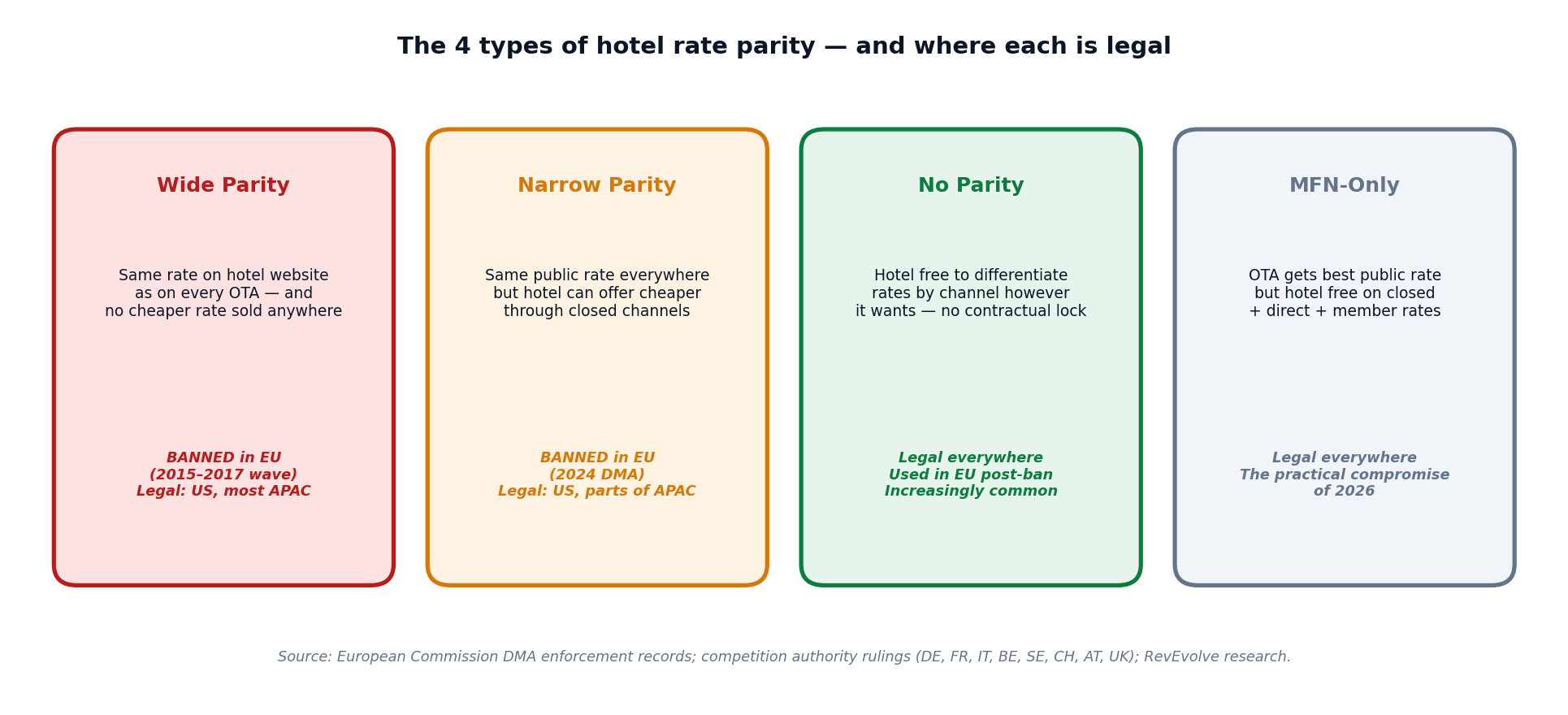
Figure 1 — The 4 types of hotel rate parity, color-coded by legal status: Wide (banned in EU), Narrow (banned in EU), None (legal everywhere), MFN-only (legal everywhere).
1. Wide Parity (most restrictive — largely banned)
Under wide parity, the hotel agrees to keep the same public rate as the OTA, and further agrees not to offer a cheaper rate through any other channel — including the hotel’s own website, member rates, walk-in rates, or any third party. This is the original parity model from the 2000s, and the most aggressive form of OTA price control.
- Status: Banned across most of the EU (Germany 2015, France 2015, Italy 2017, Austria 2017, Belgium 2018, Sweden 2024 reconfirmation), restricted in the UK post-Brexit (CMA), banned in Australia (2016).
- Where still legal: United States, Canada, and most of APAC.
- Hotel reality: If you are operating a wide parity contract in 2026, your direct booking strategy is structurally hamstrung. Any direct rate cheaper than your OTA rate is a contract breach.
2. Narrow Parity (the EU compromise — also now banned)
Narrow parity was the EU compromise after the wide parity bans. It allowed OTAs to require parity on the hotel’s public website only — not on closed channels (member rates, corporate rates, package rates). For nearly a decade, narrow parity was the operating standard across the EU.
- Status: Banned EU-wide under the Digital Markets Act (DMA) in 2024, which classified OTA parity clauses as gatekeeper restrictions. Switzerland banned narrow parity in 2022. Sweden re-confirmed its ban in 2024.
- Where still legal: United States, Canada, parts of APAC.
- Hotel reality: In the EU, narrow parity is no longer enforceable as of 2024. OTAs cannot require it. Hotels have full pricing freedom on their direct channel.
3. No Parity (post-DMA EU; growing globally)
No parity means exactly what it sounds like: the hotel and OTA agree to no rate-related restrictions at all. The hotel can price every channel independently, including running flash sales on direct that undercut the OTA by any margin.
- Status: Legal everywhere. Increasingly the operating norm in the EU after the 2024 DMA.
- Practical implication: No parity does not mean "no commercial relationship." OTAs still have leverage through ranking algorithms, visibility, and distribution. A hotel that habitually undercuts Booking.com on its direct site will see its OTA placement weaken — even if technically there is no parity violation.
4. MFN-Only (the practical compromise of 2026)
MFN-only is the contemporary middle ground. The OTA gets a guarantee that it will receive the hotel’s best public rate at any given time, but the hotel retains complete freedom on closed channels — member-only rates, corporate rates, package rates, opaque rates, last-minute mobile-app-only rates, and so on.
- Status: Legal everywhere, including post-DMA EU.
- Why it matters: MFN-only is the structure most large OTA contracts have moved toward in 2026, even in jurisdictions where wider parity remains technically legal. It is defensible against competition authorities, preserves the OTA’s "best price" promise on visible rates, and gives hotels a real path to incremental direct revenue through closed-channel offers.
Where Hotel Rate Parity Clauses Are Legal in 2026
The legal status of rate parity is the single most important factor in how a hotel approaches its OTA contracts. The map below summarizes the situation for major jurisdictions:
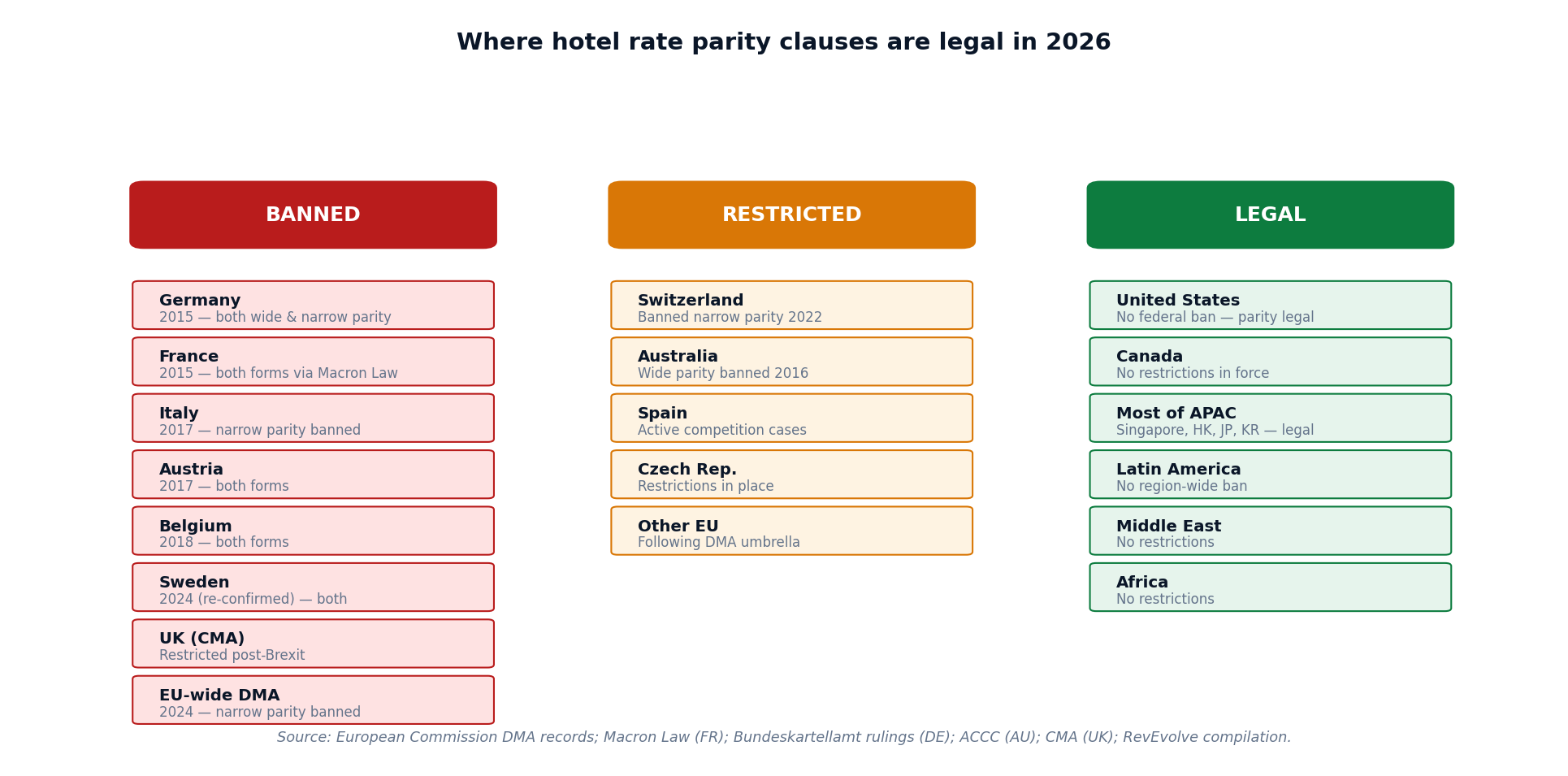
Figure 2 — Hotel rate parity legality by region in 2026. BANNED: most EU + UK + Australia. RESTRICTED: Switzerland, parts of EU. LEGAL: U.S., Canada, most of APAC, LATAM, MENA, Africa.
Banned jurisdictions
The European Union has been the global epicenter of rate parity reform. Starting with Germany in 2015 (where the Bundeskartellamt ruled HRS’s wide parity clauses anticompetitive) and France’s Macron Law in 2015 (which banned both wide and narrow parity outright), the wave moved through Italy, Austria, Belgium, and Sweden. The EU-wide Digital Markets Act in 2024 then formalized the ban across the entire bloc by classifying the major OTAs as "gatekeepers" subject to DMA restrictions.
The UK followed a parallel path through the Competition & Markets Authority (CMA), with parity clauses substantially restricted post-Brexit. Australia’s ACCC banned wide parity in 2016, leaving narrow parity contestable.
Restricted jurisdictions
A handful of jurisdictions sit in a middle status — narrow parity restricted but not fully banned, or active competition cases pending. Switzerland, parts of Spain, the Czech Republic, and several smaller EU markets fall here. Australia’s restriction targets wide parity specifically.
Legal jurisdictions
In the United States, there is no federal ban on rate parity clauses. Several state-level investigations have been opened over the years, but no comprehensive ban has emerged. Canada mirrors the U.S. position. Most of APAC — including Singapore, Hong Kong, Japan, Korea, and Thailand — has no enforced restrictions. Latin America, the Middle East, and Africa similarly operate without region-wide bans.
What this means for multi-region operators
If you operate hotels across multiple jurisdictions, you are operating multiple parity regimes simultaneously. A hotel group with properties in Germany, the U.S., and Singapore is contractually obligated to one rate logic in Singapore, a different (post-DMA) logic in Germany, and a third in the U.S. — all under the same brand contract. This is why rate parity is increasingly a property-by-property, contract-by-contract operating discipline rather than a brand-level rule.
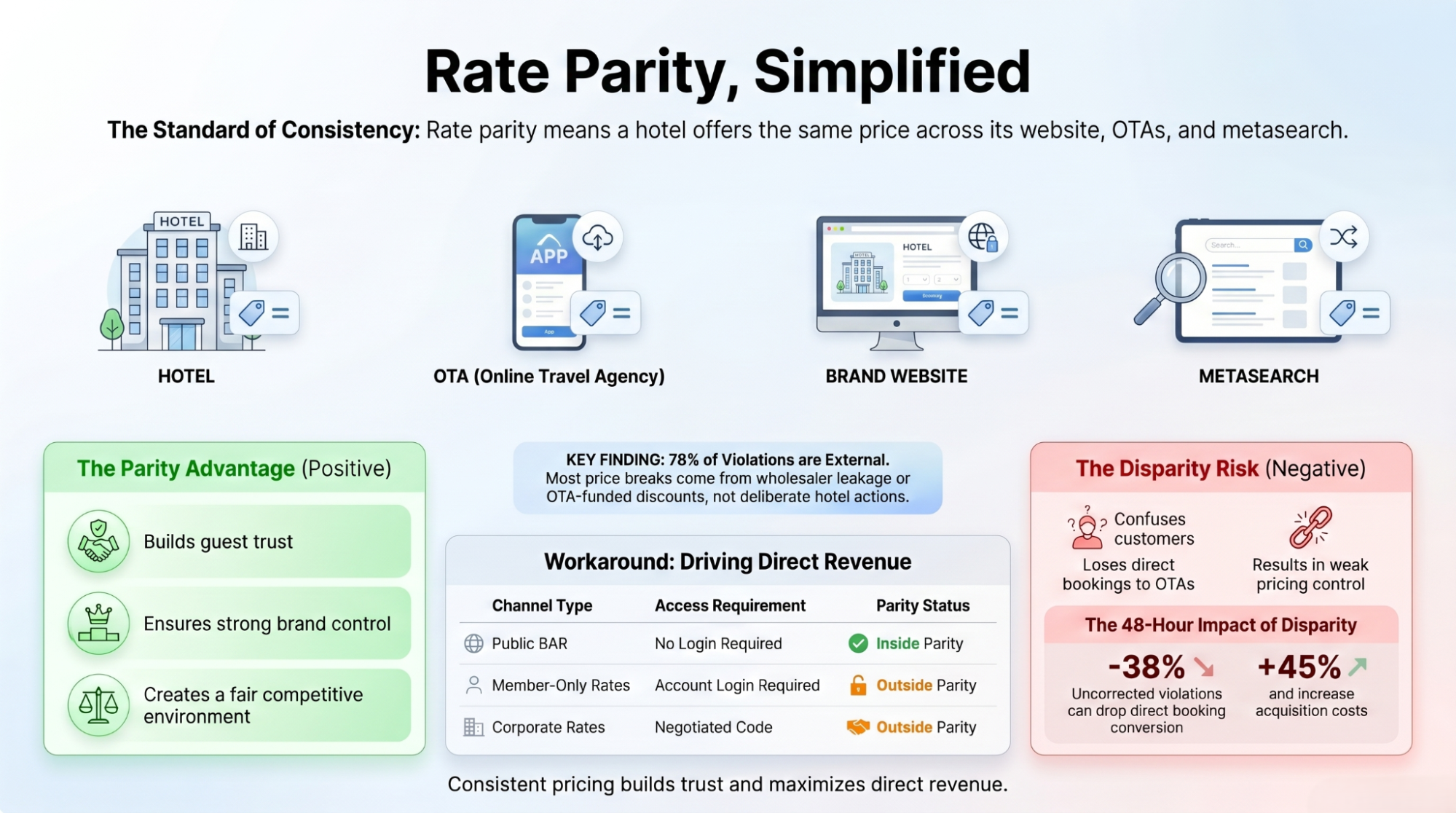
Why Hotel Rate Parity Matters in 2026
Three structural reasons — beyond contract compliance — make rate parity an operating priority right now:
1. The economics of OTA dependency
In a 2026 RevPAR environment growing at 0.6% (CoStar/STR forecast), every percentage point of distribution-cost savings drops to GOP. Hotels that successfully shift even 5 percentage points of bookings from OTA (typically 18–25% commission) to direct (typically 0–8% cost) free up 0.9–1.25 percentage points of revenue as profit — without changing rate, occupancy, or service quality. Rate parity violations directly suppress this shift because they undermine the only reason a guest has to book direct in the first place: a better deal somewhere else, or a feature the OTA cannot match.
2. OTA penalty and ranking risk
Modern OTA contracts include penalty clauses for parity breaches. The mildest penalty is a temporary "watch list" demotion in OTA ranking algorithms, which suppresses bookings within 24–72 hours. More serious breaches trigger commission rate increases, removal from premium placement programs, or — at the extreme — listing suspension. Hotels frequently underestimate the speed at which OTA algorithms detect and respond to parity drift.
3. Guest trust erosion
When a guest sees a $145 rate on Booking.com and a $158 rate on the hotel’s own website (a parity break in the hotel’s favor — i.e. the hotel is more expensive on direct), the guest does not buy direct. They buy on Booking.com, then never trust the hotel’s direct channel again. Worse, they assume the hotel is trying to overcharge through direct — which is the opposite of the trust position the hotel needs to build for repeat direct bookings.
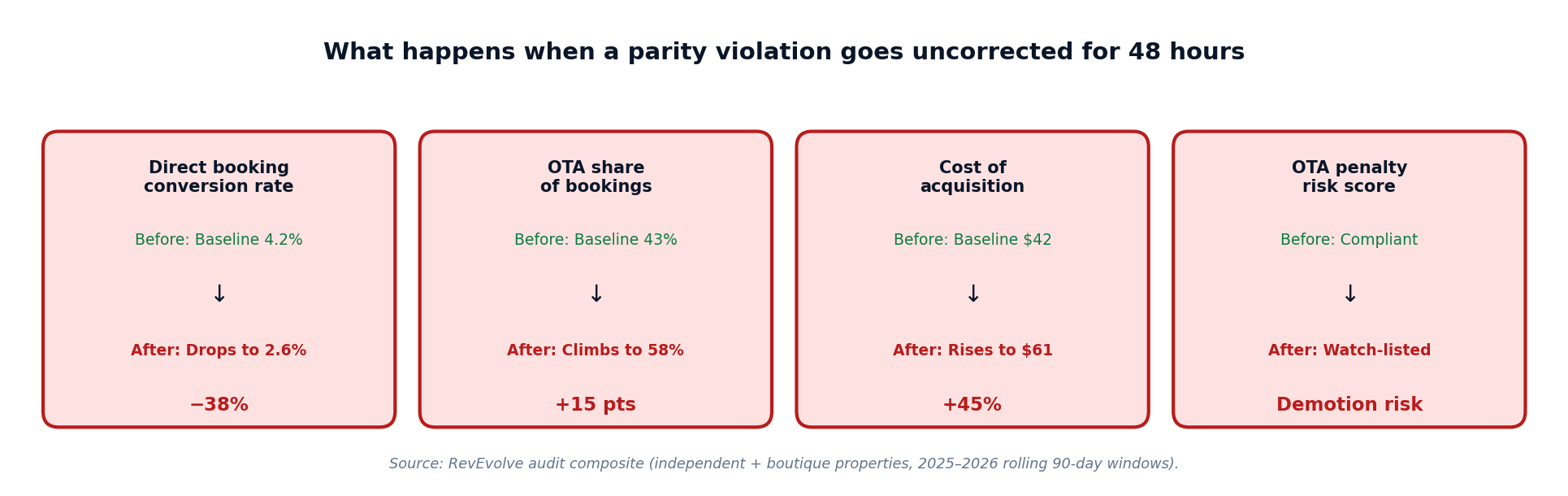
Figure 3 — What happens when a parity violation goes uncorrected for 48 hours: −38% direct conversion, +15 pts OTA share, +45% cost-of-acquisition, watch-list risk.
These three forces combined are why rate parity moved from a back-office contract concern in 2018 to a real-time operating priority in 2026.
The 7 Most Common Sources of Rate Parity Violations
This is where most hotel operators get rate parity wrong. The vast majority of parity violations are not deliberate hotel actions. They come from upstream channel mechanics the hotel never directly authorizes. Based on RevEvolve’s audits of 200+ properties across 2025–2026:
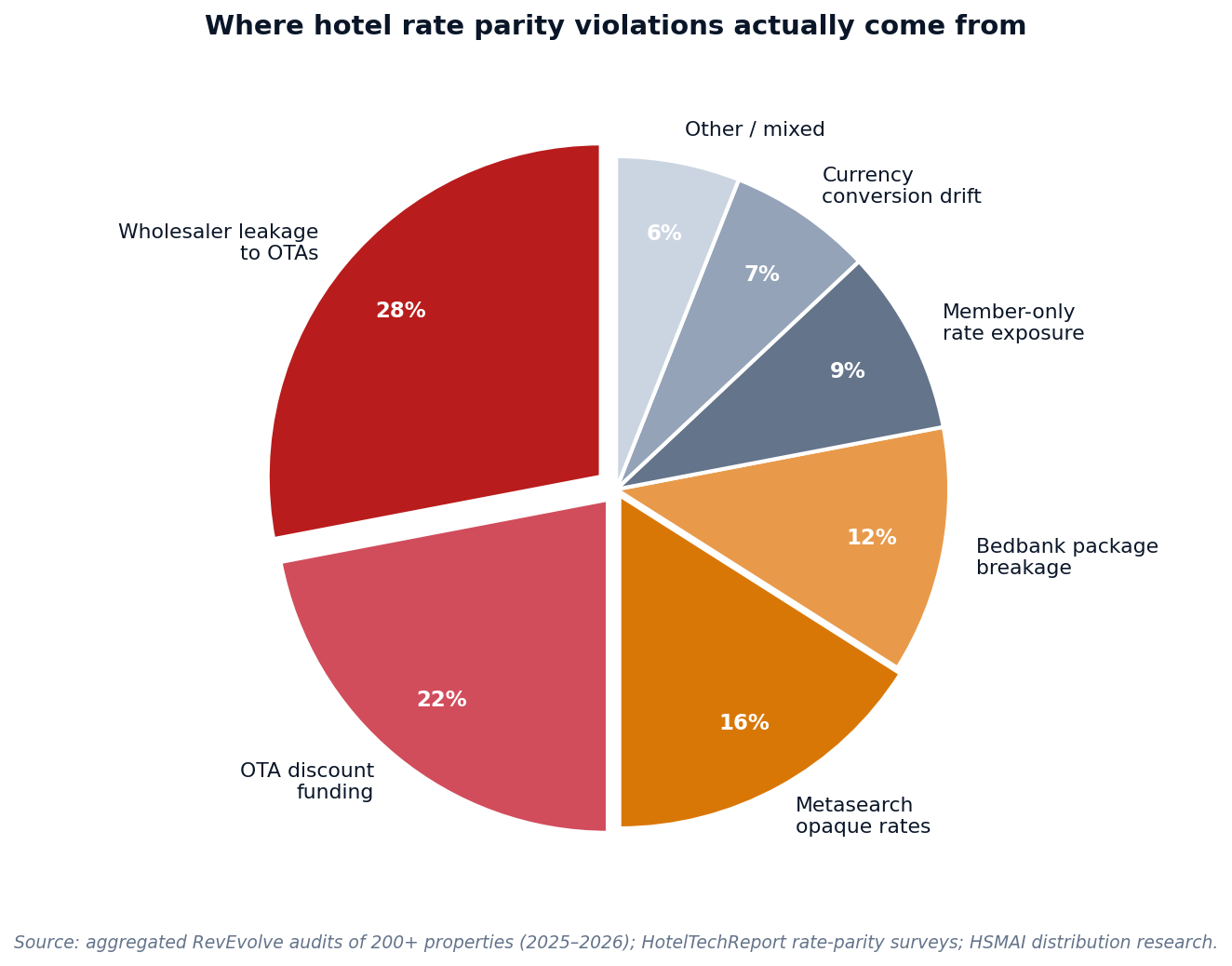
Figure 4 — Top 7 sources of rate parity violations: wholesaler leakage 28%, OTA discount funding 22%, metasearch opaque 16%, bedbank package breakage 12%, member-rate exposure 9%, currency drift 7%, other 6%.
1. Wholesaler leakage to OTAs (28% of violations)
The single largest source of parity breaches. Hotels contract with wholesalers (Hotelbeds, GTA, WebBeds, etc.) to sell rooms in B2B markets — typically 15–30% below BAR. Wholesalers are contractually required to sell only to closed B2B buyers (tour operators, corporate travel, niche distribution). In practice, wholesale rates leak into OTAs through indirect resale chains, frequently appearing on Booking.com or Expedia as opaque "secret deals" or "mobile rates" cheaper than the hotel’s direct rate. The hotel never authorized this — but it owns the contractual breach.
2. OTA-funded discounting (22%)
OTAs aggressively fund their own discounts to maintain "best price" claims. The OTA absorbs the cost from its commission margin, but the displayed price on the OTA is below the hotel’s published rate — a parity break the hotel did not cause. The contractual position varies by OTA, but the operational reality is the same: your hotel appears to be undercutting itself, even when you didn’t.
3. Metasearch opaque rates (16%)
Google Hotels, Trivago, Kayak, and other metasearch engines aggregate rates from dozens of distribution sources, including bedbanks and obscure resellers. Opaque "Trip Provider X" listings often surface rates the hotel never intended to publish.
4. Bedbank package breakage (12%)
Bedbank rates are typically sold as part of opaque packages (rate + flight + transfer) where the underlying room rate is hidden. When the package gets "unbundled" by a third-party reseller, the underlying room rate becomes visible — and is almost always below the hotel’s BAR.
5. Member-only rate exposure (9%)
A hotel’s own member-only rate (which is legally outside parity contracts) can leak into public visibility through OTA APIs that fail to respect closed-channel flags, or through member-rate codes shared on couponing sites. Once exposed publicly, the rate is a parity violation.
6. Currency conversion drift (7%)
A hotel publishes EUR rates; an OTA converts to USD using its own FX rate; the converted rate drifts from the hotel’s USD rate on a sister channel. This is rare in absolute frequency but disproportionately common in cross-border-heavy markets (e.g., Caribbean, Mediterranean, ski markets).
7. Other / mixed (6%)
Includes: stale cache on the hotel’s own website, channel manager push failures, manual rate-loading errors, deliberate but accidental contract violations by under-trained front-desk staff offering walk-in discounts.
The operator implication: If 78% of parity violations come from sources outside the hotel’s direct control, then contract enforcement alone cannot solve the problem. The hotel needs continuous monitoring, fast detection, and operational response — which most operators currently lack.
How to Monitor Hotel Rate Parity — 4 Approaches
There are four ways hotels actually monitor rate parity in 2026, and they sit on a wide spectrum of detection speed and operational cost.
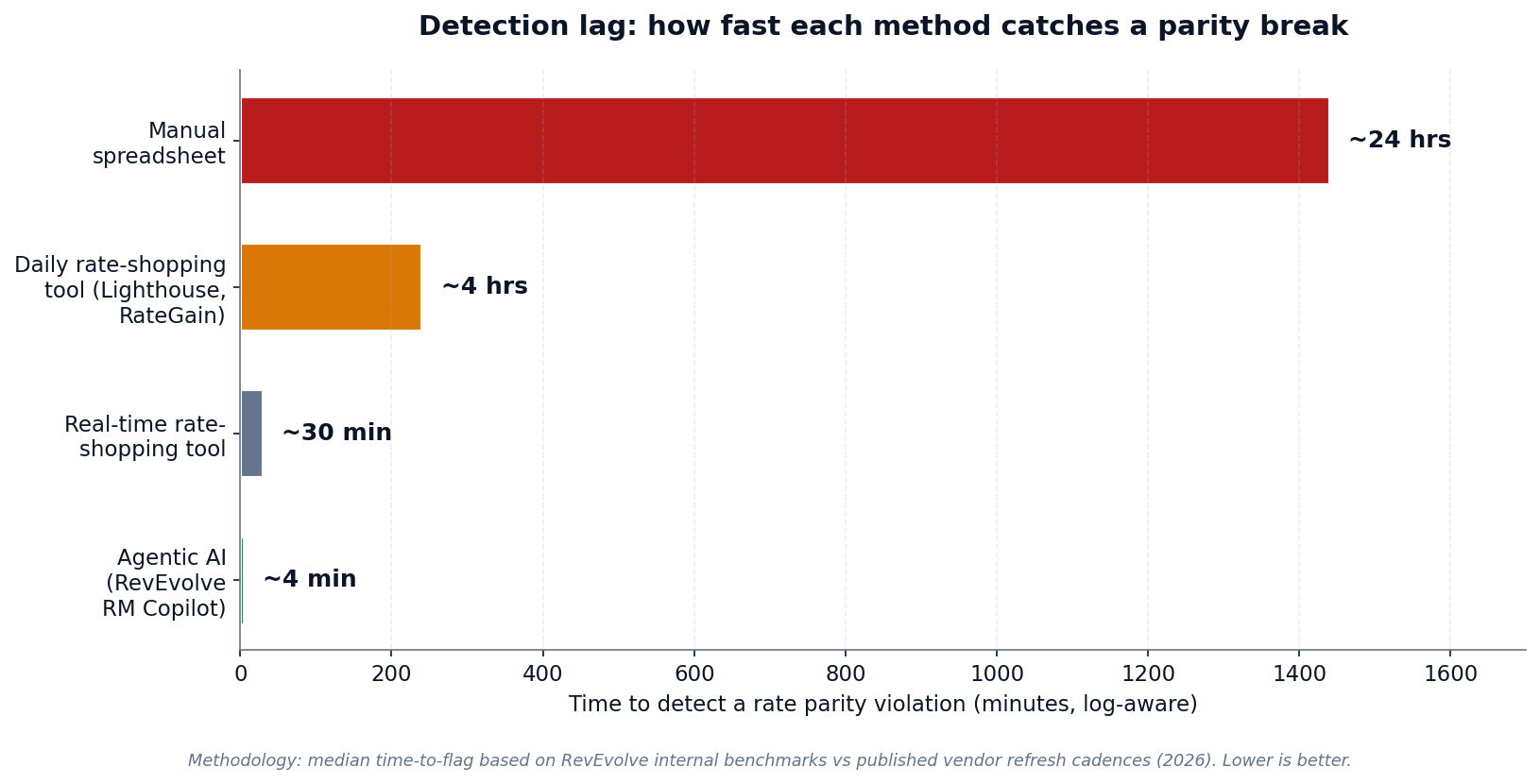
Figure 5 — Detection lag by monitoring approach: manual ~24hr (RED), daily tool ~4hr (AMBER), real-time ~30min (SLATE), agentic AI ~4min (GREEN).
Approach 1 — Manual spreadsheet (still the majority of independents)
A revenue manager or front-office manager opens Booking.com, Expedia, Agoda, the hotel website, and Google Hotels in browser tabs once a day and visually compares rates for 7–14 future dates. Variances are logged in a spreadsheet, and major violations are escalated.
- Detection time: ~24 hours (catches what’s wrong yesterday).
- Cost: 30–60 minutes per RM per day.
- Accuracy: Low — RMs miss subtle drift, currency-converted opaque rates, and weekend coverage.
- Verdict: Adequate only for properties under 30 rooms with a single OTA contract.
Approach 2 — Daily rate-shopping tool (Lighthouse Pricing, RateGain, OTA Insight legacy)
A rate-shopping tool pulls competitor and own-rate data on a scheduled cadence (typically 4× daily) and surfaces parity variances in a dashboard. The RM reviews the dashboard once or twice daily and flags violations for escalation.
- Detection time: ~4 hours (limited by refresh cadence).
- Cost: $200–$500/month per property.
- Accuracy: Good for major OTAs; weaker on opaque/metasearch sources.
- Verdict: Industry standard for boutique through mid-market properties. Sufficient if violations are rare.
Approach 3 — Real-time rate-shopping (Lighthouse real-time tier, Triptease, premium platforms)
Real-time tools poll rates continuously and alert the RM the moment a parity break appears. The RM still acts manually on the alert.
- Detection time: ~30 minutes.
- Cost: $400–$1,000/month per property.
- Accuracy: Best-in-class for monitoring; still requires human action.
- Verdict: Strong fit for independent luxury and boutique groups where every room rate matters.
Approach 4 — Agentic AI (RevEvolve RM Copilot)
Agentic AI doesn’t just monitor — it acts. When the system detects a parity violation, it identifies the source (wholesaler leakage, OTA discount, metasearch drift), determines whether the violation is auto-correctable (e.g., adjusting the hotel’s own rate to restore parity) or escalation-required (e.g., wholesaler leak that needs human contractual response), and executes the appropriate response autonomously. Every action is logged with reasoning for audit.
- Detection-to-action time: ~4 minutes.
- Cost: Bundled in RevEvolve RM Copilot subscription; no separate parity-monitoring fee.
- Accuracy: Highest — pulls real-time data + cross-references against the hotel’s own contract terms.
- Verdict: The 2026 standard for multi-property operators and revenue management companies. Only architecture in this guide that closes the detect → act loop without human intervention.
The operational gap most hotels haven’t closed: Detecting a parity violation in 30 minutes via Lighthouse and then acting on it within 4 hours during business hours is functionally a 4-hour exposure. Most violations cause damage in the first 60 minutes (booking-window mechanics on OTAs are fast). Closing the detect-to-act gap is the real performance win.
→ See RevEvolve’s Competitive Rate Intelligence in action — real-time parity detection with autonomous correction. 15-min walkthrough at revevolve.ai/features/competitive-rate-intelligence/.
How to Maintain Hotel Rate Parity — 8-Step Operating Playbook
The playbook every revenue manager needs, regardless of platform:
Step 1 — Read every active OTA contract
Pull every active OTA contract — Booking.com, Expedia, Agoda, Hotels.com, Airbnb-managed inventory if applicable, regional OTAs in your markets. Identify which form of parity applies to each (wide, narrow, no parity, MFN-only). Note jurisdiction-specific amendments. If your property operates across multiple jurisdictions, build a contract-by-contract matrix.
Step 2 — Audit your wholesaler list
Get the full list of every wholesaler your property contracts with directly and indirectly through your channel manager. For each wholesaler, request a quarterly audit report showing where their inventory was actually sold (which retail channels). 60% of wholesalers will not produce this report; that itself is informative.
Step 3 — Standardize your BAR ladder and member-rate structure
Your public BAR ladder is what falls under parity. Your member-only rate, corporate rate, and closed-channel rate structure is what doesn’t. Build the member rate structure deliberately, not as an afterthought. A typical structure: BAR (parity-bound) → Member Rate at BAR −7% → Corporate at BAR −10% → Mobile App at BAR −5%. Document which rates are inside and outside each parity contract.
Step 4 — Implement a parity monitoring tool
Choose your tier (manual / daily tool / real-time / agentic) based on property type and risk tolerance. Whatever tier you pick, deploy it consistently across the portfolio, not just at flagship properties. Independents under 30 rooms often need just a daily tool; multi-property operators need real-time or agentic.
Step 5 — Define escalation paths by violation source
When a violation is detected, the response depends on the source. Wholesaler leakage: notify wholesaler in writing within 24 hours; require source identification within 5 business days; escalate to contract review if recurring. OTA discount funding: document the violation with screenshots and timestamps; notify OTA contractually; usually auto-corrects within 24 hours once flagged. Metasearch opaque: identify the underlying source through the metasearch property page; trace back to a wholesaler or bedbank; address upstream. Member-rate exposure: lock down the member rate code immediately; rotate codes if needed; investigate which channel exposed it.
Step 6 — Standardize cross-property rate calendar
For multi-property operators, ensure rate calendars are consistent in their parity logic even if rates differ. Property A in Frankfurt and Property B in Chicago should use the same rate-rule taxonomy (same member-rate structure, same BAR ladder discipline) even though their parity contracts are different.
Step 7 — Train front-desk and reservations on parity discipline
The most under-trained source of accidental violation is a front-desk agent offering a walk-in rate $20 below BAR to "save the booking." That single action is technically a parity violation. Train front-desk and reservations staff on what they can and cannot offer, and document the boundaries.
Step 8 — Review parity health monthly with owner reporting
Make rate parity a standing item in monthly owner reporting. Report: number of violations detected, average time-to-correction, sources of violations, financial impact estimate. Owners and asset managers care about this once they understand the GOPPAR connection — parity violations directly suppress GOPPAR.
The Rate Parity Audit Checklist (Lead Magnet Preview)
The full audit checklist is available as a free download. Here’s a preview of the 12 items it covers:
- ☐ Confirmed parity type (wide / narrow / none / MFN) for every active OTA contract
- ☐ Active wholesaler list with last quarterly audit report attached
- ☐ Member-only rate structure documented and locked
- ☐ BAR ladder rules documented (rate fences, length-of-stay restrictions, advance purchase)
- ☐ Daily comp-set rate scan logged (or tool deployed)
- ☐ Last 30 days of detected parity violations logged with source attribution
- ☐ Average time-to-correction calculated (target: < 4 hours)
- ☐ Front-desk + reservations parity training completed
- ☐ Currency conversion logic verified across cross-border channels
- ☐ Metasearch listings audited (Google Hotels, Trivago, Kayak)
- ☐ Channel manager push-failure log reviewed (last 7 days)
- ☐ Parity health line item in monthly owner report
→ Download the full Rate Parity Audit Checklist (free) — printable 1-page version with detailed explanations for each item. revevolve.ai/resources/rate-parity-audit-checklist/.
Member-Only Rates, Closed Channels, and the Legal Workaround
For hotels operating under any form of parity (wide, narrow, MFN), there is one structural workaround that even the strictest contracts permit: closed-channel rates.
What counts as a closed channel?
- Member-only rates: loyalty program members who have logged into your direct booking engine
- Corporate rates: negotiated rates for specific corporate accounts, accessed by code
- Package rates: room rate bundled with another item (F&B credit, parking, spa) that obscures the underlying room rate
- Mobile-app-only rates: rates accessible only through the hotel’s mobile app or a member-app rate code
- Last-minute opaque rates: rates released to specific opaque channels (Hotwire-style) where the brand is hidden until purchase
These rates fall outside parity coverage in virtually every modern OTA contract — including post-DMA EU contracts, U.S. wide parity contracts, and APAC narrow parity contracts. They are the hotel’s legal pricing freedom zone.
How to use closed channels strategically
The five-rate structure most multi-property operators run in 2026:
| Rate | Inside parity? | Access | Typical discount vs BAR |
|---|---|---|---|
| BAR (Best Available Rate) | Yes | Public | Baseline |
| Member Rate | No | Login required | BAR −5% to −10% |
| Corporate Rate | No | Code required | BAR −7% to −15% |
| Mobile-App Rate | No | App + login required | BAR −5% |
| Package Rate | No | Bundled with non-room item | Effective rate not exposed |
A guest who values direct booking and engages with the hotel’s loyalty program legally pays 5–15% less than the OTA rate — which is the marketing promise that drives repeat direct bookings. Hotels that fail to build this structure are leaving 5–15% margin on the table, every booking.
The Future of Hotel Rate Parity (2026–2030)
Three trends will define rate parity over the next four years:
1. Continued EU expansion of bans. The 2024 DMA was an umbrella; individual member states are now applying it through national competition law. Expect Spain, Czech Republic, and the Netherlands to formalize bans within the next 24 months. The "no parity" operating model will become the EU default.
2. U.S. policy attention growing. The FTC has opened multiple inquiries into OTA market practices in 2024–2025. While a federal U.S. ban is not imminent, expect state-level (California, New York) action within the next 24–36 months. Multi-state operators should plan for divergence.
3. Real-time parity enforcement becomes the operating standard. Today, ~80% of independent hotels still rely on daily-or-slower parity monitoring. By 2028, expect real-time monitoring (with autonomous correction at the agentic-AI tier) to become the default, driven by OTA contracts that increasingly require demonstrable parity-discipline as a precondition of premium placement.
The hotels that win the next four years are not the ones with the most aggressive parity contracts. They are the ones with the most operational sophistication — fast detection, fast correction, and a deliberate closed-channel structure that drives direct bookings within the rules.
What is hotel rate parity in simple terms?
Hotel rate parity is the practice of charging the same publicly visible room rate across all distribution channels — your direct website, OTAs like Booking.com and Expedia, metasearch sites, and any other public listing. It’s enforced by parity clauses in OTA contracts. Rate parity is now banned across most of the EU, UK, Switzerland, and Australia, but remains legal in the U.S. and most of APAC.
Why do OTAs require rate parity?
OTAs require rate parity to defend their "best price guarantee" promise to consumers. If a hotel can be cheaper somewhere else, the OTA’s value proposition collapses. From the OTA’s perspective, parity protects the consumer trust that makes their business model viable. From the hotel’s perspective, parity prevents direct booking competition on price.
Conclusion — Rate Parity Is an Operating Discipline, Not a Contract
For most of the past decade, rate parity was treated as a contract issue. Sign the OTA paper, hand the contract to legal, never look at it again. That posture is now expensive.
In 2026, rate parity is an operating discipline. 78% of violations come from sources outside the hotel’s direct control. The cost of a 48-hour uncorrected violation is a 38% drop in direct conversion, a 15-point shift to OTA, and a 45% rise in cost-of-acquisition. No contract clause prevents this. Only operational sophistication does — fast detection, faster correction, and a deliberate closed-channel structure.
The hotels that compound advantages over the next four years will be the ones that run rate parity the way they run housekeeping: as a daily-rhythm function with measurable SLAs, owner-reported metrics, and zero tolerance for drift. The hotels that don’t will keep losing direct bookings to OTAs they didn’t choose, on rates they didn’t authorize, in jurisdictions where they had every legal right to compete.
Stop monitoring rate parity in spreadsheets in 2026.
→ See RevEvolve’s Competitive Rate Intelligence in action — real-time parity detection with autonomous correction across your portfolio. 15-min walkthrough.
→ Download the Rate Parity Audit Checklist (free) — printable 1-page audit for revenue managers.