

AI Virtual Revenue Manager: Why the Next Era of Hotel RM Isn’t About Better Dashboards
The next evolution in hotel revenue management isn’t a faster dashboard or a smarter pricing algorithm – it’s an AI…
Discover tailored revenue strategies that help
maximize occupancy, optimize pricing, and
boost profitability.
Get tips, insights, and expert advice to maximize performance.
Explore strategies, successes, and insights from real-world examples.
Get clear, step-by-step guidance to maximize the platform’s features and benefits.
Access comprehensive whitepapers packed with data-driven insights, expert analysis, and proven strategies to help you drive smarter decisions and sustainable revenue growth.
Explore expert insights, tips, and the latest trends in revenue management to boost your financial strategies and drive growth.
Revenue Management | Harikrishna Patel January 12, 2026
January is when World Cup mistakes begin.
Budgets are locked. Owners start asking questions. Sales teams want clarity. Revenue teams feel pressure to “get something on the books.” And quietly, without realizing it, hotels start committing their most valuable inventory for FIFA World Cup 2026 far too early.
It feels responsible. It looks productive. Pace reports turn green.
But history shows something uncomfortable: hotels that price World Cup inventory too early consistently underperform those that wait.
Across Brazil 2014, Russia 2018, and Qatar 2022, hotels that committed inventory more than six months out lost flexibility just as demand clarity emerged. The result wasn’t empty rooms. It was full hotels at the wrong price.
This blog breaks down what “too early” really means, why early buyers are rarely your best buyers, and how to protect inventory without freezing sales or upsetting ownership.
Early pricing appeals to hotel psychology.
It creates certainty. It satisfies ownership. It helps sales teams close conversations. It fills pace charts and reduces anxiety.
But World Cups don’t reward certainty. They reward optionality.
In Russia 2018, several Moscow hotels priced World Cup dates 6–9 months in advance at what felt like aggressive premiums. Those hotels filled early, but when knockout-stage demand surged and booking windows compressed to under 10 days, they had no inventory left to reprice. Competitors who held inventory longer achieved 20–40% higher RevPAR on the same nights with similar occupancy.
The critical insight is this:
Early demand is not high-value demand.
Early buyers are planners. High-value buyers are reactors. World Cup pricing power lives with the second group.
“Too early” isn’t a calendar date. It’s a behavior.
It’s pricing without clarity on:
Based on historical World Cup data, any pricing decision made more than 120 days out should be treated as probing, not committing. When hotels fully release inventory, premium room types, or restrictive policies beyond this window, they trade flexibility for false comfort.
In Brazil 2014, hotels that locked group and wholesale rates before team draw clarity saw premium nights capped while compsets pushed rates 30–50% higher once match significance became clear.
Too early means deciding before the story of demand has revealed itself.

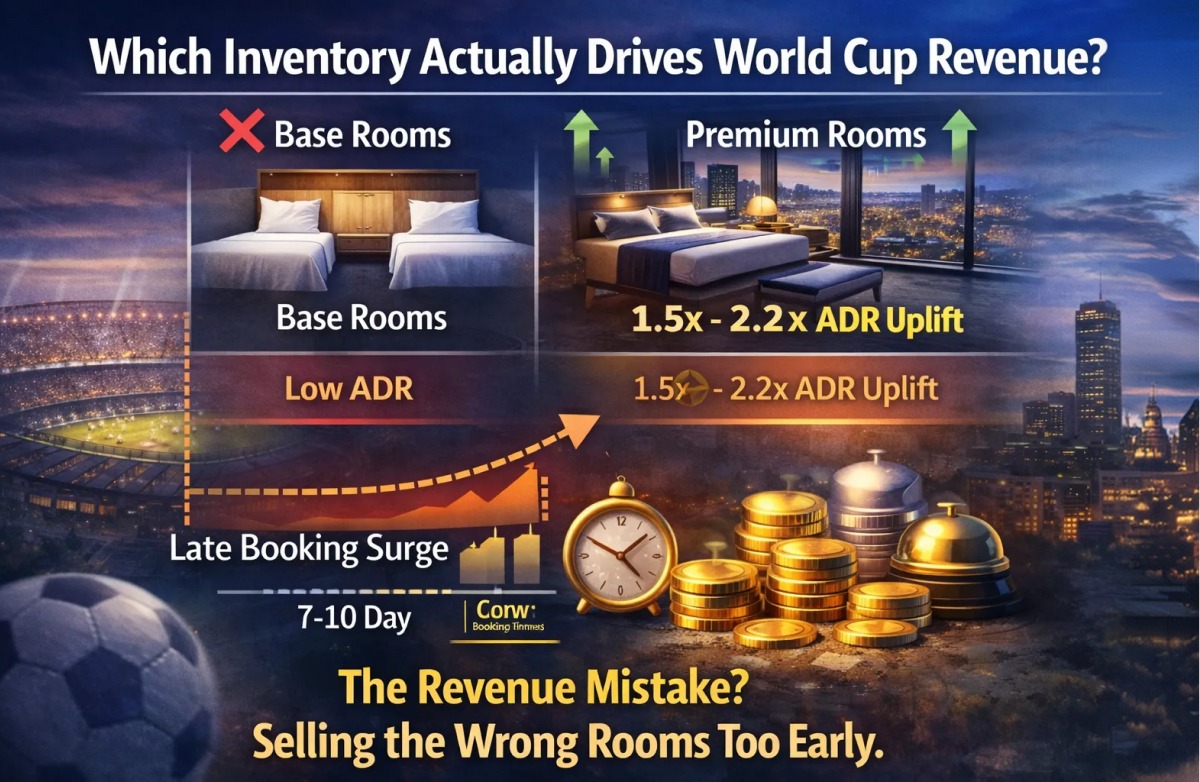
Not all rooms are equal during a World Cup.
Across multiple tournaments, premium room categories consistently captured 1.5x to 2.2x ADR uplift compared to base rooms when held for late demand. These rooms are not bought early. They are bought when urgency peaks.
Similarly, peak match nights behave differently:
These nights experience booking window compression to 7–10 days, sometimes even closer. Hotels that released these nights early rarely recovered lost pricing power later.
The revenue mistake isn’t selling rooms.
It’s selling the wrong rooms too early.
Consider this pattern, repeated in every World Cup.
A hotel prices all World Cup nights at a flat +40% premium six months out. Early demand is strong. Pace looks healthy. Ownership feels reassured.
Then team progression reshapes demand.
A quarterfinal lands in the city. International demand surges. Competing hotels, still holding inventory, push rates to +90% or higher. The early-priced hotel sells out at +40%.
Occupancy is the same.
Revenue is not.
That difference is unrecoverable. You don’t get to reprice a sold room.
Hotels don’t lose World Cup revenue because demand disappears. They lose it because flexibility does.
Inventory protection doesn’t mean blocking everything.
It means controlling exposure.
Hotels that performed best in past World Cups used layered strategies:
This approach allowed hotels to capture early demand without sacrificing late upside.
Protection is not a restriction.
It’s sequencing.

Preparing for World Cup 2026 pricing decisions right now?
We’re building a Free FIFA World Cup 2026 Hotel Revenue Playbook that breaks down:
Register for early access or book a World Cup pricing strategy call
World Cups punish speed and reward timing.
Selling early feels productive, but productivity isn’t profitable. The hotels that win World Cup 2026 will not be the ones with the best pace reports in January. They’ll be the ones with pricing power in June.
The real risk isn’t unsold rooms.
It’s sold rooms at the wrong price.
Before deciding when to release or hold World Cup inventory, hotels need clarity on where demand will actually come from and how it moves between markets. If you haven’t read it yet,
World Cup 2026 Demand Map: Host vs Spillover Cities and What It Means for Hotel Pricing breaks down how host, spillover, and transit cities behave differently and why early pricing carries very different risks in each.
In the next blog, we’ll tackle booking window compression and why World Cup demand arrives later than most hotels expect and how to plan for it without losing your nerve.
Share onHarry Sheta is a hospitality technology entrepreneur focused on helping hotels make faster, smarter revenue decisions. As Co-Founder of Hotel Switchboard and the driving force behind RevEVOLVE, he works closely with hoteliers, revenue managers, and management companies to modernize how pricing, forecasting, and portfolio insights are delivered.
Revenue Management 26 Mar 2026
Revenue Management 09 Mar 2026
AI-Driven Strategy 03 Mar 2026
Market Insights 16 Feb 2026
Revenue Management 30 Jan 2026
Revenue Management 27 Jan 2026
Revenue Management 19 Jan 2026
Revenue Management 12 Jan 2026
Revenue Management 29 Dec 2025
Revenue Management 19 Dec 2025
The next evolution in hotel revenue management isn’t a faster dashboard or a smarter pricing algorithm – it’s an AI…

Hotel revenue management in 2026 is defined by three fundamental shifts: AI-powered demand forecasting now achieves accuracy rates exceeding 90%,…
Los Angeles will host eight FIFA World Cup 2026 matches at SoFi Stadium, including the USA’s opening match against Paraguay…
Join the ranks of successful hoteliers who are leveraging AI to maximize their revenue. Get started today and see the difference our solution can make.