


AI Virtual Revenue Manager: Why the Next Era of Hotel RM Isn’t About Better Dashboards
The next evolution in hotel revenue management isn’t a faster dashboard or a smarter pricing algorithm – it’s an AI…
Discover tailored revenue strategies that help
maximize occupancy, optimize pricing, and
boost profitability.
Get tips, insights, and expert advice to maximize performance.
Explore strategies, successes, and insights from real-world examples.
Get clear, step-by-step guidance to maximize the platform’s features and benefits.
Access comprehensive whitepapers packed with data-driven insights, expert analysis, and proven strategies to help you drive smarter decisions and sustainable revenue growth.
Explore expert insights, tips, and the latest trends in revenue management to boost your financial strategies and drive growth.
Revenue Management | Harikrishna Patel January 19, 2026
If you’re an RMC owner reading this in early January, you’re probably doing the same thing we’re seeing across the industry: setting ambitious revenue goals for 2026.
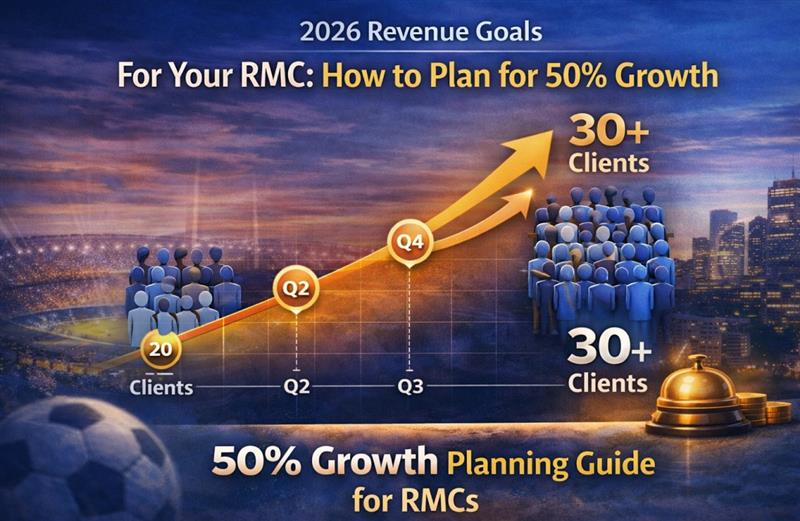
And if you’re like most RMC owners we talk to, you’re thinking about something in the 30-50% growth range. Maybe you’re managing 20 hotel clients today and want to get to 30. Or you’re at 35 and ready to push toward 50+.
Here’s the challenge: Most RMC owners set big revenue goals but don’t have a clear, actionable plan to actually achieve them.
You know you need to grow. You know the opportunity is there. But when you sit down to figure out how you’ll actually get from $720,000 in annual revenue to $1.08M (50% growth), the path forward gets murky.
This article breaks down exactly how to plan for 50% revenue growth in 2026—with specific frameworks, financial models, and strategic decisions that successful RMCs are using to scale profitably.
Let’s get into it.
Before we talk strategy, let’s ground this in reality with some math.
Let’s say you’re running an RMC with this profile:
50% growth means:
That means you need to:
Sounds straightforward, right?
Not so fast. The real question isn’t whether you can acquire 10 clients—it’s whether you can service 30 clients profitably with your current business model.
That’s where most RMCs get stuck.
Here’s what typically happens when RMCs try to grow 50%:
Current state (20 clients):
To reach 30 clients traditionally:
And here’s the real problem:
Bottom line: Traditional scaling means your revenue grows 50%, but your profit margins shrink and your operational complexity increases dramatically.
There has to be a better way.
Let’s look at the same growth scenario with a different approach:
Current state (20 clients):
To reach 30 clients with technology:
Why this works:
This is how the fastest-growing RMCs are scaling in 2026.
Now let’s break down the step-by-step plan to make this happen.

Start by getting crystal clear on your numbers.
Use this worksheet:
Current Monthly Revenue: $__________
Target Growth Percentage: _______% (e.g., 50%)
Target Monthly Revenue: $__________ (Current × 1.5)
Target Annual Revenue: $__________
Current Clients: _______
Average Monthly Fee: $__________
Required Total Clients: _________ (Target Monthly Revenue ÷ Avg Fee)
New Clients Needed: _________ (Required Total – Current)
Expected Annual Churn: _______ clients (typically 15-25%)
Gross New Clients Needed: _________ (New Clients + Expected Churn)
Example:
This is your acquisition target for 2026.
Critical question: Can your current team handle 30 clients?
Traditional capacity calculation:
Technology-enabled capacity:
Decision point: How will you handle the capacity challenge?
Option A: Hire proportionally (traditional approach)
Option B: Implement technology (modern approach)
Option C: Hybrid approach
Our recommendation: Start with Option B or C. Technology gives you the flexibility to scale without being constrained by hiring.
You need 14 new clients in 2026. Here’s how to get them:
Acquisition Channel Breakdown
Based on industry data, plan to acquire clients through these channels:
1. Referrals from Existing Clients (35% = 5 clients)
2. Competitive RFPs (30% = 4 clients)
3. Direct Outreach/Sales (20% = 3 clients)
4. Digital Marketing/Inbound (15% = 2 clients)
Total: 14 new clients through diversified channels
Quarterly Acquisition Targets
Don’t try to get all 14 clients in December. Spread it out:
This pacing gives you time to onboard clients properly and adjust tactics based on what’s working.
Growth requires investment. Here’s where to allocate budget:
Technology Investment
If implementing revenue management platform:
ROI on technology:
Sales & Marketing Investment
To acquire 14 new clients:
Cost per acquisition: $2,071-4,071 per new client
Payback period: 1 month of fees (if $3,000/month client fee)
Operations Investment
Total Investment for 50% Growt
Year 1 total investment: $65,000-115,000
Return on investment:
The math works. Now let’s talk execution.
You can’t grow 50% if you’re losing clients out the back door.
Industry average RMC churn: 20-25% annually. That’s unacceptable if you want to scale.
Here’s how to reduce churn to under 10%:
Retention Tactic 1: Deliver Consistent Results
Technology helps here:
Retention Tactic 2: Professional Reporting
Clients leave when they can’t see your value:
Retention Tactic 3: Proactive Communication
Don’t wait for clients to complain:
Retention Tactic 4: Raise the Switching Cost
Make it painful to leave:
Target: 90%+ retention rate in 2026
If you retain 18 of 20 current clients (90%) and add 14 new clients:
Retention is a growth strategy.
50% growth doesn’t happen by accident. You need systems.
Here’s your monthly operating cadence:
Week 1: Performance Review
Monday:
Tuesday-Wednesday:
Thursday:
Friday:
Week 2: Strategic Planning
Monday:
Tuesday-Thursday:
Friday:
Week 3: Client Development
Monday-Wednesday:
Thursday-Friday:
Week 4: Team & Systems
Monday-Tuesday:
Wednesday-Thursday:
Friday:
This rhythm keeps you focused on the activities that drive 50% growth.

Let’s break down exactly what to do each quarter:
Primary Goals:
Key Activities:
Milestone: End Q1 with 23 clients, technology operational
Primary Goals:
Key Activities:
Milestone: End Q2 with 27 clients, strong retention metrics
Primary Goals:
Key Activities:
Milestone: End Q3 with 30 clients, proven results to showcase
Q4 (Oct-Dec): Acceleration
Primary Goals:
Key Activities:
Milestone: End Q4 with 32+ clients, $1.15M+ annual revenue
Monthly KPIs to monitor:
Acquisition Metrics
Retention Metrics
Financial Metrics
Operational Metrics
If you’re hitting 80%+ of these KPIs each month, you’re on track for 50% growth.
Mistake: Acquiring 10 clients in Q1, overwhelming your team, and delivering poor service.
Solution: Stick to quarterly pacing. Build capacity before you fill it.
Mistake: Dropping fees to $2,500/month to close deals faster.
Reality: You now need 36 clients instead of 30 to hit revenue goal—and your margins are crushed.
Mistake: Focusing 100% on new business while existing clients churn.
Reality: You’re running on a treadmill. Acquire 14, lose 5, net +9 clients.
Solution: Balance 60% effort on retention, 40% on acquisition.
Mistake: “We’ll implement technology once we’re bigger.”
Reality: You can’t GET bigger without it. You hit capacity ceiling and growth stalls.
Solution: Implement technology in Q1 before you’re drowning. Prevention is easier than rescue.
Mistake: “We want to grow 50% this year” with no quarterly breakdown.
Reality: December arrives, you’re at 20% growth, and you don’t know where you went wrong.
Solution: Set quarterly targets and review monthly. Adjust course early if you’re off track.
Pacific Revenue Management (name changed for confidentiality):
Starting point (Jan 2025):
Their 2025 plan:
What actually happened:
Q1: Implemented technology across 18 clients (3 weeks). Added 2 new clients.
Q2: Technology enabled faster onboarding. Increased RFP win rate from 15% to 28%. Added 5 new clients.
Q3: Lost 1 client to acquisition by brand (unavoidable). Added 3 new clients.
Q4: Referrals accelerated (satisfied clients referred 4 prospects, closed 3). Added 5 new clients.
Final Results:
Key to success: Technology created leverage that allowed them to exceed growth goals without proportional cost increases.

If you’re serious about 50% growth in 2026, here’s what to do this week:
Use the worksheet from Step 1 of this article. Get crystal clear on:
Honestly evaluate:
Map out:
Get specific about January-March:
Block time on your calendar for:
Total time investment: 5 hours to plan for $360,000+ in additional revenue.
That’s a pretty good ROI on your time.
50% growth is ambitious—but it’s absolutely achievable with the right plan.
The RMCs that will hit this goal in 2026 have three things in common:
The RMCs that will miss this goal:
Which path will you choose?
Start planning today. Your Q4 2026 self will thank you.
Share onHarry Sheta is a hospitality technology entrepreneur focused on helping hotels make faster, smarter revenue decisions. As Co-Founder of Hotel Switchboard and the driving force behind RevEVOLVE, he works closely with hoteliers, revenue managers, and management companies to modernize how pricing, forecasting, and portfolio insights are delivered.
Revenue Management 26 Mar 2026
Revenue Management 09 Mar 2026
AI-Driven Strategy 03 Mar 2026
Market Insights 16 Feb 2026
Revenue Management 30 Jan 2026
Revenue Management 27 Jan 2026
Revenue Management 19 Jan 2026
Revenue Management 12 Jan 2026
Revenue Management 29 Dec 2025
Revenue Management 19 Dec 2025
The next evolution in hotel revenue management isn’t a faster dashboard or a smarter pricing algorithm – it’s an AI…
Hotel revenue management in 2026 is defined by three fundamental shifts: AI-powered demand forecasting now achieves accuracy rates exceeding 90%,…
Los Angeles will host eight FIFA World Cup 2026 matches at SoFi Stadium, including the USA’s opening match against Paraguay…
Join the ranks of successful hoteliers who are leveraging AI to maximize their revenue. Get started today and see the difference our solution can make.