

AI Virtual Revenue Manager: Why the Next Era of Hotel RM Isn’t About Better Dashboards
The next evolution in hotel revenue management isn’t a faster dashboard or a smarter pricing algorithm – it’s an AI…
Discover tailored revenue strategies that help
maximize occupancy, optimize pricing, and
boost profitability.
Get tips, insights, and expert advice to maximize performance.
Explore strategies, successes, and insights from real-world examples.
Get clear, step-by-step guidance to maximize the platform’s features and benefits.
Access comprehensive whitepapers packed with data-driven insights, expert analysis, and proven strategies to help you drive smarter decisions and sustainable revenue growth.
Explore expert insights, tips, and the latest trends in revenue management to boost your financial strategies and drive growth.
Support | Disha Limbasiya July 30, 2025
RevEvolve has been enhanced with the introduction of new widgets designed to provide better visibility into key performance metrics and business insights. These additions aim to support more informed decision-making by presenting real-time data in a clear and actionable manner. The widgets focus on critical areas such as occupancy trends, revenue performance, market positioning, and operational efficiency. By offering user-friendly visualizations.
The following section outlines detailed information about each newly introduced widget, including its purpose, key features, and the benefits it brings to the overall dashboard experience.
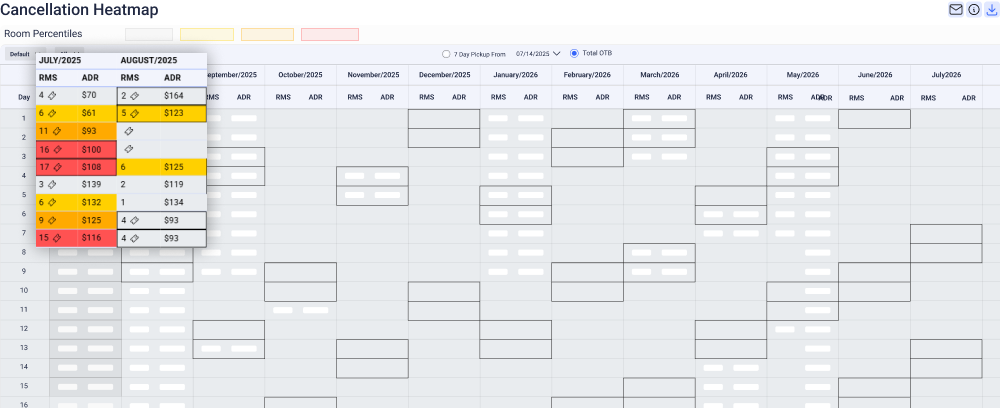
The Cancellation Heatmap widget is designed to visually represent booking cancellations across different dates and segments, helping hotels quickly identify patterns or spikes in cancellations. By showcasing cancellation trends over time in an easy-to-read heatmap format, this widget enables revenue and operations teams to proactively investigate underlying causes, adjust inventory strategies, and mitigate potential revenue losses. It supports better forecasting accuracy and aids in decision-making for pricing, overbooking strategies, and guest retention efforts.

1. Identify Cancellation Trends: Quickly spot patterns in cancellations by date, day of week, or booking window to determine the most common times for cancellations.
2. Segment Analysis: Analyze cancellations across different market segments, rate plans, or booking sources to detect which areas contribute most to cancellation rates.
1. Improved Revenue Management: By visualizing cancellation patterns, hotels can fine-tune overbooking strategies to maximize occupancy without risking overselling.
2. Enhanced Forecast Accuracy: Understanding when and where cancellations peak helps improve demand and occupancy forecasts, leading to better business planning.
3. Reduced Revenue Loss: Identifying high-risk cancellation periods enables timely actions like stricter cancellation policies or targeted promotions to retain bookings.
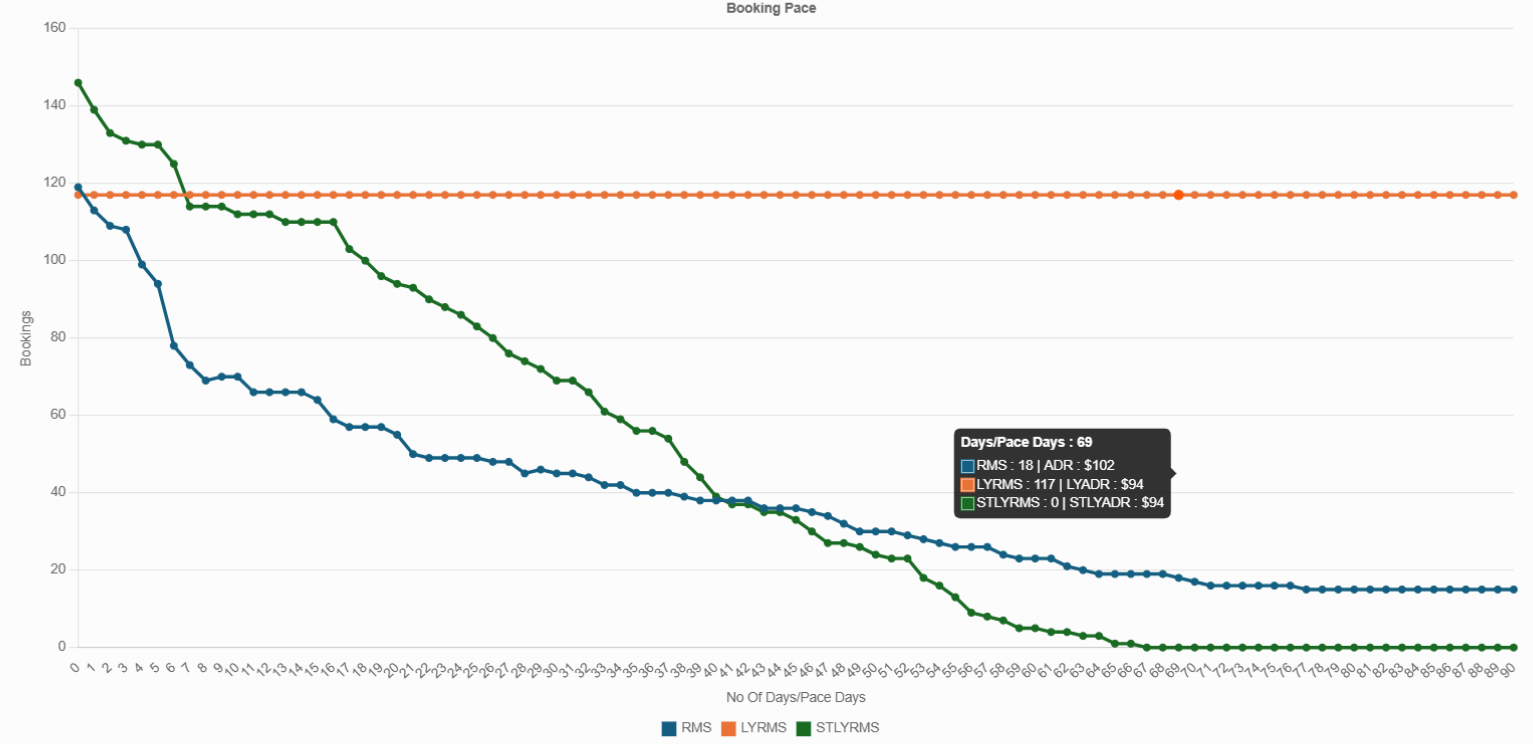
The Booking Pace widget provides a visual comparison of how current bookings are pacing against previous periods, such as Last Year (LYRMS) and Same Time Last Year (STLYRMS), along with their corresponding ADR (Average Daily Rate). Its purpose is to help revenue managers and decision-makers quickly understand if the property is ahead or behind in pickup trends compared to historical data.
1. Performance Benchmarking: Quickly compare current booking trends (RMS) with Last Year (LYRMS) and Same Time Last Year (STLYRMS) to evaluate growth or gaps in performance.
2. Rate Strategy Alignment: Assess how ADR is performing alongside booking pace to determine if rate strategies are driving both occupancy and revenue effectively.
3. Forecast Validation: Validate on-the-books data against historical patterns to confirm if pacing aligns with forecasts or needs strategic intervention.

1. Enhanced Decision-Making: Empowers revenue managers to make timely and data-driven decisions on pricing, promotions, and inventory controls.
2. Revenue Growth: Helps in identifying booking trends early, enabling strategies that capture more revenue through optimized rates and occupancy.
3. Strategic Planning: Supports better alignment between sales, marketing, and operations based on real-time booking momentum.
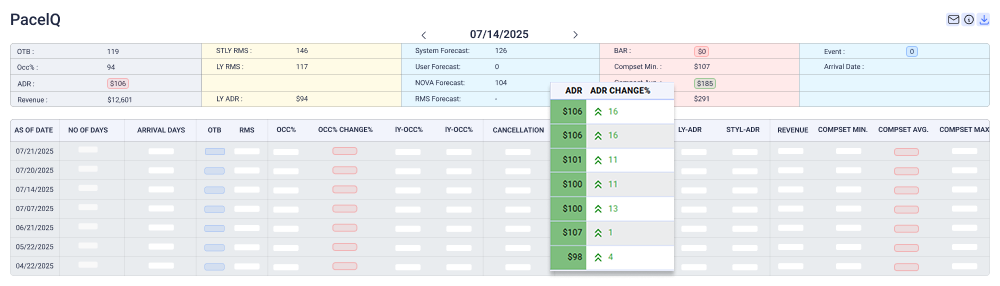
The PaceIQ widget is designed to give a full picture of the booking pace for a specific arrival date. It tracks current On-The-Books (OTB) data against historical trends such as Last Year (LY) and Same Time Last Year (STLY) metrics. It helps revenue managers to monitor booking velocity, assess occupancy trends, and adjust pricing strategies proactively to maximize revenue potential.
1. Current OTB and Occupancy Percentage: Displays updated booking positions (119 OTB, 94% occupancy) for the selected date.
2. Comparative Metrics: Provides RMS, LY RMS, and STLY RMS comparisons, enabling historical pacing analysis
3. Forecast Accuracy: Integrates multiple forecasts (System, NOVA, and User) to cross-check projected occupancy and bookings.
4. Competitive Analysis: Displays CompSet Minimum, Average, and Maximum rates to understand market positioning.
5. Event Impact: Identifies nearby events that may influence booking behavior and rates.

1. Informed Pricing Decisions: Enables dynamic pricing by comparing ADR against historical and competitive benchmarks.
2. Competitive Edge: Understanding CompSet trends allows positioning the property competitively in the market.
3. Strategic Insights: Enables proactive strategy adjustments if pacing is below or above expectations, minimizing last-minute revenue losses.
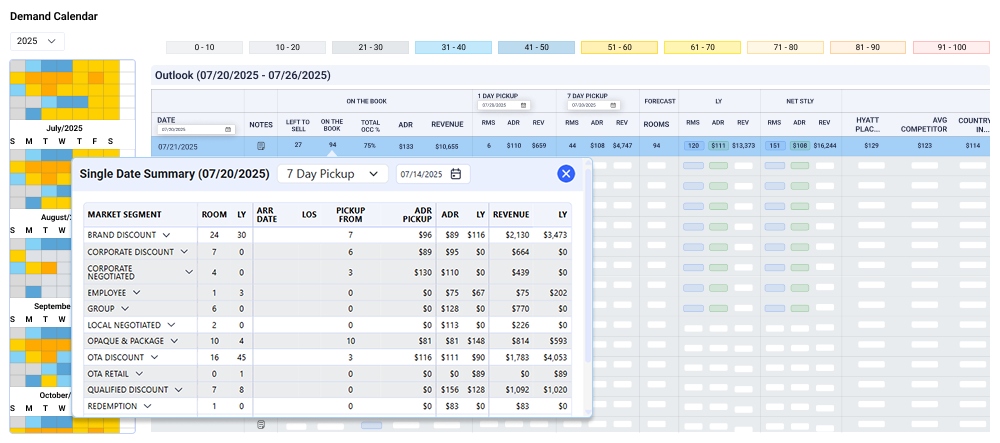
The Demand Calendar widget is designed to provide a consolidated, visual representation of demand patterns and booking data across multiple dates and months. It enables revenue managers and operational teams to monitor On-The-Books (OTB), occupancy trends, ADR (Average Daily Rate), revenue, and projected and historical performance in a glance. The calendar view helps quickly identify high and low demand days, and the heatmap shows active pricing, inventory, and marketing strategies.
1. Visual Occupancy Heatmap: A color-coded calendar highlights occupancy ranges, making it easy to spot high and low demand periods.
2. Weekday/Weekend Trends: Aggregated data for weekdays vs weekends, aiding in strategy formulation based on day patterns.
3. Event Awareness: Notes and event markers help contextualize spikes or drops in demand.

1. Enhanced Revenue Strategy: Empowers revenue managers to adjust pricing dynamically based on demand trends and pickup activity.
2. Optimized Inventory Control: Helps prevent overbooking or underselling by providing visibility on remaining inventory and demand pacing.
3. Decision-Making Agility: Supports data-driven decisions for yield management, ensuring profitability and maximizing revenue potential.
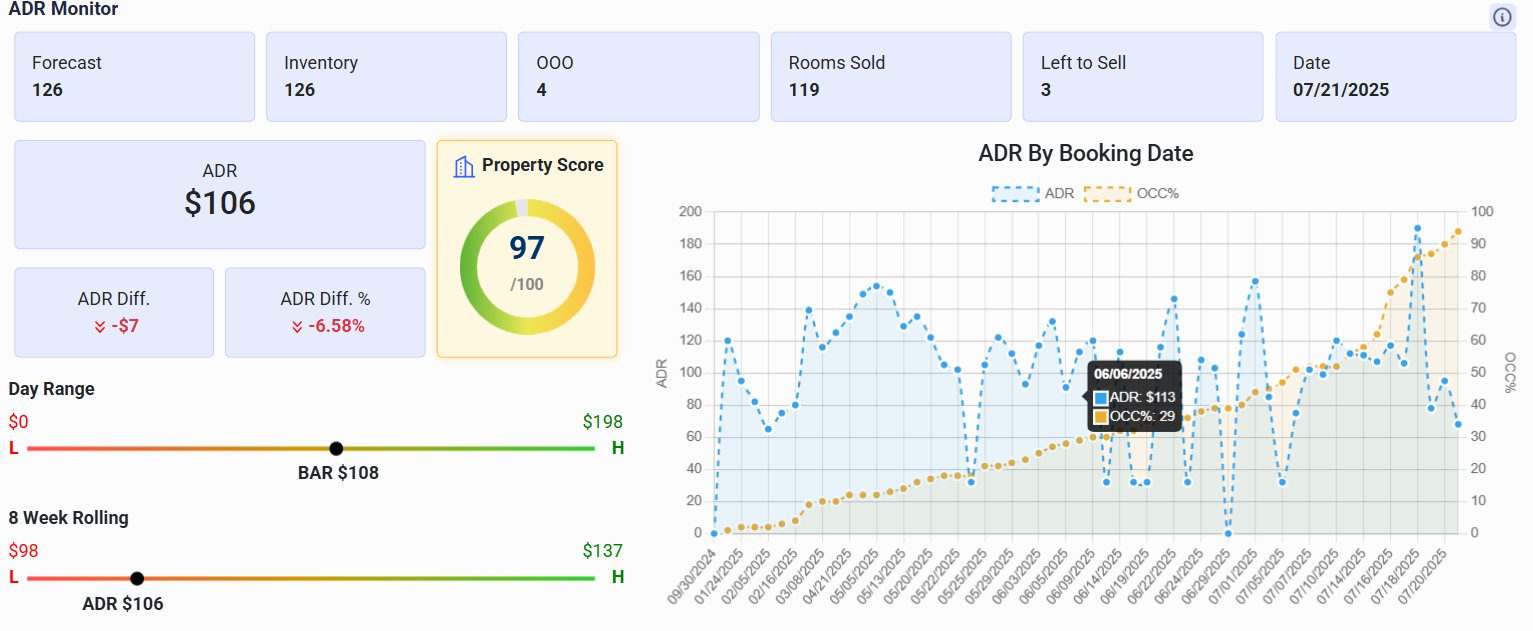
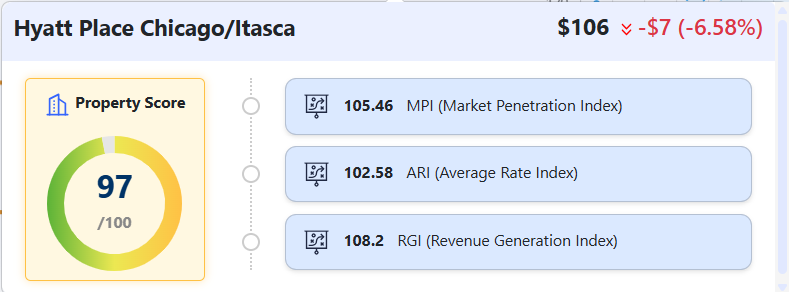
The Performance Monitor widget provides a comprehensive overview of key performance indicators (KPIs) for hotel revenue management, focusing on Average Daily Rate (ADR), occupancy, and property health scores. It visually connects the relationship between ADR and occupancy trends over time and benchmarks the property’s market competitiveness using MPI, ARI, and RGI indices. The widget helps revenue managers quickly assess current performance against historical trends and market positioning to make informed pricing and sales strategies.
1. Variance & Current ADR: Shows the current ADR ($114), the percentage change (-10.98%), and the absolute difference from the benchmark (-$14), indicating underperformance in relation to market or historical data.
2. Occupancy Tracking: Visual occupancy trends plotted alongside ADR help correlate pricing strategies with occupancy rates.
3. Property Score: A performance health indicator (97/100) showing the property’s overall operational and revenue strength.
4. Market Competitiveness:
MPI (Market Penetration Index): 105.46, indicating market share relative to competitors.
ARI (Average Rate Index): 102.58, reflecting rate competitiveness.
RGI (Revenue Generation Index): 108.2, showing overall revenue performance against the comp set.
5. BAR and Day Range Tracking: Highlights minimum BAR rates and price ranges over time.


1. Revenue Optimization: Helps identify ADR shortfalls and opportunities for rate adjustments to improve profitability.
2. Market Benchmarking: Provides real-time insight into how the property performs relative to the competitive set.
3. Data-Driven Decisions: Supports strategic decision-making on pricing, inventory management, and marketing campaigns.
4. Performance Transparency: Gives leadership and teams a clear picture of operational health and revenue potential.
5. Trend Awareness: Enables quick detection of declining trends in occupancy or ADR, prompting timely interventions.
6. Holistic View: Integrates multiple KPIs for a comprehensive snapshot of both pricing efficiency and market positioning, ensuring balanced revenue management.
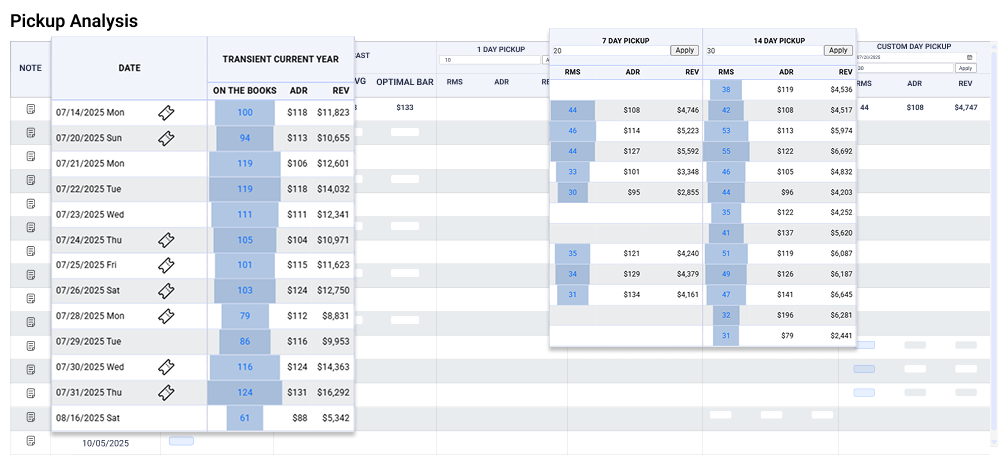
The Pickup Analysis widget provides a detailed view of room pickup trends over various time frames (1-day, 7-day, 14-day, and custom periods). It helps revenue managers monitor transient bookings, assess the pace of reservations, and compare them with forecasts and optimal pricing. This widget ensures that pricing strategies are aligned with booking trends and highlights days requiring immediate attention for pricing adjustments.
1. Monitor Booking Trends: Track real-time booking activity (On the Books, ADR, and Revenue) for upcoming dates.
2. Compare Pickup Across Timeframes: View and analyze how many rooms were picked up in the past 1, 7, and 14 days, or any custom period.
3. Forecast vs. Actual: Compare current bookings against system forecasts and the 28-day average to identify over- or under-performance.
4. Optimal BAR Guidance: Provides an optimal BAR rate for each date to guide pricing decisions.
5. Flexible Analysis: Allows dynamic filtering using custom day pickups to focus on specific periods of interest.
6. Booking Velocity Insights: Identify dates with slow or fast booking rates to adjust marketing or pricing strategies accordingly.

1. Informed Pricing Decisions: Helps in adjusting prices in real-time based on booking momentum to maximize revenue.
2. Improved Forecast Accuracy: Continuous comparison of pickup data with forecasts enhances prediction accuracy.
3. Early Risk Detection: Identifies potential low-demand dates early, enabling proactive interventions such as promotions.
4. Enhanced Revenue Strategies: Supports dynamic pricing strategies based on recent booking behaviors and market responses.
5. Operational Efficiency: Facilitates better planning for inventory management and staff allocation by predicting occupancy trends.
This is designed to visualize the distribution and performance of different market segments in a hotel’s business mix. It helps revenue managers and decision-makers quickly identify which segments contribute most to occupancy and revenue.
1. Market Segment Monitoring: Tracks performance of each market segment in terms of rooms sold and ADR.
2. Performance Comparison: Compares volume-driven segments with revenue-driven segments for strategic insights.
3. Business Mix Analysis: Evaluates the proportion of room nights and revenue coming from each segment.
4. Rate Strategy Evaluation: Helps assess if pricing per segment aligns with performance and business goals.
5. Channel Management: Supports decision-making on which segments or booking channels to prioritize.
6. Forecast Alignment: Aids in aligning actual performance with forecasted segment-wise business expectations.

1. Revenue Optimization: Improves overall revenue by focusing on high-ADR or high-potential segments
2. Informed Decision-Making: Enables data-driven decisions around pricing, promotions, and sales focus.
3. Profitability Improvement: Shifts mix away from lower-yielding segments to more profitable ones.
4. Demand Risk Mitigation: Identifies over-reliance on any one segment and encourages diversification.
5. Strategic Targeting: Helps marketing and sales teams focus on segments with higher conversion and value.
6. Operational Focus: Guides allocation of inventory and effort to the most impactful segments.
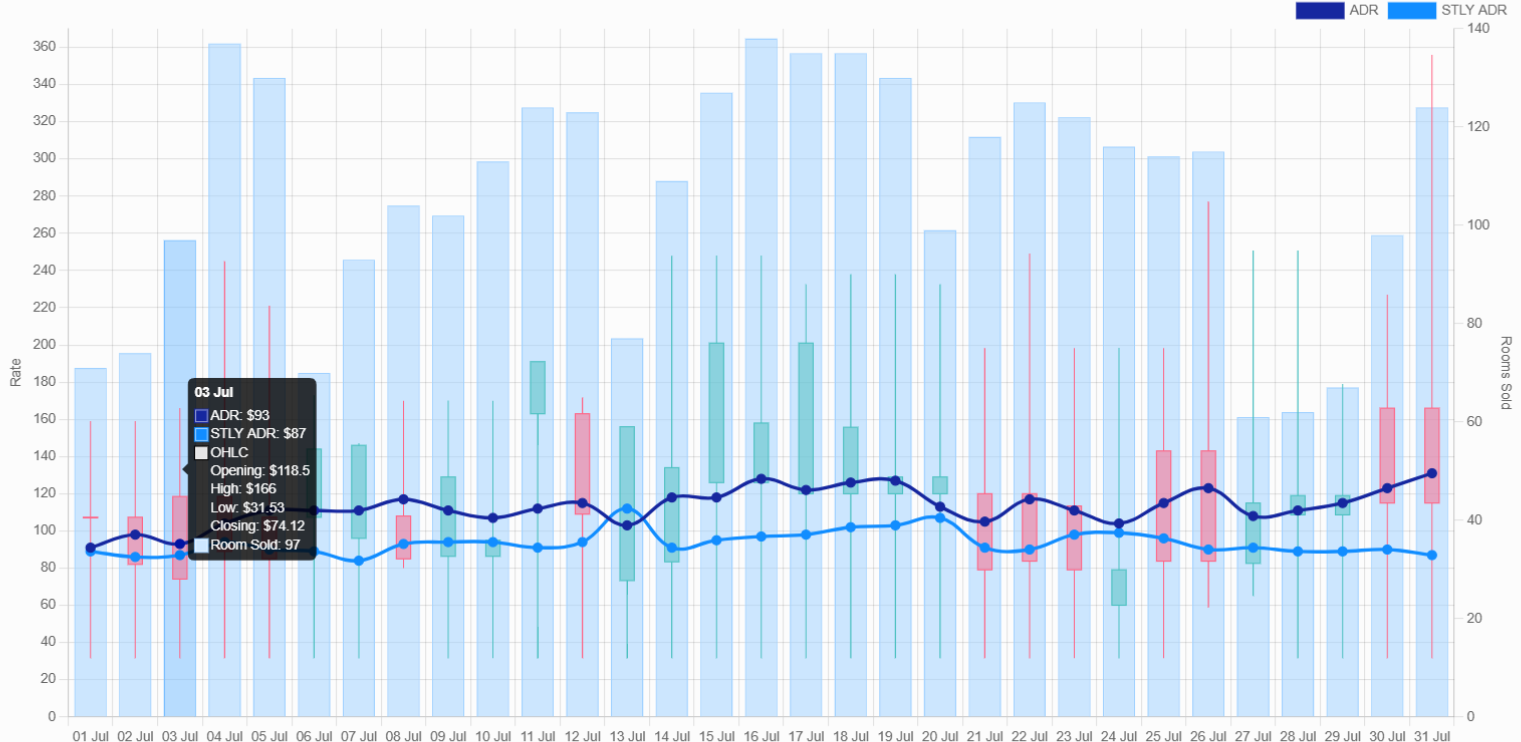
In hospitality revenue management, pricing is never static, and it’s strategic. Revenue managers can make well-informed decisions quickly thanks to the “Pricing Trend Analysis” visualization, which shows daily Average Daily Rate (ADR) movement along with comparisons from previous years, competitor rates, and demand patterns.
Rate Confidence Assessment: Comparing current ADR against same-time-last-year values helps identify how aggressively or conservatively the rate strategy is performing and is vital for forecasting yield potential.
Competitor Benchmarking: The high/low bars represent competitors’ price volatility. Revenue leaders use this to spot gaps, avoid underselling, and protect ADR integrity without losing occupancy.
The Demand Forecasting Signals: When ADR lifts with rooms sold (blue bars), it confirms pricing power. A flat ADR with high competitor volatility suggests opportunity for correction.

1. Revenue Opportunity Identification: Helps pinpoint days with strong ADR performance or gaps compared to last year to adjust rates accordingly.
2. Market Competitiveness Tracking: Provides visibility on pricing trends against historical benchmarks, ensuring competitive positioning.
3. Increased Pricing Agility: Enables quicker rate adjustments by observing real-time demand and booking behavior patterns.
4. Demand Pattern Recognition: Highlights high and low room-sold days, allowing proactive inventory and promotional planning.
5. Improved Forecast Accuracy: Supports refinement of future rate and demand forecasts by comparing actual vs. last year’s trends.
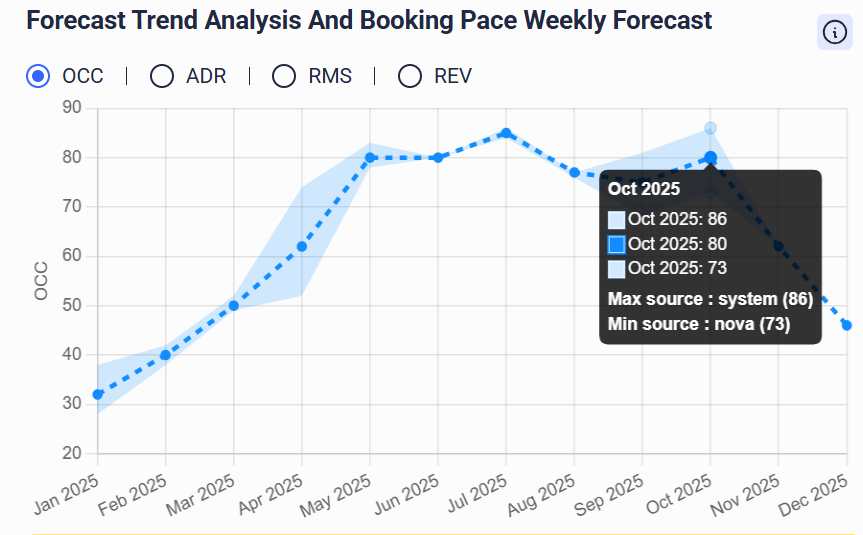
In revenue management, it’s not just about where your hotel is—it’s about where it’s going. The Forecast Trend Analysis & Booking Pace Dashboard within RevEvolve empowers revenue managers to project with precision and prepare with purpose.
1. Forecast Comparison: Enables side-by-side evaluation of multiple forecast sources like system-generated and user-adjusted forecasts.
2. Pace Tracking: Monitors how future occupancy is building up over time to assess booking momentum.
3. Accuracy Assessment: Identifies gaps between forecasts and actuals or between different forecasting models.
4. Seasonality Planning: Highlights monthly occupancy trends to support seasonal pricing and inventory strategies.
5. Scenario Analysis: Helps evaluate best-case and worst-case scenarios by showing the forecast range.
6. Decision Support: Assists revenue and sales teams in aligning their strategies with expected performance patterns.

1. Improved Forecast Precision: Supports more accurate demand forecasting by incorporating multiple perspectives.
2. Proactive Strategy Adjustment: Allows early interventions in pricing or marketing if pace is below expectations.
3. Revenue Risk Mitigation: Helps detect slow periods in advance, reducing the risk of revenue loss through timely action.
4. Optimized Inventory Allocation: Enables better planning of room distribution based on forecasted occupancy peaks and dips.
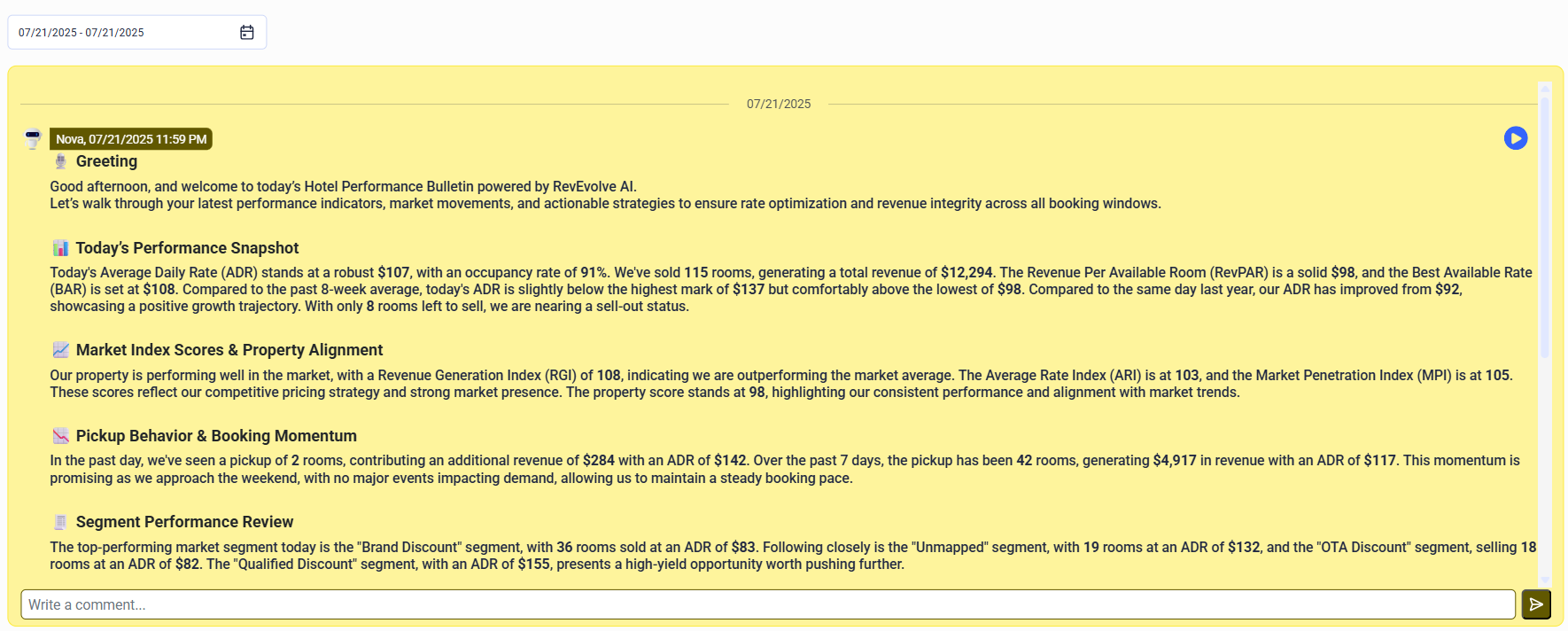
The widget provides a concise, data-rich snapshot of daily hotel performance, blending key operational metrics with market comparisons and strategic insights. It aims to help revenue managers and GMs make informed, real-time decisions to optimize pricing, maximize occupancy, and align with market dynamics.
1. Daily Performance Monitoring: Tracks ADR, occupancy, RevPAR, and revenue trends to assess day-to-day business health.
2. Market Competitiveness Assessment: Uses RGI, ARI, and MPI to benchmark the hotel’s pricing and penetration against market averages.
3. Booking Pace Analysis: Highlights short-term booking pickup to identify surges or lags in momentum, useful for demand forecasting.
4. Segment Performance Tracking: Breaks down revenue contribution by segment (e.g., Brand, OTA, Qualified Discount), aiding targeted sales efforts and rate strategy.

1. Informed Rate Adjustments: Real-time insights enable dynamic pricing based on pickup trends and competitive benchmarks.
2. Improved Forecast Accuracy: Short-term pickup and segment behavior help refine future demand projections.
3. Revenue Maximization: Identifying high-yield segments (e.g., “Qualified Discount” ADR $155) can drive smarter marketing focus and upsell strategies.
4. Operational Readiness: With only 8 rooms left to sell, the alert on near sell-out status helps the team prepare for full occupancy scenarios.
5. Strategic Market Positioning: Strong RGI and ARI scores indicate successful market penetration, validating current revenue strategies and encouraging consistency.
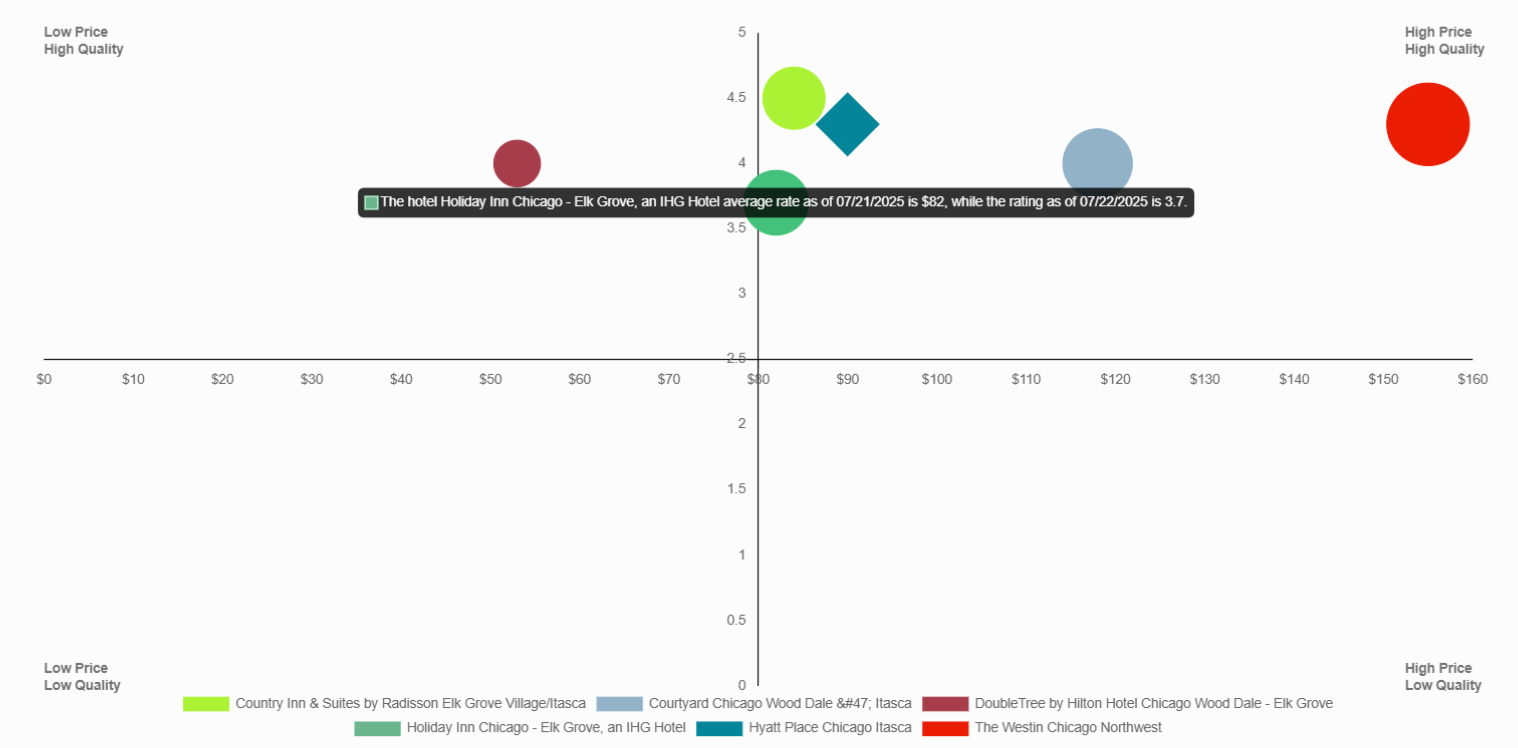
The Price-Quality Insights widget is designed to visualize how your property’s price and guest-rated quality compare to competitors in the market. It enables strategic positioning by plotting average daily rates (ADR) on the x-axis and guest ratings on the y-axis, offering a direct view into perceived value across properties.
1. Competitive Benchmarking: Compares your price and quality positioning against other hotels in the same market.
2. Value Proposition Assessment: Highlights if your pricing aligns with the quality guests experience and perceive.
3. Strategic Pricing Guidance: Informs decisions on rate increases or reductions based on competitor quality and pricing.
4. Position Validation: Verifies if your hotel is in the ideal quadrant (e.g., high quality at a reasonable price).
5. Reputation-Rate Alignment: Identifies mismatches between guest satisfaction and pricing, guiding improvement strategies.
6. Market Opportunity Identification: Reveals underpriced high-quality competitors or overpriced low-quality properties to exploit in pricing strategy

1. Improved Market Positioning: Supports repositioning efforts to enhance competitiveness in both rate and quality.
2. Revenue Growth: Enables smarter pricing that reflects value delivered, potentially boosting ADR without hurting demand.
3. Guest Satisfaction Focus: Encourages quality improvement when prices are high but ratings are low, enhancing long-term brand value.
4. Competitive Advantage: Strengthens decision-making with a visual tool that balances both financial and experiential performance.
Share onDisha Limbasiya is a Data Analyst at HotelSwitchboard, where she operates at the intersection of hospitality and analytics. With a strong eye for detail and a natural curiosity for how data reflects real-world operations, she focuses on turning complex information into clear, actionable insights.
Revenue Management 26 Mar 2026
Revenue Management 09 Mar 2026
AI-Driven Strategy 03 Mar 2026
Market Insights 16 Feb 2026
Revenue Management 30 Jan 2026
Revenue Management 27 Jan 2026
Revenue Management 19 Jan 2026
Revenue Management 12 Jan 2026
Revenue Management 29 Dec 2025
Revenue Management 19 Dec 2025
The next evolution in hotel revenue management isn’t a faster dashboard or a smarter pricing algorithm – it’s an AI…

Hotel revenue management in 2026 is defined by three fundamental shifts: AI-powered demand forecasting now achieves accuracy rates exceeding 90%,…
Los Angeles will host eight FIFA World Cup 2026 matches at SoFi Stadium, including the USA’s opening match against Paraguay…
Join the ranks of successful hoteliers who are leveraging AI to maximize their revenue. Get started today and see the difference our solution can make.