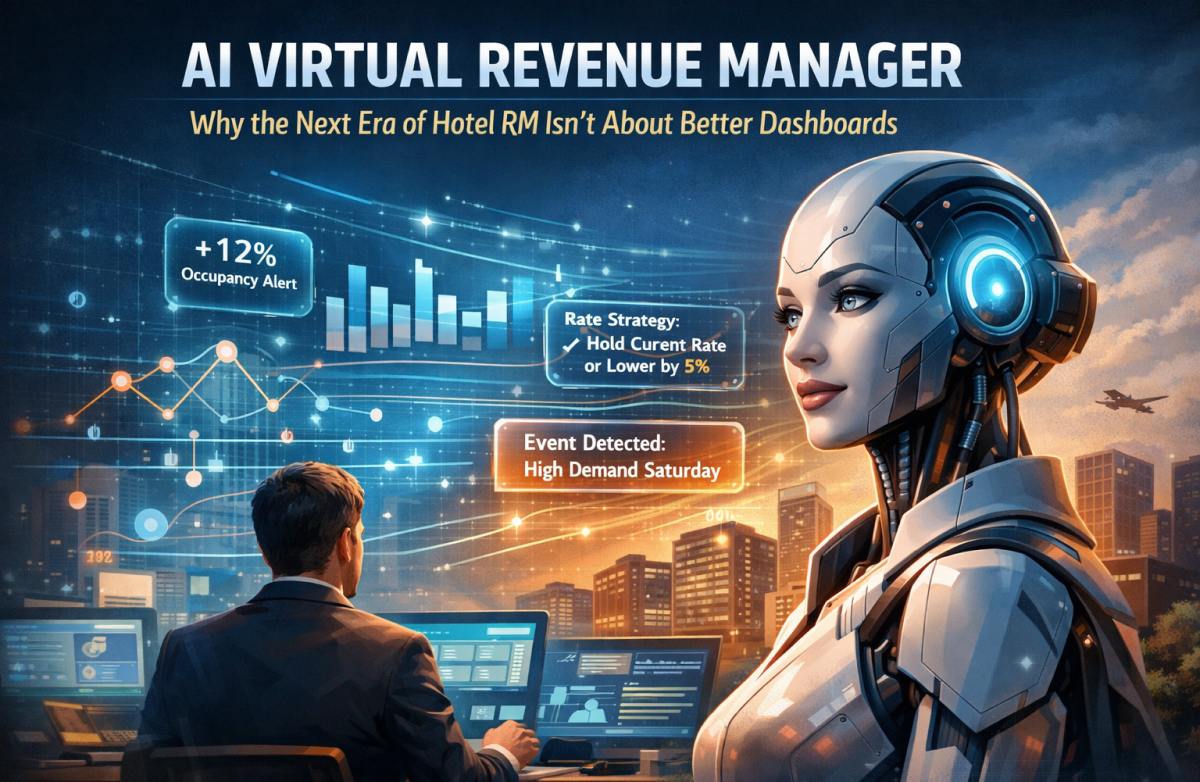


AI Virtual Revenue Manager: Why the Next Era of Hotel RM Isn’t About Better Dashboards
The next evolution in hotel revenue management isn’t a faster dashboard or a smarter pricing algorithm – it’s an AI…
Discover tailored revenue strategies that help
maximize occupancy, optimize pricing, and
boost profitability.
Get tips, insights, and expert advice to maximize performance.
Explore strategies, successes, and insights from real-world examples.
Get clear, step-by-step guidance to maximize the platform’s features and benefits.
Access comprehensive whitepapers packed with data-driven insights, expert analysis, and proven strategies to help you drive smarter decisions and sustainable revenue growth.
Explore expert insights, tips, and the latest trends in revenue management to boost your financial strategies and drive growth.
Revenue Management | Harikrishna Patel September 24, 2025
For years, revenue management meant spreadsheets, historical reports, and a constant race to keep up with your comp set. It was reactive, siloed, and often reserved for big brands with big budgets. But hospitality has changed. Traveler behavior has shifted. Booking patterns are less predictable. Margins are tighter, and decisions can’t wait.
Today’s revenue leaders need more than just data; they need clarity, speed, and confidence.
That’s where the new era of revenue management comes in. Powered by AI, automation, and real-time insights, modern hotel revenue strategies go beyond forecasting and rate setting. They connect the dots between revenue and marketing, operations and guest behavior, demand signals and pricing decisions.
Here we explore how hotels can take advantage of this shift, with guidance, tactics, and technology to drive revenue growth.
Revenue management is the process of using data to determine the right price, at the right time, for the right guest. By analyzing market demand, booking patterns, and historical performance, hotels can adjust pricing to maximize their revenue.
Modern revenue management strategies go beyond forecasting and rate setting. They integrate AI and automation to provide actionable insights, improve decision-making, and optimize profitability.
Revenue management in the hotel industry isn’t just about copying your comp set’s pricing, chasing after 100% occupancy, or saying yes to every group inquiry that hits your inbox. In fact, doing those things without a strategy can do more harm to your financial performance than good.
Yes, keeping an eye on competitors and managing occupancy are important, but they’re just one piece of the puzzle. If you don’t factor in your own property’s unique data and market dynamics, you’re flying blind.
To build a winning strategy, you need to consider:
Another common myth? Treating revenue and marketing like separate silos. Today, your pricing decisions should be deeply connected to your demand generation efforts. With AI-powered tools, hotels can now sync revenue and marketing strategies, pulling from the same source of truth to drive smarter promotions, optimize campaigns, and fill the right hotel rooms with the right guests.
These terms are often used interchangeably, but they’re not the same, and if you want to build a more profitable hotel business, it’s worth knowing the distinction.
Yield management is about maximizing revenue from a fixed, perishable asset—like a room night—at a specific moment in time. It’s the classic “right room, right guest, right price, right time” strategy, often focused on optimal pricing for peak periods or optimizing occupancy.
Revenue management, on the other hand, takes a step back and looks at the bigger picture. It’s a comprehensive, data-driven approach to growing your total revenue, not just from rooms, but across all departments and segments. It includes forecasting, segmentation, distribution, and pricing strategy, often months (or even a year) in advance.
Here’s one way to look at it:
Here are the foundational key performance indicators (KPIs) every hotel should know, and how they apply to revenue performance.
| KPI | Description | Why It Matters |
|---|---|---|
| Occupancy & ADR | Measures the percentage of rooms sold and the average rate. | High occupancy with low ADR? You’re filling rooms but not maximizing revenue. |
| RevPAR (Revenue per Available Room) | Combines occupancy and ADR to show overall revenue from rooms. | Helps benchmark performance against competitors. |
| TRevPAR (Total Revenue per Available Room) | Includes all revenue streams beyond rooms. | Provides insight into total revenue potential per guest. |
| GOPPAR (Gross Operating Profit per Available Room) | Subtracts operating costs from revenue. | Shows the true profitability of each room after operational costs. |
| Total Profitability | Combines revenue, costs, and demand generation to gauge overall financial health. | Measures efficiency in commercial strategy and revenue marketing. |

As an expert in hotel revenue management, we understand how vital it is for hotels to adopt strategic pricing, inventory control, and distribution tactics to maximize profitability. By using proven strategies backed by data, hotels can optimize their operations and maintain a competitive edge. Here’s a comprehensive breakdown of 15 essential hotel revenue management strategies designed to elevate your hotel’s financial performance.
Adjust your room rates based on real-time demand and market conditions. Raise rates during peak periods (holidays, local events) and lower them during off-peak seasons to maintain occupancy.
Key Benefits:
Maintain consistent pricing across all channels, including OTAs, booking engines, and your website. This ensures trust and transparency with your guests.
Key Benefits:
Increase prices as your occupancy levels rise. Lower prices when occupancy is low to encourage more bookings.
Key Benefits:
Use tiered pricing for different room categories. Adjust prices dynamically based on market demand to ensure rooms are priced appropriately.
Key Benefits:
Divide your customer base into segments (business, leisure, family, etc.) and set customized rates based on each group’s needs and preferences.
Key Benefits:
Adjust rates based on the day of the week. For example, higher rates on weekdays for business travelers and lower rates on weekends for leisure travelers.
Key Benefits:
Monitor competitor pricing to ensure your rates remain competitive while maximizing revenue. Leverage market intelligence tools to track competitor rates and occupancy levels.
Key Benefits:
Use initial low rates to attract guests and build occupancy, then increase rates as demand rises.
Key Benefits:
Offer limited-time discounts or flash sales to boost bookings during slow periods.
Key Benefits:
Offer discounts for longer stays or impose minimum stay requirements during peak times.
Key Benefits:
Offer flexible cancellation options at a higher price and semi-flex rates at a lower price for stricter cancellation terms.
Key Benefits:
Encourage guests to purchase additional products or services like room upgrades or spa packages.
Key Benefits:
After a reservation is made, offer add-ons such as airport transfers, tour packages, or dining experiences.
Key Benefits:
Create bundled packages that include accommodation, meals, and other experiences at a competitive price.
Key Benefits:
Use Revenue Management Systems (RMS) and Property Management Systems (PMS) to automate pricing and inventory decisions.
Key Benefits:
By implementing these 15 hotel revenue management strategies, powered by tools like RevEvolve, hotels can optimize their pricing, increase occupancy, and maximize revenue. Whether it’s using AI-driven pricing models or focusing on market segmentation, these strategies provide a clear roadmap for navigating the evolving hospitality landscape.
Q1: How do I implement dynamic pricing at my hotel?
Start by integrating an RMS like RevEvolve to automate price adjustments based on real-time demand and market conditions.
Q2: What is the best revenue management system for small hotels?
RevEvolve is an affordable and easy-to-use RMS designed to help small hotels implement dynamic pricing and market segmentation strategies.
Q3: How can upselling and cross-selling improve revenue?
By offering personalized services to guests, you can increase RevPAG and improve the guest experience, resulting in more revenue per booking.
Share onHarry Sheta is a hospitality technology entrepreneur focused on helping hotels make faster, smarter revenue decisions. As Co-Founder of Hotel Switchboard and the driving force behind RevEVOLVE, he works closely with hoteliers, revenue managers, and management companies to modernize how pricing, forecasting, and portfolio insights are delivered.
Revenue Management 26 Mar 2026
Revenue Management 09 Mar 2026
AI-Driven Strategy 03 Mar 2026
Market Insights 16 Feb 2026
Revenue Management 30 Jan 2026
Revenue Management 27 Jan 2026
Revenue Management 19 Jan 2026
Revenue Management 12 Jan 2026
Revenue Management 29 Dec 2025
Revenue Management 19 Dec 2025
The next evolution in hotel revenue management isn’t a faster dashboard or a smarter pricing algorithm – it’s an AI…

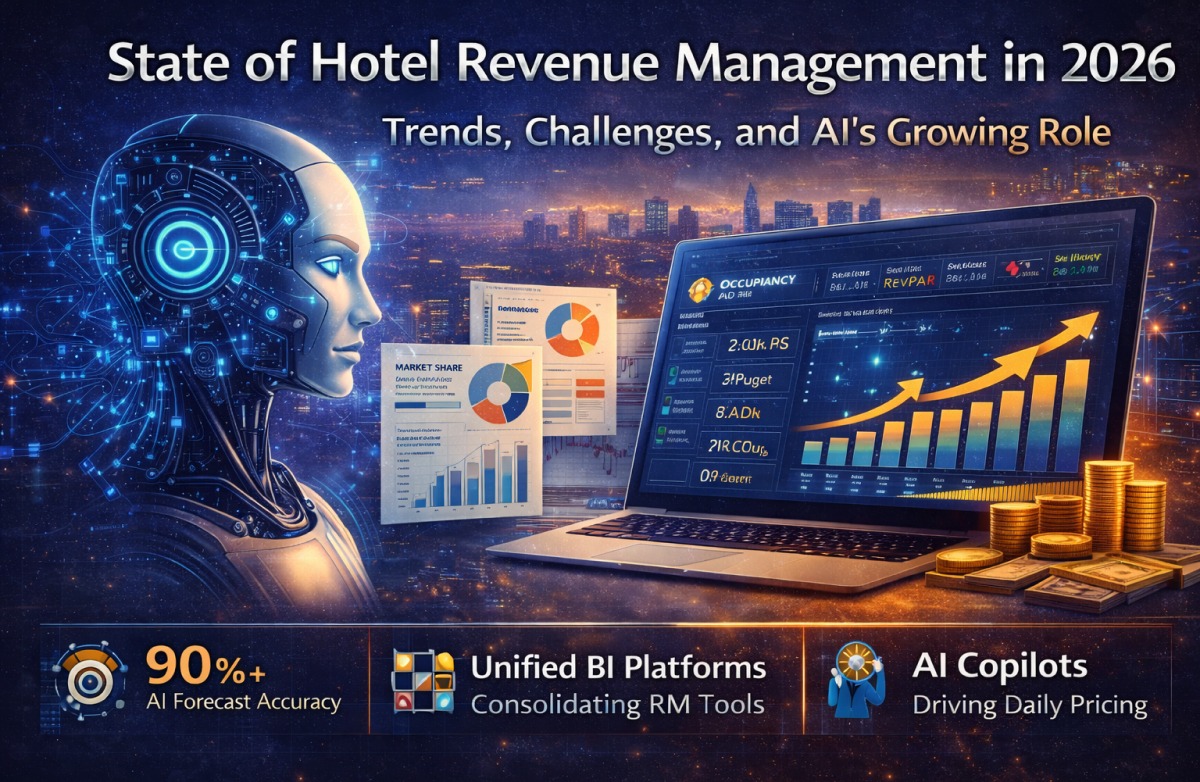
Hotel revenue management in 2026 is defined by three fundamental shifts: AI-powered demand forecasting now achieves accuracy rates exceeding 90%,…
Los Angeles will host eight FIFA World Cup 2026 matches at SoFi Stadium, including the USA’s opening match against Paraguay…
Join the ranks of successful hoteliers who are leveraging AI to maximize their revenue. Get started today and see the difference our solution can make.