

AI Virtual Revenue Manager: Why the Next Era of Hotel RM Isn’t About Better Dashboards
The next evolution in hotel revenue management isn’t a faster dashboard or a smarter pricing algorithm – it’s an AI…
Discover tailored revenue strategies that help
maximize occupancy, optimize pricing, and
boost profitability.
Get tips, insights, and expert advice to maximize performance.
Explore strategies, successes, and insights from real-world examples.
Get clear, step-by-step guidance to maximize the platform’s features and benefits.
Access comprehensive whitepapers packed with data-driven insights, expert analysis, and proven strategies to help you drive smarter decisions and sustainable revenue growth.
Explore expert insights, tips, and the latest trends in revenue management to boost your financial strategies and drive growth.
Revenue Management | Harikrishna Patel March 26, 2026
The next evolution in hotel revenue management isn’t a faster dashboard or a smarter pricing algorithm – it’s an AI virtual revenue manager that reasons about your property’s strategy, adapts to your ownership’s priorities, and proactively surfaces revenue opportunities before you even log in. After two decades of incremental improvements to how we visualize data, the industry is ready for something fundamentally different: AI that doesn’t just show you numbers, but thinks with you about what they mean.
Revenue management technology has made enormous progress over the past fifteen years. We’ve gone from spreadsheets to sophisticated cloud platforms. Real-time comp set data. Automated rate recommendations. Beautifully designed interfaces showing 90-day grids, booking curves, and segment breakdowns.
And yet, if you ask most revenue managers how they spend their mornings, the answer hasn’t changed much.
Revenue managers spend roughly 60% of their working hours gathering, organizing, and preparing data – pulling reports from the PMS, checking competitive rates, building slides for the weekly strategy meeting, cross-referencing OTB against STLY and budget. Only about 40% of their time goes to actual strategic thinking: the rate decisions, the segment analysis, the competitive positioning moves that directly impact RevPAR.
This isn’t because the dashboards are bad. Most modern RMS platforms are well-designed. The problem is structural. A dashboard is a passive tool. It waits for you to log in, navigate to the right screen, ask the right question, and interpret the answer. It doesn’t know what you care about. It doesn’t know your owner wants heads in beds over rate integrity. It doesn’t know that your Tuesday pickup pattern is abnormal compared to the same week last year.
A dashboard shows you data. It doesn’t reason about what that data means for your specific property, in your specific market, against your specific goals.
For a revenue manager overseeing one or two hotels, this friction is manageable. For an RM at a revenue management company overseeing 12 to 20 properties, the math stops working. There aren’t enough hours in the day to deeply analyze every property every morning. Some get a detailed review. The rest get a glance. And when a property only gets a glance, signals get missed. Revenue leaks happen silently.
The industry has spent 15 years making dashboards prettier. The next era is about eliminating the need to stare at dashboards in the first place.
We’ve talked to hundreds of revenue professionals over the past two years – at conferences, in strategy sessions, over late-night calls when a compression event caught someone off guard. The pain points are remarkably consistent across property types, brands, and geographies.
They fall into three categories.
Every current RMS operates on the same model: data arrives, gets stored, gets displayed, and waits for you to notice something. The RM is the detection engine. They scan the grid, spot the anomaly, investigate the cause, and decide the response.
What revenue managers actually want is the opposite flow. They want the system to surface the anomaly before they look for it. Not just a red number on a dashboard – but a complete analysis: here’s what happened, here’s why it’s happening, here’s the revenue impact, and here are three things you can do about it.
Think about the difference between a weather dashboard showing barometric pressure dropping and a weather app that says: “Rain likely at 3 PM. Bring an umbrella.” Both use the same data. One requires expertise to interpret. The other delivers a decision.
An AI virtual revenue manager operates like the second model. It monitors continuously. It understands what “normal” looks like for each specific property. And when something deviates – occupancy pacing behind STLY, a competitor dropping rates, a segment shifting – it surfaces a fully analyzed signal with evidence and recommended actions.
Most AI in hotel revenue management today operates at one level: price optimization. The algorithm ingests demand signals, competitor rates, and historical patterns, then outputs a recommended BAR. This is valuable, but it’s only one dimension of what a revenue manager actually does.
Real revenue management is multi-dimensional reasoning. It’s weighing a group request against transient displacement at a specific ADR. It’s deciding whether to chase occupancy or protect rate when pace is soft. It’s explaining to ownership why a 5% ADR drop in low season actually generated more total revenue.
These aren’t calculations. They’re strategic judgments that require understanding the property’s goals, the owner’s risk tolerance, the competitive dynamics, and the seasonal context. Traditional pricing algorithms don’t reason about tradeoffs. They optimize for one metric. But RMs live in a world of competing priorities.
An AI virtual revenue manager needs to think like a strategist, not just calculate like an algorithm. It needs to say: “Your comp set average just dropped $12. Here are two options – match them and protect volume, or hold rate and accept 3–4% occupancy loss. Given your ownership’s focus on rate integrity, Option B nets $1,200 more this week but risks falling behind pace by Thursday. Here’s the math either way.”
That’s reasoning. No RMS on the market does this today.
Revenue managers communicate with multiple stakeholders daily. The GM who wants a two-sentence summary. The owner who cares about budget variance. The director of sales who needs to know which dates to push for group business. The asset manager who thinks in terms of NOI, not RevPAR.
The same data needs to be packaged differently depending on who’s reading it. A morning briefing for an RM should be detailed and metric-heavy. The same information presented in an ownership meeting should be high-level, strategic, and tied to financial outcomes.
Current tools have one voice. They present data the same way to everyone. The RM becomes the human translator – reformatting, summarizing, and re-contextualizing the same information for each audience multiple times a day.
An AI virtual revenue manager should adapt its communication based on context. Technical and granular in a one-on-one RM session. Executive and outcome-focused in an ownership review. Brief and action-oriented during a live call. This isn’t a nice-to-have – it’s the difference between AI that creates work and AI that eliminates work.
The hospitality industry is at an inflection point in how we think about artificial intelligence.
Generation 1 of AI in revenue management was rule-based automation. If occupancy exceeds 80%, raise BAR by $10. If comp set drops, match within 5%. These systems saved time but required extensive manual configuration and constant babysitting.
Generation 2 where most of the market sits today in 2026 – is machine learning-powered pricing. Systems like IDeaS, Duetto, Atomize, and FLYR use sophisticated algorithms to forecast demand and recommend rates. They ingest more data, learn from patterns, and update faster than any human could. This is genuine progress. Hotels using ML-based RMS platforms routinely see 5–15% RevPAR improvements.
But both generations share a fundamental limitation: they treat AI as a tool that outputs answers, not a partner that engages in reasoning.
Generation 3 is the AI revenue partner. This is an AI that doesn’t just recommend a rate – it explains why, considers your specific strategic context, adapts to how you and your ownership think about revenue, and proactively surfaces things you haven’t asked about yet.
| Feature | Gen 1: Rules | Gen 2: ML Pricing | Gen 3: AI Partner |
|---|---|---|---|
| Input | Manual rules | Historical + market data | Everything Gen 2 + property strategy + ownership goals |
| Output | Rate change | Rate recommendation | Strategic analysis with reasoning, alternatives, and context |
| Communication | Alert email | Dashboard display | Natural language conversation adapted to audience |
| Initiative | None | Recommendation on login | Proactive signals before you ask |
| Strategic depth | None | Price optimization | Multi-dimensional reasoning across pricing, segments, channels, and positioning |
| Personalization | Per-property rules | Per-property model | Per-property personality calibrated to ownership philosophy |

Imagine arriving at your desk on a Tuesday morning. Before you open any report, your AI virtual revenue manager has already done the following:
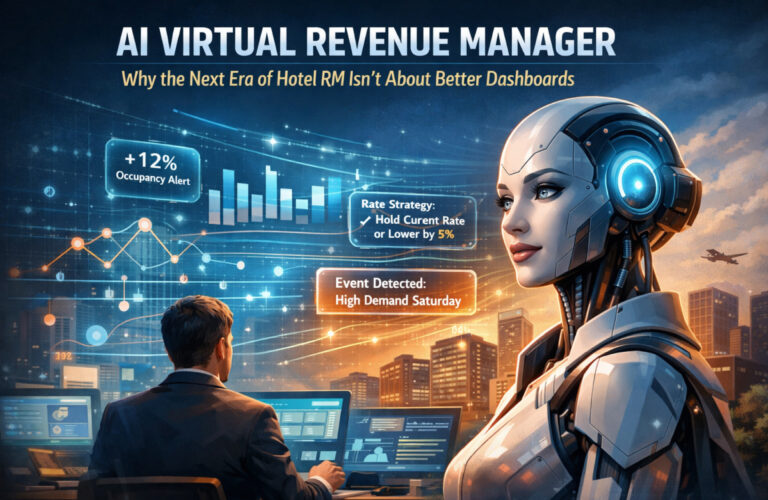
It analyzed overnight pickup across all your properties. It compared booking pace for the next 14 days against the same period last year. It noticed that your downtown property is pacing 12% behind on Thursday – not because demand is weak, but because two corporate accounts reduced their travel volume this quarter. It checked your comp set and found that two competitors dropped rates by $8 overnight, but your property’s rate is already positioned $14 below the set average, suggesting you don’t need to follow. It flagged a compression opportunity next Saturday – a local convention that wasn’t in your events calendar but showed up in forward-looking demand signals.
All of this is waiting for you. Not as rows in a spreadsheet. As a structured morning briefing with the critical signals highlighted, the evidence explained, and the recommended actions listed.
You read the Thursday pacing issue and type: “What are my options for Thursday?”
The AI responds with three scenarios. Each one modeled with projected occupancy, ADR impact, and RevPAR outcome. Each one framed through the lens of what your ownership actually prioritizes – because the AI was calibrated to their strategy during the initial property setup.
Later, you have a revenue strategy meeting. The AI has already built the agenda, pulled the relevant data for each discussion point, and prepared a scorecard comparing actual performance against budget and STLY across six metrics. You walk into the meeting and start strategizing. No prep time. No slide-building. No copy-paste.
This isn’t science fiction. This is what the next generation of revenue management technology looks like. And it’s closer than you think.
At RevEVOLVE, we’ve spent the past two years building the data foundation for this shift – demand forecasting, competitive intelligence, booking pace analysis, market segmentation, and automated reporting across hundreds of hotel properties.
That foundation gave us something critical: the data layer required to build a true AI virtual revenue manager. Not a chatbot answering generic questions, but a system that understands each property’s market, comp set, seasonality, segment mix, ownership goals, and pricing guardrails – and reasons about them like a senior revenue strategist would.
On March 27, we’re introducing what we’ve been building: a new module that brings conversational revenue management to the RevEVOLVE platform. It’s designed for the revenue manager who oversees multiple properties and needs AI that works as a strategic partner, not just another screen to check.
It’s built for the RMC owner who wants each of their analysts to operate at the level of a 15-year veteran. And it’s calibrated – property by property – to the way each owner thinks about revenue.
We’ll share the full details on Thursday. If you’ve ever wished your RMS could explain the “why” behind the numbers, prepare your meetings, monitor your portfolio while you sleep, and adapt its recommendations to what your ownership actually cares about – this is what we’ve been building.
The next era of hotel revenue management isn’t about better dashboards, faster algorithms, or more data visualizations. It’s about AI that thinks with you – proactively, strategically, and in a voice calibrated to your property’s unique context. The revenue managers and RMCs that adopt this model first will fundamentally change how many properties one person can effectively manage, and how deeply they can manage each one. The shift from “AI-assisted pricing” to “AI revenue partner” is the most significant change in hotel revenue technology since the move from spreadsheets to cloud platforms.
Q1. What is an AI virtual revenue manager?
Ans. An AI virtual revenue manager is an artificial intelligence system that performs many of the analytical and strategic functions traditionally done by human revenue managers. Unlike basic RMS pricing algorithms, a virtual RM proactively monitors property data, reasons about strategic tradeoffs, generates natural language analysis and recommendations, and adapts its communication style to different stakeholders. It functions as an always-on strategic partner rather than a passive tool.
Q2. How is an AI virtual revenue manager different from a traditional RMS?
Ans. A traditional revenue management system (RMS) focuses primarily on demand forecasting and automated rate recommendations based on historical patterns and market data. An AI virtual revenue manager goes beyond pricing to provide strategic reasoning, proactive signal detection, natural language conversations about revenue data, meeting preparation, and communication adapted to ownership priorities. The key difference is initiative: a traditional RMS waits for you to check it; a virtual RM surfaces insights before you ask.
Q3. Can AI replace human revenue managers?
Ans. AI cannot and should not replace experienced revenue managers. The value of a virtual RM is in amplifying human capability – handling the 60% of time currently spent on data gathering so that revenue professionals can focus on strategic decisions, relationship management, and complex judgment calls that require human expertise. A more accurate framing is that AI virtual revenue managers let one RM effectively manage 2–3x more properties at the same depth of analysis.
Q4. How does an AI virtual revenue manager adapt to different ownership strategies?
Ans. Advanced AI virtual revenue managers use onboarding data to calibrate their reasoning and communication. When a property’s ownership prioritizes aggressive rate growth, the AI frames every analysis through a rate-first lens. When another owner prioritizes filling rooms, the same AI shifts to volume-first reasoning. This calibration goes beyond simple configuration – it changes how the AI weighs tradeoffs, which signals it prioritizes, and how it communicates recommendations to different stakeholders.
Q5. What should hotels look for in an AI revenue management assistant?
Ans. Hotels evaluating an AI virtual revenue manager should prioritize five capabilities: proactive signal detection (does it surface insights before you ask?), natural language interaction (can you ask questions in plain English?), strategic reasoning (does it explain the “why” and present alternatives?), persona adaptation (does it adjust to your ownership’s priorities?), and multi-property scalability (can it monitor your entire portfolio simultaneously?). Avoid solutions that are simply chatbots bolted onto existing dashboards – true AI revenue partners are built from the ground up for strategic hospitality reasoning.
Share onHarry Sheta is a hospitality technology entrepreneur focused on helping hotels make faster, smarter revenue decisions. As Co-Founder of Hotel Switchboard and the driving force behind RevEVOLVE, he works closely with hoteliers, revenue managers, and management companies to modernize how pricing, forecasting, and portfolio insights are delivered.
Revenue Management 26 Mar 2026
Revenue Management 09 Mar 2026
AI-Driven Strategy 03 Mar 2026
Market Insights 16 Feb 2026
Revenue Management 30 Jan 2026
Revenue Management 27 Jan 2026
Revenue Management 19 Jan 2026
Revenue Management 12 Jan 2026
Revenue Management 29 Dec 2025
Revenue Management 19 Dec 2025
The next evolution in hotel revenue management isn’t a faster dashboard or a smarter pricing algorithm – it’s an AI…
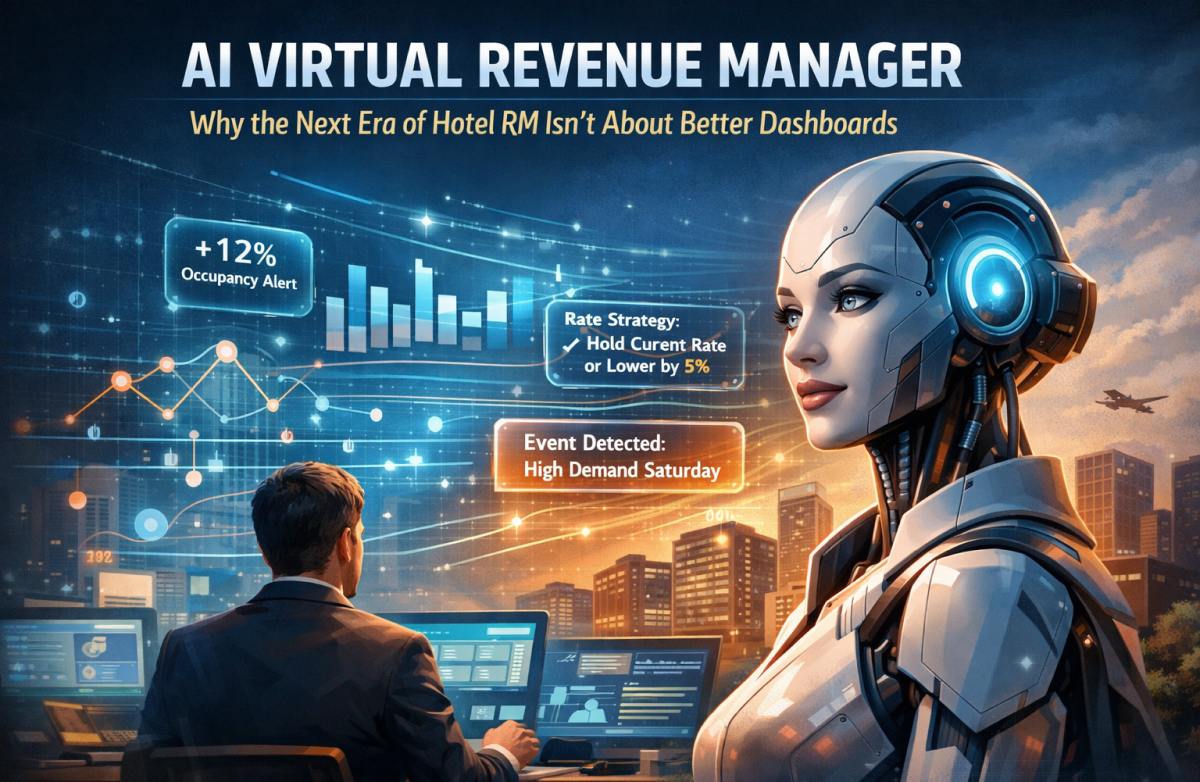
Hotel revenue management in 2026 is defined by three fundamental shifts: AI-powered demand forecasting now achieves accuracy rates exceeding 90%,…
Los Angeles will host eight FIFA World Cup 2026 matches at SoFi Stadium, including the USA’s opening match against Paraguay…
Join the ranks of successful hoteliers who are leveraging AI to maximize their revenue. Get started today and see the difference our solution can make.